


At the opening of Haruki Murakami's new novel, Sputnik Sweetheart, we meet a young girl called Sumire. The name means `violet', and she is indeed shy and reticent. She is eager only to make a name for herself as an author of novels, and her current enthusiasm is the writer Jack Kerouac.
It never takes long for sex to appear in any of Murakami's creations, but in this case it takes the form of Sumire having no interest in men whatsoever. Her closest male friend is the narrator, a teacher, and he discusses this problem with her -- or rather, he tells her sex is not something to be discussed but to be experienced. Sumire still isn't interested, so he goes off to look elsewhere.
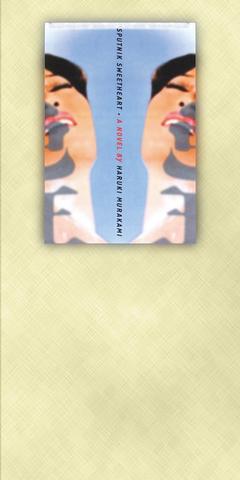
But the moment his back is turned, Sumire falls in love -- with another women, someone 17 years older than herself, called Miu.
At their first meeting Sumire mentions her enthusiasm for Kerouac, and Miu dimly remembers a school of writers back in the 1950s who she thinks called themselves Sputniks. Sumire corrects her -- "Beatniks!" But ever after she thinks of Miu as her "sputnik sweetheart." Sputnik, of course, was the first satellite, put into space by the Russians in 1957. It was a mere 58cm in diameter and orbited the earth once every 96 minutes and 12 seconds.
That was Sputnik I. Sputnik II was launched later the same year, and this time contained a dog, Laika, who thereby became the first living being ever to leave the earth. Unfortunately Sputnik II was never recovered, and the image of Laika forlornly circling the earth, staring out of her little window at the stars, haunts this novel.
Miu takes Sumire under her wing, gives her an undemanding part-time job in her office, and passes on to her a selection of expensive clothes that she had handy and which just happen to fit.
Before long, Sumire has moved into a bigger apartment, gone full-time, learnt Italian, and put any idea of writing novels on the back burner. Meanwhile her friend the narrator, who has become involved with the mother of one of his students, realizes just how physical his attraction to Sumire really is.
Unattainable women are a very regular feature of Murakami's novels, and when the narrator starts to receive letters from Sumire from Europe, where she's gone with Miu in the role of her translator and secretary, his frustration reaches near unmanageable proportions. Like many a Murakami hero before him, he cracks open a beer, settles down to watch TV, and fantasizes about the object of his desire, in this case naked on an island beach in Greece.
The mix here is very much par for the course for Murakami -- reasonable, worldly men with bookish interests, unattainable girls over whom a dark fate seems to hover, and a jokey writing style, alternately casual and amateurishly philosophic. The narrator, too, is very like the hero in South of the Border, West of the Sun, and Sumire equally reminiscent of his beloved, someone also under the influence of an older woman, in the same novel.
But this time the story suddenly takes a new turn when the narrator receives a phone-call from Greece. Instead of Sumire on the line, it's Miu. Something's happened. Can he get on a plane at once and join her? She'll pay the fare.
It would be wrong to give any more of the plot away. Suffice it to say that in adding a heavy new dose of mystery to this essentially triangular situation, Murakami appears to be moving his characters into a tighter, more economical version of some of his long-standing preoccupations.
This novel makes easy reading. It's in a way not much more than a novella, or even a long short story. This suits Murakami's style, which these days is relaxed and spartan at one and the same time.
It's also refreshing, like one of the crisp white wines that feature in the story (Miu's job is importing European wines into Japan, and she makes a point of visiting the small vineyards she buys from, and getting to know the families that own them).
Time and again Murakami has done this -- taken a journey into a woman's mind and come up against a brick wall. And over and over again he has used the same vehicle for the journey -- a man who has happy but unemotional sex with one or more women, but no, or unsatisfactory, sex with the one to whom he is attracted at a deeper level.
It's as if what he's saying is that men are easily satisfied but need more than they can readily find, while the kind of women they really need are mysteries they can never manage to understand.
This is a very old proposition. Man is the quester, eternally searching and forever unsatisfied; woman is the mystery, on one level available, but on another utterly inscrutable.
It goes back to the ancient Greeks, and perhaps it is no accident that Murakami places the middle section of this short novel in Greece, in a setting of ageless Aegean beauty -- stony islands in a blue sea, olive trees, goats, fried fish, and a yellow wine tasting of resin.
Unfortunately, at least for this reader, he then plunges into the world of the paranormal. This harks back to earlier books such as The Wind-up Bird Chronicle but my guess is that even if you are attuned to that kind of thing, you'll nevertheless find this book, and especially its ending, unsatisfactory.
To be honest, this book feels like something Murakami began long ago, then set aside. Wanting something new to publish, he took it up again and added what musicians call a "development section." Then, in a bout of extreme concentration, he tied the two parts together in a brief conclusion.
So -- gem or botched job? I tend to opt for the latter judgment. For me this new book is Murakami's least satisfactory so far.

The Portuguese never established a presence on Taiwan, but they must have traded with the indigenous people because later traders reported that the locals referred to parts of deer using Portuguese words. What goods might the Portuguese have offered their indigenous trade partners? Among them must have been slaves, for the Portuguese dealt slaves across Asia. Though we often speak of “Portuguese” ships, imagining them as picturesque vessels manned by pointy-bearded Iberians, in Asia Portuguese shipping between local destinations was crewed by Asian seamen, with a handful of white or Eurasian officers. “Even the great carracks of 1,000-2,000 tons which plied
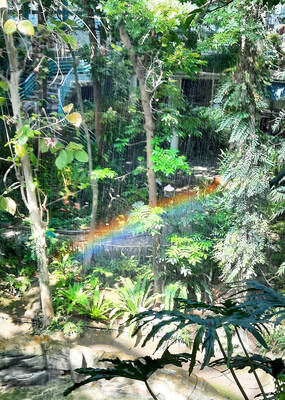
It’s only half the size of its more famous counterpart in Taipei, but the Botanical Garden of the National Museum of Nature Science (NMNS, 國立自然科學博物館植物園) is surely one of urban Taiwan’s most inviting green spaces. Covering 4.5 hectares immediately northeast of the government-run museum in Taichung’s North District (北區), the garden features more than 700 plant species, many of which are labeled in Chinese but not in English. Since its establishment in 1999, the site’s managers have done their best to replicate a number of native ecosystems, dividing the site into eight areas. The name of the Coral Atoll Zone might
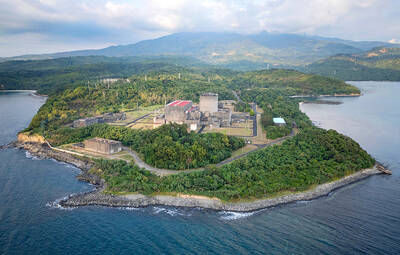
Nuclear power is getting a second look in Southeast Asia as countries prepare to meet surging energy demand as they vie for artificial intelligence-focused data centers. Several Southeast Asian nations are reviving mothballed nuclear plans and setting ambitious targets and nearly half of the region could, if they pursue those goals, have nuclear energy in the 2030s. Even countries without current plans have signaled their interest. Southeast Asia has never produced a single watt of nuclear energy, despite long-held atomic ambitions. But that may soon change as pressure mounts to reduce emissions that contribute to climate change, while meeting growing power needs. The
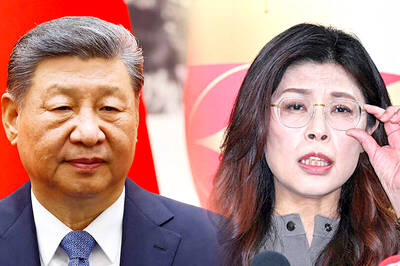
On Monday morning, in quick succession, the Chinese Communist Party (CCP) and the Chinese Nationalist Party (KMT) released statements announcing “that the Central Committee of the Communist Party of China and General Secretary Xi Jinping (習近平) have invited KMT Chairwoman Cheng Li-wun (鄭麗文) to lead a delegation on a visit to the mainland” as the KMT’s press release worded it. The KMT’s press release added “Chairwoman Cheng expressed her gratitude for the invitation and has gladly accepted it.” Beijing’s official Xinhua news release described Song Tao (宋濤), head of the Taiwan Work Office of the CCP Central Committee, as


 RSS
RSS