


Western opera in Taiwan is a bizarre phenomenon. Tickets are sometimes cheap, sometimes expensive, and the quality of the production often bears little relation to the ticket price.
The production of Puccini's Turandot by the Latvian National Opera opening in Taipei tonight is the third time this piece will be seen in Taiwan in the past four years. A version from Beijing was here in 1998, and last year saw a home-grown production sponsored by Taipei City government.
Since the tiny Baltic republic of Latvia voted to break away from the former Soviet Union in 1990, its national opera company has undertaken onerous touring schedules, possibly to shore up the finances of the fledgling state. This is its second in Taiwan, having first come in September, 1999, with Bizet's Carmen.

PHOTO COURTESY OF PARIS INTERNATIONAL
"This production is 25 years old," said company tour manager Dace Bula. "It therefore dates from the Soviet era. But it's been very popular and so we haven't changed anything, though we've renovated the costumes where necessary. This is the first time it's been seen in a Chinese community, and I hope you'll bear with us.
"The picture on the poster is of an outdoor version we've performed in Latvia and Sweden. What you will see will not be quite as grand."
The group's arrival in Taiwan has been accompanied by some dissenting voices, however. One was from the Austrian musician Werner Kastner, a percussionist with the National Symphony Orchestra.
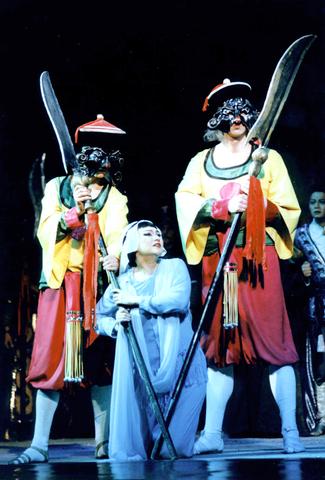
PHOTO COURTESY OF PARIS INTERNATIONAL
"The prices being charged are on a level with those you might pay in Vienna or New York to hear some of the finest singers and orchestras in the world," he said. "Yet these soloists are certain to be inferior to what you would expect to hear in even quite small opera houses in Germany, Austria or Italy. And the orchestra and chorus will be only half the size you have in the major operatic centers."
Ticket prices for Turandot range from NT$4,800 to NT$600 in Taipei, and from NT$3,600 to NT$600 elsewhere. The orchestra of the Latvian National Opera numbers 68, and the chorus has 50 singers, said the agency inviting them, Paris International Entertainment, based in Kaohsiung.
Against such a view as Kastner's, it can be argued that touring something as cumbrous and labor-intensive as opera is an expensive business. Scenery, costumes and musical instruments all have to be brought in, and 131 personnel transported, fed and accommodated.
Local opera productions, such as the artistically outstanding La Boheme mounted by Taipei City last October, are by contrast not only generously subsidized, but less expensive to stage. The top price for tickets for La Boheme was NT$1,000.
Members of the company who were here with Carmen in 1999 remember good technical facilities in Taiwan's theaters, and especially appreciated the audience response.
"People were very attentive, following the story closely, and there was a very positive reaction to what was happening on stage," said Ieva Kepe, one of the two sopranos taking the title role of the frigid Chinese princess Turandot. "It added up to a very pleasant atmosphere."
As is usual with opera everywhere, the major roles in this Turandot have been double cast to alleviate strain on the soloists' voices. Many international opera celebrities refuse to sing more than three times a week, but stress does not appear to worry the stalwart Latvians. Irena Milkeviciute, for example, will sing the title role of the Chinese princess on three consecutive nights in Taipei, and two consecutive nights in Taichung and Tainan. Ieva Kepe will sing in the remaining three performances.
The opera's other lead soprano role, the slave girl Liu, is also divided, again unequally, between two Latvian singers, Kristine Gailite and Zigrida Krigere.
And the part of the central Asian prince Calaf, who sues for Turandot's hand in marriage (and hence control of the entire Chinese empire) at the risk of beheading if he answers any of her three riddles incorrectly, will be shared by the Ukranian tenor Oleg Kulko and Mario Diaz from Chile.
Taipei, Kaohsiung and Taichung regularly host four or five Western operas a year. Such events are less familiar in Tainan, however, and a substantial number of tickets for the two performances there are still available.
Latvia is a republic in northeastern Europe, approximately twice the size of Taiwan but with a population of under 3 million. Its capital Riga was for centuries a prosperous Baltic port, and as a result it has a long operatic tradition. Several of Mozart's operas were produced there not long after their Viennese premieres, and the young Richard Wagner was music director of the opera house for two years in the 1830s.
This visit by the Latvian Opera is exclusively to Taiwan, Paris International Entertainment said, and is not part of a wider Asian tour.
The three leading roles in the opera will be taken by the following singers:
Turandot (soprano): Irena Milkeviciute and Ieva Kepe
Calaf (tenor): Oleg Kulko and Mario Diaz
Liu (soprano): Zigrida Krigere and Kristine Gailite.
Taipei, National Theater
March 9. 7:30pm: Milkeviciute, Kulko, Gailite
March 10, 2pm: Kepe, Diaz, Krigere
March 10, 7:30pm: Milkeviciute, Kulko, Gailite
March11, 2pm: Kepe, Diaz, Krigere
March 11, 7:30pm: Milkeviciute, Kulko, Gailite
Taichung, Chung Shang Hall
March 14, 7:30pm: Milkeviciute, Diaz, Gailite
March 15, 7:30pm: Milkeviciute, Kulko, Gailite
Kaohsiung, Chih Teh Hall
March 17, 7:30pm: Milkeviciute, Kulko, Gailite
March 18, 7:30pm: Kepe, Diaz, Krigere
Tainan, Municipal Cultural Center
March 21, 7:30pm Milkeviciute, Kulko, Gailite
March 22, 7:30pm: Milkeviciute, Diaz, Gailite
For tickets call 02-23911297 (Taipei), 04-22298278 (Taichung), 07-3368080 (Kaohsiung) and 06-2149441 (Tainan).

It’s a good thing that 2025 is over. Yes, I fully expect we will look back on the year with nostalgia, once we have experienced this year and 2027. Traditionally at New Years much discourse is devoted to discussing what happened the previous year. Let’s have a look at what didn’t happen. Many bad things did not happen. The People’s Republic of China (PRC) did not attack Taiwan. We didn’t have a massive, destructive earthquake or drought. We didn’t have a major human pandemic. No widespread unemployment or other destructive social events. Nothing serious was done about Taiwan’s swelling birth rate catastrophe.

Words of the Year are not just interesting, they are telling. They are language and attitude barometers that measure what a country sees as important. The trending vocabulary around AI last year reveals a stark divergence in what each society notices and responds to the technological shift. For the Anglosphere it’s fatigue. For China it’s ambition. For Taiwan, it’s pragmatic vigilance. In Taiwan’s annual “representative character” vote, “recall” (罷) took the top spot with over 15,000 votes, followed closely by “scam” (詐). While “recall” speaks to the island’s partisan deadlock — a year defined by legislative recall campaigns and a public exhausted

In the 2010s, the Communist Party of China (CCP) began cracking down on Christian churches. Media reports said at the time that various versions of Protestant Christianity were likely the fastest growing religions in the People’s Republic of China (PRC). The crackdown was part of a campaign that in turn was part of a larger movement to bring religion under party control. For the Protestant churches, “the government’s aim has been to force all churches into the state-controlled organization,” according to a 2023 article in Christianity Today. That piece was centered on Wang Yi (王怡), the fiery, charismatic pastor of the

Hsu Pu-liao (許不了) never lived to see the premiere of his most successful film, The Clown and the Swan (小丑與天鵝, 1985). The movie, which starred Hsu, the “Taiwanese Charlie Chaplin,” outgrossed Jackie Chan’s Heart of Dragon (龍的心), earning NT$9.2 million at the local box office. Forty years after its premiere, the film has become the Taiwan Film and Audiovisual Institute’s (TFAI) 100th restoration. “It is the only one of Hsu’s films whose original negative survived,” says director Kevin Chu (朱延平), one of Taiwan’s most commercially successful


 RSS
RSS