


Intellectuals have always had an anomalous place in the theater. Drama has generally been a popular art form depending on such things as suspense, conflict, the reversal of fortunes, and the strong delineation of character. Attempts to confront fundamental and profound questions of human destiny have by and large only succeeded in the theater when incorporated, as in Hamlet, into vigorous, forceful and easily-graspable plots. For the rest, the theater historically has been the locale for wit, romance, thrills, and simple entertainment.
Of course there have been exceptions. Some of the early masterpieces of European modernism in the theater such as Ibsen's Peer Ghynt and Strindberg's Ghost Sonata were deliberate attempts to address a minority audience willing to think about philosophical issues while occupying their theater seats. And by mid-century, Beckett's plays were able to succeed while containing none of the above ingredients.
Nevertheless, today, when TV and the cinema have almost entirely captured the audiences that once patronized the popular theater, live drama has, as never previously, become the domain of specialist groups -- students, intellectuals, and outsiders seeking the subversive thrill of attending events that fly in the face of everything that mass entertainment has to offer.
It is only in the context of this kind of elite audience that it is possible to think about the plays of Gao Xingjian (
There is no reason why the theater cannot recapture a mass audience, but to do so it must turn its attention once again to color, charm, energy, mystery -- the things, in other words, that the human heart has always been drawn to, and has always longed for. Plenty of dramatists still know how to provide these things, but they are all working in television and film where the largest audiences can so easily be reached, and where the highest financial rewards lie. Shakespeare today would undoubtedly be writing for television. The live theater, in the mean time, has been sidelined for those with other, more elevated, interests.
Gao looks set, up to a point, to satisfy these audiences. No pulses will be set running by his plays. What they will do, rather, is provide fodder for earnest discussions in expensive coffee-shops after the performance. What does he mean? How should we behave? What is the meaning of life?
These five plays date from Gao's residence in Paris. His Beijing success Bus Stop, and his controversial meditation on the aftermath of the events of June 4, 1989, Absconding, are, for example, not included. Gao, you can deduce, was by the time these plays were written already turning away from popular audiences, and addressing himself to narrower interest groups.
In a note, he cites the ideas of the late Polish theater guru Grotowski who believed in a "poor theater," drama stripped of its traditional accouterments but rich in primal images such as fire or ice. Unfortunately, he also believed the word was over-valued in drama, whereas Gao's plays are nothing if not wordy.
One play here, Between Life and Death, is a monologue from a women who speaks about herself throughout in the third person. Various mimes provide a measure of relief, but you cannot but agree with the translator when he writes in his Introduction that Gao was interested in "internal conflicts, the psychological drama within a character's consciousness." This is not a piece of theater that will ravish anyone's emotions. For intellectuals it may serve as a test of intelligence; for the average person, to be honest, probably be a test of endurance.
Gao comments on another play that it "attempts to arrive at an explanation of some traditional themes such as the relationship between God and Satan, man and woman, good and evil, and salvation and suffering, and modern man's concerns for language and consciousness, as well as the relationship between the individual and the Other." Such a mixture of confidence and innocence simply leaves one lost for words. The play itself consists largely of urban slang exchanged between nocturnal vagrants.
The problem is not with the surreal mix of harangue, memory and dream in the plays. No one thinks any more that realism is the only option for drama. The problem lies with what the characters actually say. This is almost invariably colorless and unmemorable. Maybe it's the case that the translations (by Gilbert C.F. Fong) fail to do Gao justice. Generally, though, the impression is that the plays themselves are diagrammatic and angular. They have no fragrance, are bleached and without atmosphere, and make little attempt to please the senses or the imagination.
Live theater is certainly in need of rejuvenation, and the huge wealth of Asian theater traditions alone, China's included, suggests numerous possible sources of inspiration. But a move in the direction of an obscure intellectuality is exactly the reverse of where theater should be going. It needs to be more accessible to the ordinary man and woman, not less.
Nor is it a good sign that Gao appears, for the most part, to direct his own plays. Even the finest drama needs the outside sensibility of an independent director to create the alchemy out of which great performances spring. But perhaps other directors are frightened off by the intransigence of the material.
It may be that Gao is, in some way that has escaped this reviewer, an artist of genius. But the truth is that I found these plays virtually unreadable. I was not moved by them, and I did not find them intellectually stimulating. For the record, I felt the same about the author's novel Soul Mountain, at least in its English translation by Mabel Lee. Despite this, I sincerely welcome Gao to Taiwan, and hope other readers will have a better experience of these two works, and his other creations, than I have had.

Taiwan’s English education system is being pulled apart by three opposing forces. Bilingual Nation 2030 pulls students toward English and global communication. Artificial Intelligence (AI) readiness pulls them toward digital judgment, verification and AI-mediated work. But Taiwan’s old exam culture pulls them back toward memorization, grammar drills, timed reading and correct answers. If the education system keeps using old exams to define success, it risks producing graduates who are neither genuinely bilingual nor genuinely AI-ready, but trained for tasks machines can already perform. The first force is Bilingual Nation 2030. Launched in 2018, the policy aimed to “help Taiwan’s workforce connect
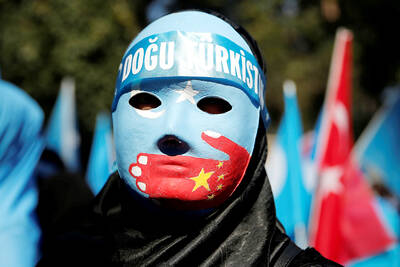
It seems every few days one bumps into one of those “real man” comments in which Taiwan is urged to “face reality” or similar, and “make a deal,” with the speaker implying that soon it will be too late. “Deal” advocates always present themselves as having a superior grip on reality, and the manly ability to make the “hard choice.” Their testosterone-laden language often echoes that of Taiwan sellout advocates. Note that such commentary always specifies a process (“make a deal, work with, make progress”), never the end state of what occupation by a violent authoritarian colonialist state will entail. In

“Taiwan’s Opposition Leader Comes to US With a Message Straight Out of Beijing” read a May 31 headline in the Wall Street Journal. Top US administration officials and members of Congress almost certainly read the WSJ, and if there was a bullet point takeaway that people in Washington should absorb ahead of Chinese Nationalist Party (KMT) Chair Cheng Li-wun’s (鄭麗文) arrival in DC on June 9, that headline is it. The last few columns have discussed this very topic, and the timing is not coincidental. While those top officials likely do not read the Taipei Times, judging by the number
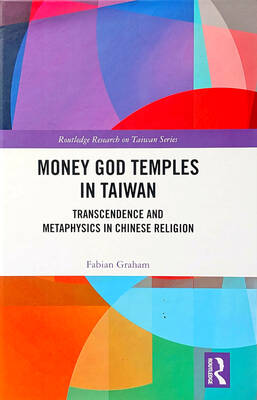
As someone who normally steers clear of books with “transcendence” or “metaphysics” in their subtitles, this reviewer — a casual observer of local belief systems since the 1990s — found Fabian Graham’s Money God Temples in Taiwan a challenging read. Those who’ve only dipped their toes into temple culture will likely need to parse several sections with special care if they’re to keep up with the author, a British ethnographic researcher whose previous books have investigated religious practices among ethnic Chinese in Southeast Asia. This scholarly volume examines a facet of Taiwan’s religious landscape that didn’t exist a century ago, and


 RSS
RSS