


In 1839, James Brooke, an independent English adventurer, sailed east from Singapore in his own 142-tonne schooner in search of commercial opportunities. At Kuching he met the presumed heir to the Sultan of Brunei, Muda Hasim, who was at his wits' end trying to suppress pirates operating from inland. Brooke, with all the advantages of European technology, sailed upriver and blew the pirates' forts to pieces. In gratitude, Muda Hasim made him Governor of Sarawak, shortly afterwards granting him absolute powers in exchange for an annual tribute.
Thus, at the age of 39, James Brooke became the first Rajah of Sarawak. He was knighted by Queen Victoria five years later, and placed in order of precedence immediately after the maharajahs of India.
It is interesting to note that it had been the offer to suppress pirates that had given the Portuguese their entry into China four hundred years earlier, when they gained the use of Macau for the same purpose.
Inevitably, Sarawak dominates this collection of travel writing about Borneo. Whether it was the stability established by the Brooke family (who continued to rule there largely independent of the government in London until the Japanese invasion of 1941) or the intrinsic attractiveness of the location, far more accounts survive from there than from anywhere else on the world's fourth largest island. Despite the tropical climate, the dense jungle and the head-hunting traditions of the local Dayaks, many considered it a paradise on earth.
In fact, in this sequel to the same editor's , The Best of Borneo Travel, the Dayaks come in for particular praise. One notable visitor, Ida Pfeiffer, a woman who at the age of 45 had left her husband in Vienna and taken to traveling the world, judged them for honesty and modesty "above any of the races I have ever known." Their head-hunting was simply an unfortunate custom, and one relatively newly acquired.
Pfeiffer and Brooke both stand out as people who display no trace of arrogance or patronizing feelings of superiority. Brooke believed he had a mission to preserve local customs, head-hunting excepted, and to save Sarawak from the degradation he believed would inevitably follow the arrival of unrestricted Western influence. As for Pfeiffer, she took her rest in longhouses next to the dried heads (the place of honor), traveled through west Borneo -- now Indonesia's Kalimantan -- where the Dutch had only a nominal presence, and in the forest slept when necessary on the bare ground.
Brooke had his would-be imitators, but none were successful. One represented here is James Erskine Murray who tried to secure a foothold at Kutei in 1844, but died of gunshot wounds in the process.
It wasn't long before anthropologists and naturalists arrived, eager to catalogue the wonders of the interior. One such was Hugh Low, eager among other things to satisfy the growing enthusiasm among collectors for orchids to beautify European conservatories. His entry is marked by fastidiousness preserved in the face of a sometimes hostile environment. In the jungle, he advises, "the rattan will answer all the purposes of a corkscrew, if the benighted wayfarer be fortunate enough to have occasion for its services." He must himself have been among these fortunates -- at times it took 30 men to carry his equipment.
All was not peace and benevolence, however. In 1857 there was an insurrection by Hakka gold-miners inland, resentful of Brooke's attempts to control them. Harriette McDougal, wife of a missionary, lived to describe it, but she was witness to many horrors.
The editor apologizes for having included only one woman author in his former collection. This time he has four. Among them is Marianne North, a globe-trotting painter and sister of the wife of the Victorian art critic John Addington Symonds. She, too, can command an ironic turn of phrase when the need arises. A party of Dyaks, she writes, "had come down the river in a long canoe from a great distance to ask leave to take the heads of another tribe which had insulted them, and had been told they must not have that pleasure. They seemed to submit without a murmur to the prejudices of civilization."
The oldest item, from 1780, notes with admiration the industry and efficiency of the Chinese merchants (who set up shops in their boats), and contrasts them with the resident Malay traders who were, it asserts, addicted to smoking opium.
Other parts of the island are not entirely neglected. There's a wonderful description of the ascent of Mount Kinabalu in 1925, with a detailed explanation of the topography of the summit that would still be of use to anyone making it up there. The accommodation the writer mentions as available on the route at Sayat Sayat is apparently still on offer.
In addition, there are innumerable colorful incidents illustrating how the Victorians conducted themselves in the tropics. A piano arrives, crocodile eggs are carefully studied (but rejected with horror when suggested as food), and a reported case of human sacrifice is recorded in what is clearly fascinated detail.
But James Brooke towers effortlessly over the other contributors. Here he is, for example, on the approaches to Kuching: "The tide from the Indian Ocean encounters and checks the flood from the eastward, and occasions the rise on shore; and the ebb from Pulo Pisang into the Indian Ocean allows the escape of the waters, causing the fall on the shore, whilst a current from the China Sea prevents their regular retreat." With such grandiloquent authority, it is hardly surprising few could find it in their hearts to resist him.
Generally, the tone declines as the date advances. Shooting animals merely for the fun of it appears to have begun to be popular at the end of the nineteenth century, and you end up relieved the collection stops in 1927. That there is no map is this excellent book's only real shortcoming.

The Portuguese never established a presence on Taiwan, but they must have traded with the indigenous people because later traders reported that the locals referred to parts of deer using Portuguese words. What goods might the Portuguese have offered their indigenous trade partners? Among them must have been slaves, for the Portuguese dealt slaves across Asia. Though we often speak of “Portuguese” ships, imagining them as picturesque vessels manned by pointy-bearded Iberians, in Asia Portuguese shipping between local destinations was crewed by Asian seamen, with a handful of white or Eurasian officers. “Even the great carracks of 1,000-2,000 tons which plied
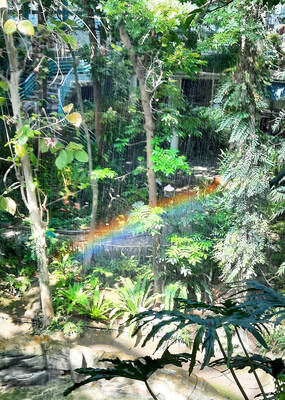
It’s only half the size of its more famous counterpart in Taipei, but the Botanical Garden of the National Museum of Nature Science (NMNS, 國立自然科學博物館植物園) is surely one of urban Taiwan’s most inviting green spaces. Covering 4.5 hectares immediately northeast of the government-run museum in Taichung’s North District (北區), the garden features more than 700 plant species, many of which are labeled in Chinese but not in English. Since its establishment in 1999, the site’s managers have done their best to replicate a number of native ecosystems, dividing the site into eight areas. The name of the Coral Atoll Zone might

On Monday morning, in quick succession, the Chinese Communist Party (CCP) and the Chinese Nationalist Party (KMT) released statements announcing “that the Central Committee of the Communist Party of China and General Secretary Xi Jinping (習近平) have invited KMT Chairwoman Cheng Li-wun (鄭麗文) to lead a delegation on a visit to the mainland” as the KMT’s press release worded it. The KMT’s press release added “Chairwoman Cheng expressed her gratitude for the invitation and has gladly accepted it.” Beijing’s official Xinhua news release described Song Tao (宋濤), head of the Taiwan Work Office of the CCP Central Committee, as
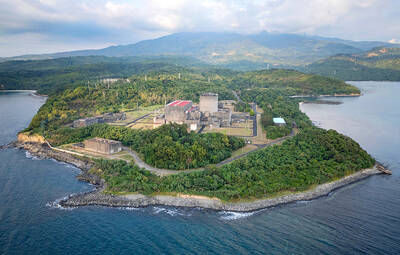
Nuclear power is getting a second look in Southeast Asia as countries prepare to meet surging energy demand as they vie for artificial intelligence-focused data centers. Several Southeast Asian nations are reviving mothballed nuclear plans and setting ambitious targets and nearly half of the region could, if they pursue those goals, have nuclear energy in the 2030s. Even countries without current plans have signaled their interest. Southeast Asia has never produced a single watt of nuclear energy, despite long-held atomic ambitions. But that may soon change as pressure mounts to reduce emissions that contribute to climate change, while meeting growing power needs. The


 RSS
RSS