


Shifting away from the chaos that permeated his earlier work, Jason Chi (
The contextual relationships are more complex as well, says art critic Wang Pin-hwa (
Simplicity/Complexity (1998) and Fly Away (2000) are examples of scraping, both of which show the thin, white layer underneath, bringing sophistication to the web-like lines. Slippery Slope (1999) and The Nearest of You (1999), on the other hand, are examples of covering, which wraps the pictures in misty, romantic textures. Chi's colors are richer, such as in Jungle City (1999), and he introduces diamond-shaped lines, giving a sense of order and continuity, as opposed to his rather disassociated lines from before. Insistence (1999) and Come and Go (2000) are some examples. In Great Expectation, (2000), Chi innovates with his crosses cushioned by fresh light green, sending out a message of humor and tenderness.
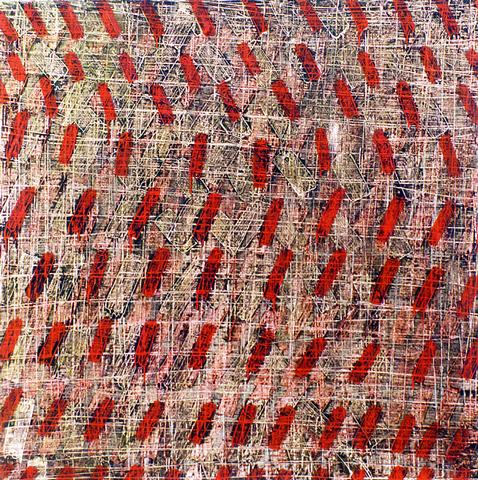
PHOTO COURTESY: ESLITE BOOK STORE
As seen from his current, rather successful exhibition at Eslite, Chi's oil pieces are becoming larger, with the top size measuring 165cm by 165cm. They are also more dynamic and full of tension. It should be noted that he is most appreciated for his pieces that focus on red hues; but, unfortunately, these red color-based pieces sold out during the first week of the exhibit.
Sculptor Hwang Ming-tse leads the way in bringing art to public places
Flying Across the Centuries, from stainless steel sculpture artist Hwang Ming-tse (
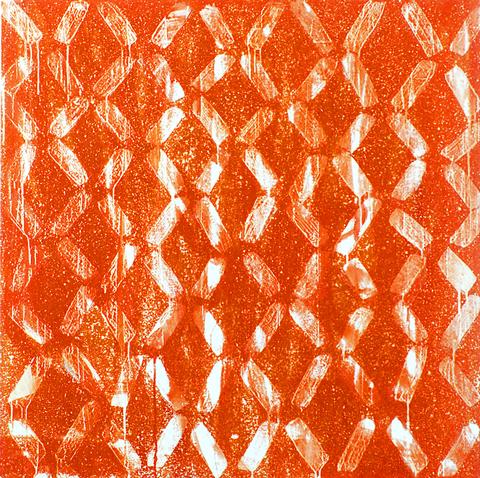
PHOTO COURTESY: ESLITE BOOK STORE
The piece, commissioned by Action Art Foundation and Mototech, has two major parts to it: an inverted T shaped top that looks like a bird spreading his wings and the bottom part, vertically stretching, that symbolizes the tail.
The popular abstract painter took up stainless sculpture several years ago.
Since then, he has proven himself chic, futuristic and cutting-edge. Most people recognize him from his public art piece, Flying in the Eastern District, a shining red, stainless-steel sculpture with a streamlined design. Looking like a perched bird, the sculpture sits at the intersection of Tunhua N. Rd and Minsheng E. Rd. Another stainless steel piece from Hwang will soon be introduced to the Panchiao MRT station.
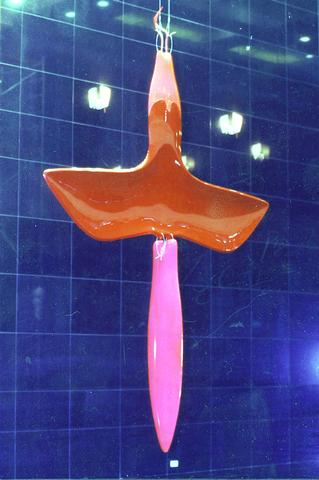
PHOTO COURTESY: ACTION ART FOUNDATION
Hwang's unique stainless sculpture uses bold colors and simple, clear lines. When he first started, he tried wood, but then quickly switched to stainless steel. "It's easier to preserve and make changes around," he said.
He built a factory of 100 pings five years ago, and hired several welders to execute his stainless steel designs, which exhibit a distinguished personal style.
Art critic Shih Jui-jen (
May 11 to May 17 Traversing the southern slopes of the Yushan Range in 1931, Japanese naturalist Tadao Kano knew he was approaching the last swath of Taiwan still beyond colonial control. The “vast, unknown territory,” protected by the “fierce” Bunun headman Dahu Ali, was “filled with an utterly endless jungle that choked the mountains and valleys,” Kano wrote. He noted how the group had “refused to submit to the measures of our authorities and entrenched themselves deep in these mountains … living a free existence spent chasing deer in the morning and seeking serow in the evening,” even describing them as
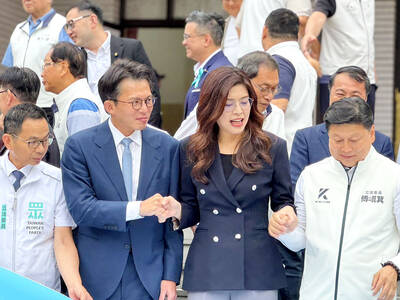
As a different column was being written, the big news dropped that Chinese Nationalist Party (KMT) caucus whip Fu Kun-chi (傅?萁) announced that negotiations within his caucus, with legislative speaker Han Kuo-yu (韓國瑜) of the KMT, party Chair Cheng Li-wun (鄭麗文), Taichung Mayor Lu Shiow-yen (盧秀燕) and Taiwan People’s Party (TPP) Chair Huang Kuo-chang (黃國昌) had produced a compromise special military budget proposal. On Thursday morning, prior to meeting with Cheng over a lunch of beef noodles, Lu reiterated her support for a budget of NT$800 or NT$900 billion — but refused to comment after the meeting. Right after Fu’s
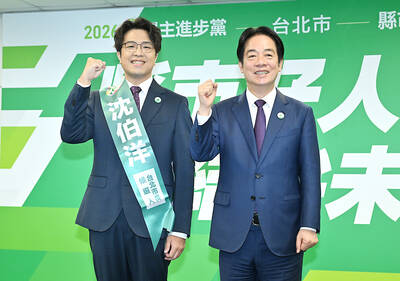
Yesterday, the Democratic Progressive Party (DPP) nominated legislator Puma Shen (沈伯洋) as their Taipei mayoral candidate, the Chinese Nationalist Party (KMT) put their stamp of approval on Wei Ping-cheng (魏平政) as their candidate for Changhua County commissioner and former legislator Tsai Pi-ru (蔡壁如) of the Taiwan People’s Party (TPP) has begun the process to also run in Changhua, though she has not yet been formally nominated. All three news items are bizarre. The DPP has struggled with settling on a Taipei nominee. The only candidate who declared interest was Enoch Wu (吳怡農), but the party seemed determined to nominate anyone
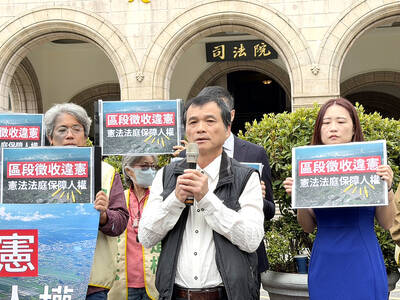
What government project has expropriated the most land in Taiwan? According to local media reports, it is the Taoyuan Aerotropolis, eating 2,500 hectares of land in its first phase, with more to come. Forty thousand people are expected to be displaced by the project. Naturally that enormous land grab is generating powerful pushback. Last week Chen Chien-ho (陳健和), a local resident of Jhuwei Borough (竹圍) in Taoyuan City’s Dayuan District (大園) filed a petition for constitutional review of the project after losing his case at the Taipei Administrative Court. The Administrative Court found in favor of nine other local landowners, but


 RSS
RSS