


Today is celebrated throughout the Chinese world as the birthday of China's "First Teacher," Master Kong Qiu (孔丘) who is known to the West as Confucius. He is 2551 years old today. Perhaps.
Early this morning at temples throughout the country, ceremonies were held honoring him as teacher, sage, prophet, statesman and even deity. Who was the real Confucius?
The Confucian School evolved his legend over 2000 years, while Taoists have assassinated his good character to promote their own ideas. Very little is known about the real man.
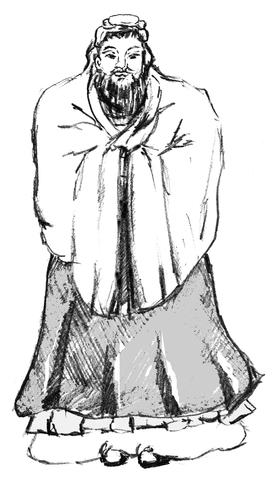
Illustration: June Hsu
He was probably a private tutor who taught the sons of gentlemen the virtues proper to the ruling class. He desired a more public role and wandered from state to state in the fragmented China of that time (today's Shandong and Henan). There is no evidence that he succeeded in interesting rulers in his Way, which he recommended as that of "the ancient kings of a former golden era."
One or two of his disciples achieved official positions and others continued schools in his name. It is through their success that we know of Confucius today and through their mouths that we know what he thought.
"The Master said, Even when walking as one of three men, there is sure to be my teacher. I select their good qualities for imitation and their bad qualities for correction in myself.'"
Confucius might be amused at being worshipped in temples as a saint or even god. He himself "did not speak of the supernatural; mystical powers; abnormalities or gods."
Like many of the philosophers who offered new ideas during this chaotic phase in China's history, Confucius' recommended meritocracy. His definition of a gentleman did not depend on birth but on moral behavior. While states fought each other for control of the nation, Confucius said, "if distant people do not submit, attract them by the virtue of one's culture."
Confucius said that there was one thread running through his ideas. "Disciples asked what he meant. Zengzi replied, The Master's Way is simply Zhong-shu (
Books have been written discussing this term at the core of Confucius' teaching. ZHONG, often translated as "loyalty," meant something like "doing for others as diligently as doing for oneself" and SHU, "reciprocity" meant "imagining oneself on the receiving end of one's actions."
If there is one thing that Taiwan, indeed anywhere, could use more of today, it is this attitude of "thinking of others" put forward by Confucius more than two millennia ago.
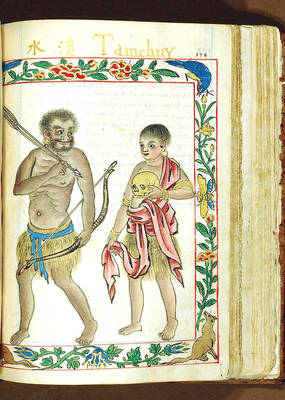
The Portuguese never established a presence on Taiwan, but they must have traded with the indigenous people because later traders reported that the locals referred to parts of deer using Portuguese words. What goods might the Portuguese have offered their indigenous trade partners? Among them must have been slaves, for the Portuguese dealt slaves across Asia. Though we often speak of “Portuguese” ships, imagining them as picturesque vessels manned by pointy-bearded Iberians, in Asia Portuguese shipping between local destinations was crewed by Asian seamen, with a handful of white or Eurasian officers. “Even the great carracks of 1,000-2,000 tons which plied

It’s only half the size of its more famous counterpart in Taipei, but the Botanical Garden of the National Museum of Nature Science (NMNS, 國立自然科學博物館植物園) is surely one of urban Taiwan’s most inviting green spaces. Covering 4.5 hectares immediately northeast of the government-run museum in Taichung’s North District (北區), the garden features more than 700 plant species, many of which are labeled in Chinese but not in English. Since its establishment in 1999, the site’s managers have done their best to replicate a number of native ecosystems, dividing the site into eight areas. The name of the Coral Atoll Zone might
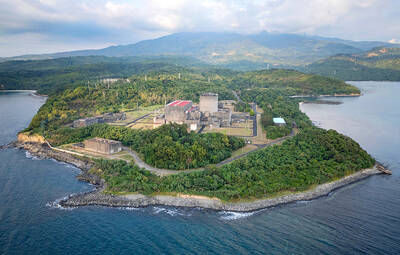
Nuclear power is getting a second look in Southeast Asia as countries prepare to meet surging energy demand as they vie for artificial intelligence-focused data centers. Several Southeast Asian nations are reviving mothballed nuclear plans and setting ambitious targets and nearly half of the region could, if they pursue those goals, have nuclear energy in the 2030s. Even countries without current plans have signaled their interest. Southeast Asia has never produced a single watt of nuclear energy, despite long-held atomic ambitions. But that may soon change as pressure mounts to reduce emissions that contribute to climate change, while meeting growing power needs. The
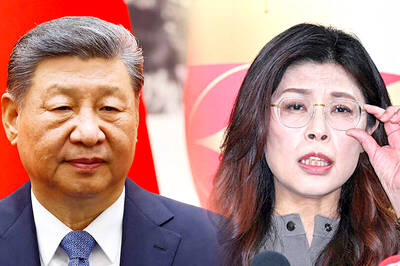
On Monday morning, in quick succession, the Chinese Communist Party (CCP) and the Chinese Nationalist Party (KMT) released statements announcing “that the Central Committee of the Communist Party of China and General Secretary Xi Jinping (習近平) have invited KMT Chairwoman Cheng Li-wun (鄭麗文) to lead a delegation on a visit to the mainland” as the KMT’s press release worded it. The KMT’s press release added “Chairwoman Cheng expressed her gratitude for the invitation and has gladly accepted it.” Beijing’s official Xinhua news release described Song Tao (宋濤), head of the Taiwan Work Office of the CCP Central Committee, as


 RSS
RSS