


Widely dubbed the father of Chinese modern art, Lin Fengmian (
For the 25 paintings on paper featured in the show, Lin drew his subjects from historical and literary characters. The renderings repeat the soft themes he favored, such as classical ladies and Chinese opera performers.
Tracing back through the history of Chinese modern art, one finds Lin as one of its great pioneers. After China became a republic in 1911, he was among the first generation of artists to study abroad. He went to Paris in 1920, then traveled to Germany in 1923, where he later married.
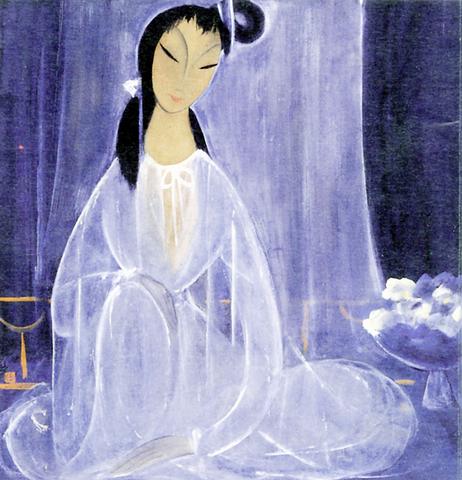
PHOTO: COURTESY OF LIN & KENG GALLERY
In Taiwan, Lin is remembered as the person who introduced western schools of art such as impressionism and fauvism into China in the years following the westward looking cultural changes of the May 4th Movement of 1919. He further promulgated western art concepts through education. When he was only 28 years old, the National Academy of the Arts was established in 1928 with Lin as the president. The school changed its title to Hangzhou Academy of the Arts (
Most of the major names in art history from that period were Lin's students, like Zhao Wou-ki (
Despite Lin's influence and contributions to art education, many appreciate his works outside their historical framework, regarding him as a great artist in his own right. "The great thing about Lin is that his art is appreciated by a wide range of people, including both connoisseurs and amateurs," said Tim Lin.
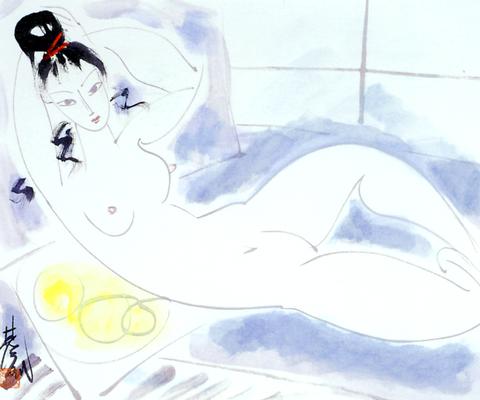
PHOTO: COURTESY OF LIN & KENG GALLERY
Lin used broad strokes and exaggerated, dramatic techniques to create his unique images on paper. One can see such contrasts in his Still Life of 1983, which poses a black fish with bulging eyes against plates and glassware that look fragile to the point of near invisibility. In his handling of paint, he was heavily influenced by post-impressionistic movements, including fauvism, cubism and expressionism. He was meticulous about how much ink he applied, the density of his brush strokes and the creation of visible changes in his works.
Thus, the figures in Lin's paintings are not presented in proper proportion; instead, they show the feelings and emotions from the characters' inner worlds. Adorned with refreshing and modern color schemes, they are also beautifully done with poetic and romantic inclinations. The women of Lin's paintings, with their stretched oval faces, are elegant and slender and in a style modeled after Sung Dynasty ceramic vases. They wear classic gowns, which, appearing as thin and fluid as cicada's wings, appear nicely against the master artist's famous "white outlining strokes (白描)." Several works on view entitled Portait of a Lady present good examples. Particularly of interest are the eyes, of which Lin once said, "There lies the verve of a person."
Gallery owners Tim Lin and Tina Keng, both associates of master Lin for over ten years before he died in 1991, described him as a remarkable and vivacious painter whose paintings tell stories and vividly incorporate light, music and color. A cubist at heart, Lin presents many of his pictures in facets gilded with different shades of light. His Opera Figures is one example. But not relying on cubism alone, the painting's visual musicality also comes through its contrasting attributes, such as masculinity and feminity, lightness and darkness and opacity and transparency. "There are strong emotions and vitality that make his art full of drama and life," said Keng. Another such example is Farewell to My Concubine which he painted in the 1950s. In it, the swiftness and lightness of the female character contrasts with the powerfulness and sturdiness of the male.
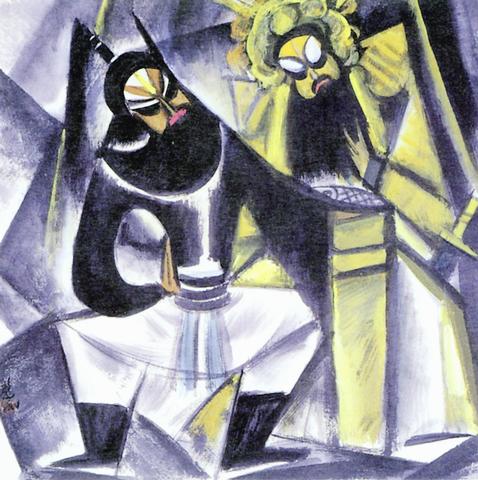
PHOTO: COURTESY OF LIN & KENG GALLERY
Keng further described the artist's fondness of depicting tragic characters from history. Lin sympathized with the disadvantaged, the suppressed and the misfortunate, she said.Perhaps, such views relate to Lin's own personal history. Tim Lin describes the master artist himself as a legendary, unique personality who was full of anecdotes. Keng is able to relate a most shocking one, a story from Lin's childhood that was somehow passed down through his students.
When Lin was only three, his mother was found guilty of adultery and tied up alongside her lover next to a river. As the villagers were throwing stones at them, Lin came down with a knife in his hand and shouted at the villagers that he would seek revenge once he'd grown up. A most courageous child indeed! He shocked the villagers into letting his mother go.
Ajay Verma, a consultant gastroenterologist at Kettering general hospital in Northamptonshire, says our gut is a “complex machine.” “It is constantly providing us with the nutrition we need, initially to grow and develop, and then for us to survive, thrive and repair from injury and illness.” How can we keep it functioning well? Put simply: “Make sure what you put into it is balanced, and that you clear out its waste products adequately,” Verma says. “In a general gastroenterology clinic, the most common conditions we see are irritable bowel syndrome (IBS), gastroesophageal reflux disease, inflammatory bowel disease and constipation,” says Nisha
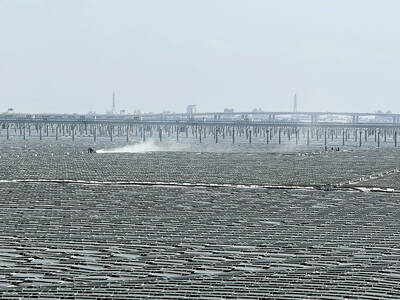
The arithmetic is straightforward and uncomfortable. By the end of 2025, Taiwan had committed itself to a 50-30-20 electricity mix — half natural gas, 30 per cent coal, 20 per cent renewables. The Ministry of Economic Affairs’s (MOEA) own monthly energy reports tell a different story. Natural gas reached 47.8 per cent of generation last year. Coal stood at 35.4 per cent, comfortably above its target ceiling. Renewables came in at 13.1 per cent, well short of the 20 per cent Taipei had pledged a decade earlier. Installed renewable capacity reached roughly half of the 12 gigawatts (GW) the government
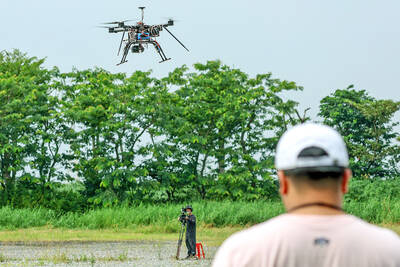
Taiwan’s drone exports are taking off, fuelled by the war in Ukraine, as Taiwanese companies seek a stake in the fast-growing global market for unmanned aerial vehicles (UAV). Low-cost drones used for reconnaissance and strikes are in high demand as governments around the world boost defense spending in the face of intensifying conflicts. A relative new player in the increasingly competitive industry, Taiwan’s pitch is to be an “Asian hub” for the production of UAVs and components free of Chinese materials, or “non-red.” That means its UAVs can be up to three times more expensive than their Chinese competitors, like the world’s biggest
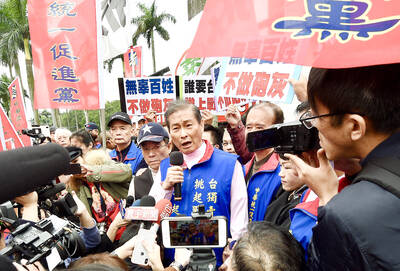
There are shadowy cabals plotting to sell out Taiwan to be annexed by China, by invasion if necessary. Fortunately, they are buffoons. In 2019, former Bamboo Union gangster and founder of the China Unification Promotion Party (CUPP), Chang An-le (張安樂, colorfully known as “White Wolf”), led a protest at the Legislative Yuan against comments made by then-premier Su Tseng-chang (蘇貞昌) that in the event of an attack by China, he would never surrender, but would protect the nation by fighting to the end, even if he only had a broom. Chang had party members bring a wooden casket that they


 RSS
RSS