


Liao Wu-chih (
Turning his back on government subsidies -- and the interference he claims does more harm than good -- Liao has followed his own vision of how to bring the temple into the 21st century, while preserving its history.
A PERSONAL VISION
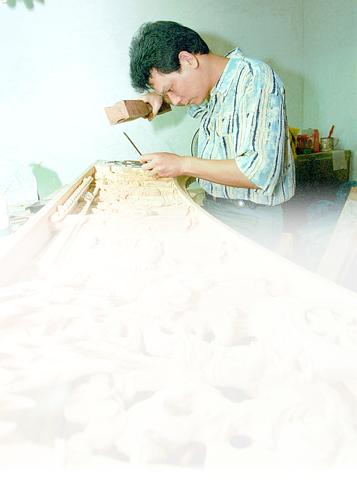
Sitting in his office, he expresses a spirit of intimate concern for the temple. The difficulties he faces are enormous, not least because there is no clear agreement as to how Taiwan's numerous architectural monuments should be dealt with. Even at the level of basic principles and laws relating to heritage preservation, "there is too much room for interpretation," says Fu Chao-ching (
So Liao is left with little choice but to go with his own ideas, treading new ground, drawing praise and criticism each step of the way. Hanging above his desk is state-of-the-art dual-directional lighting imported from Australia, illuminating not only his desk, but also the lofty tie beams and ridgepole above. On the floor are tiles of dusty orange that are now to be found only in the oldest temples. This combination is nothing particularly innovative in itself. But what is surprising about the Bao-an Temple restoration project is the thoroughness and sensitivity with which this delicate process is being carried out.
Four years into the restoration, the front hall (
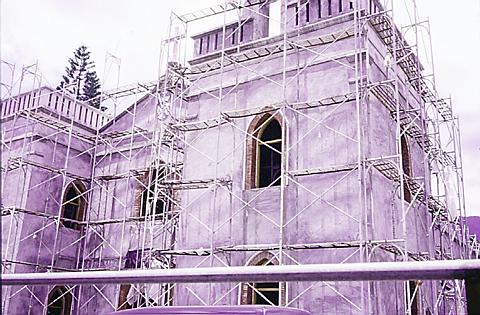
PHOTO: IAN BARTHOLOMEW
OLD WAYS AND NEW
Pointing at the tiles on the floor of his office, Liao says he rejected the use of terrazzo paving, a material made of stone chips and cement, which has been very popular in temple restoration because of its hardness. "They don't understand the basic principles of the materials used [in traditional Chinese architecture]," he says. "These old bricks and tiles serve an important function in regulating the microclimate of the building. Terrazzo does not breathe the way traditional tiles do, so it locks moisture beneath the surface. Of course, you will get problems when moisture builds up."
The question of materials is a fraught one, not least because of the question of cost. Handmade tiles are expensive to make and to lay, and for those working on a budget they could be a luxury that temples in danger of falling down might well do without.
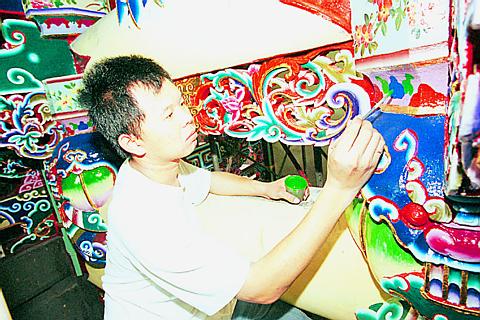
PHOTO: CHIANG YING-YING, TAIPEI TIMES
But Liao is quick to emphasize that "we are not stick-in-the-mud traditionalists" and in, some instances, he has drawn criticism for his methods. In 1996 he brought in an Australian team to study the problem of moisture in the preservation of temple murals. He pointed out at the time that if steps were not taken to prevent moisture-related damage, no amount of restoration or repainting would do any good.
The use of foreign technology brought criticism from a number of quarters, including the secretary general of Taipei's Lungshan Temple, Chang Jun-hung (
On this issue, Liao says that this attitude is yet another failure of Taiwan's restoration community to take a properly scientific attitude. "When foreigners have achieved proven results -- such as the Japanese in termite prevention -- there is no reason to reject their methods."
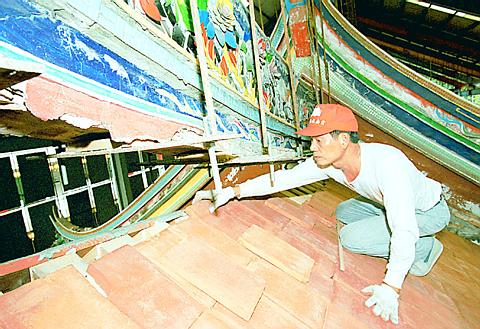
PHOTO: CHIANG YING-YING, TAIPEI TIMES
Cost, of course, is another matter. The price for using such foreign technology is often high -- NT$700,000 for the Australian study, for example -- and well out of range of less wealthy foundations.
LIVING RELICS
The debate over integration of old and new ties in with a more abstract question: what purpose is a historical monument intended to serve? Both Liao and Chang agree that their respective temples are living monuments and oppose fossilizing them. "If people don't come here to worship, then the building has no meaning," Chang says. What these two high-profile temple managers disagree about is how this affects the work of restoration.
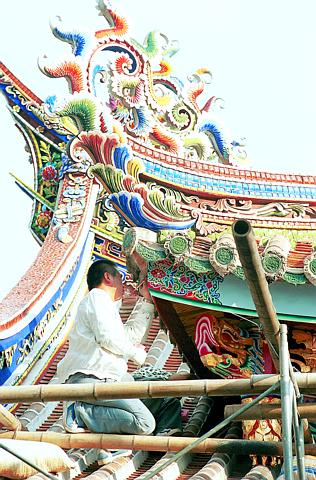
PHOTO: CHIANG YING-YING, TAIPEI TIMES
Taipei's Lungshan Temple has itself just completed a three-year restoration of its rear hall. Part of Chang's belief in the ongoing nature of the temple is a willingness to use new materials and new, yet traditional artwork. For him, the temple structure is a constantly changing entity. "If a wall collapses, then we should put in steel reinforcement. This is an option the ancients did not have," he says. But he also emphasizes "while the materials can change, the appearance of the building should not be altered."
"If we have an earthen structure that falls down because of an earthquake, we should use [stronger] materials to rebuild it, then when there is another earthquake, it will not collapse again."
Liao, with his greater insistence on using traditional materials, pointed out, not without some pride, that the Bao-an Temple was one of the very few temples to suffer no damage at all in the 921 quake. His verdict: the ancients understood the conditions they were building for. Moreover, he is less willing than Chang to leave history behind. "This is our architectural history -- so of course you want to preserve it as it is."
Chang puts a different slant on this issue, saying "A monument is a thing that can change, it is alive and can grow." In reviewing the work done on the rear hall, Chang says some scholars complained that the work was too elaborate, too intricate. "But we have the money to do it, so why shouldn't we," he says.
RETURNING TO ORIGINALS
But what happens when the past has already been largely destroyed? At the Wanchin Basilica (
The issue is complicated by the fact that all but the front wall and two side walls were rebuilt in 1960 -- which to most people's minds, does not make it much of a historical monument. But as with all buildings that have a powerful emotional hold on a community, the debate is about much more than architecture.
National Cheng Kung University's professor Fu, who compiled the report, maintains that "the building declared a heritage site was the building built in 1960. It reflects different styles of architecture and therefore should be preserved in that fashion."
But massive changes are already being undertaken to restore the original 19th-century look of the church. "We asked the people what they wanted," says Father Juan Carlos Martinez, one of three Spanish priests working at the Wanchin Basilica. "I am a foreigner, I may be gone in a few years, so it is important to ask the people who use the church. They told us, `We want it to be made the way it was like when we were children.'"
Dressed in a vest, shorts and battered deck shoes, the dust from the building site sticking to his sweaty arms, the priest points out with delight the stacked handmade paving tiles; and picks up shavings of Taiwan cypress, which are being carved to replace pillars that have rotted through. "Smell the wood," he says, as the local craftsmen work away under a mango tree in the front court.
The emotional appeal is a powerful one -- whether for better or for worse remains to be seen.
URBAN CONSERVATION
According to Fu, the international trend on restoration is shifting. He says, according to current thinking, a building should preserve previous renovations while developing in new directions. "We are moving away from the idea of `historic preservation' with the emphasis on `history,' and moving gradually to the concept of `urban conservation,' which has much wider scope."
He cites Ieoh Ming Pei's Pyramide du Louvre in Paris -- the creation of glass and steel against the backdrop of the stone building of the Second Empire -- as an example of what could be done. The still controversial work is, to quote the words of Dennis Sharp, an historian of architecture, "a startling reminder of the audacious ability of modern architects to invigorate and re-circulate traditional architectural forms."
For Fu, the work being conducted on the Wanchin Basilica is an "imitation," not a conservation of architectural heritage. By remodeling the Wanchin Basilica, Fu says the church is failing to respect the architecture of the different periods it represented.
As for what Lungshan Temple is doing, he believes there is a delicate question of what is "suitable," which for the majority of restoration projects will eventually be answered by government officials -- a situation with potential to create innumerable delays and buck passing. "The government [anywhere in the world] is never effective in the cultural field, but in Taiwan, even the basic principles have not been set up. Everything must constantly be discussed because there is no framework in place," says Robin Ruizendaal, a cultural event organizer based in Taipei, echoing feelings less directly expressed by Chang and Liao.
SHOW ME THE MONEY
The belief by some high-profile preservationists that government cooperation does more harm than good is an indictment on the central government's expressed commitment to the island's cultural heritage. At the heart of this condemnation is broad agreement that the government's system of tender prevents any project with vision from being realized.
While Father Martinez may be content to work within the government budget of NT$23 million and its NT$5 million contribution, neither Bao-an Temple nor Lungshan Temple wish to be bound by such constraints. Chang says NT$27 million has been spent on the restoration of the rear hall alone. The greater part of the restoration still remains to be completed.
Members of the restoration community carp against government budgets they say are far from adequate to meet the needs of such thorough restoration initiatives as those being conducted by Liao and Chang. Wang Yih-rong (
John Liaw (
A RECIPE FOR DISASTER
The requirement that projects be put out to public tender, however, is the issue that causes the most friction. Liao suggests that giving restoration work to a contractor is a recipe for disaster. "Naturally they are going to cut corners [on government projects]," he says. The craftsmen at Bao-an Temple are paid a traditional daily wage and are supervised by a master craftsman, the way it was done in the old days. Of course, this requires an undefined financial commitment that would be intolerable to any government accountant.
Lee Chian-lang (
Ruizendaal says the cost of construction for cultural facilities in Taiwan is double or more what it is in Europe, as a result of the government's procedure of putting everything out to tender. The government has made some effort to remedy the defects, passing amendments to the Cultural Heritage Preservation Law (
Lee says this amendment has made little difference to actual procedure. "The greater freedom permitted under the amendment also entails greater responsibility for the government officials involved, so they are still inclined to use the old procedure," he says.
Liaw of the Taipei Bureau oof Cultural Affairs agrees. "The government has said that the Government Procurement Law need not be used in certain instances, but they have not specified what will take its place. Of course nobody dares ignore the existing regulations, as the result could easily be controversial."
Liaw points out that the law creates other problems as well. "The Government Procurement Law favors architectural firms. Architects are usually people trained to build new buildings, not repair old ones." Referring to the Bao-an Temple restoration, he says "these historical monuments were built without the benefit of architects. It was just the craftsman, the temple manager and possibly a feng shui master. If they weren't well built, these historical monuments would not still be standing. But these traditional craftsmen cannot compete against architectural firms in government tenders. Their skills go to waste, and in the long term they will be lost."
POINTING THE FINGER
Wang of the MOI insists that the government is providing a high level of support, "but it is necessary to make it a matter of community concern." This, with a few notable exceptions, has so far failed to happen. "People are not interested in preserving these monuments," he says.
Ruizendaal agrees, saying: "There simply isn't the environment. It goes against the whole current of Taiwan's culture in which most people still don't care about their history."
Despite acknowledging public indifference, the government still holds back from a more proactive stance on heritage sites. Since the Cultural Heritage Law was promulgated in 1982, a lot of talk has flowed under the bridge, but the buzz on the street suggests that it lacks what it takes to restore and maintain buildings of historical or artistic importance.
This failure has been highlighted by the most recent controversy over the preservation of an old granary in Taipei's Peitou district. The owners of the building, the Peitou Farmers Association, sought to demolish the building the day before it was declared a heritage site. With the preservation order approved, the Taipei City government has ordered the association to rebuild sections that had just been demolished and have also ordered the association to pay for the heritage site's future maintenance. Given the association's manifest hostility to the granary's preservation -- an agricultural produce marketing center having greater appeal -- the government's decision would not seem to have the best interests of heritage preservation at heart because the association will still be in charge of the site.
In other words, men with the vision and the boldness to find their own way, men such as Liao and Chiang, are still necessary to get things done properly. Choosing to be unconventional, they take full responsibility for both the quality and the eventual cost of their restoration projects. Even Father Martinez, battling the heat of Pingtung's scorching summer, has taken flak for his vision of a Spanish colonial basilica -- but he knows what he wants and is willing to take responsibility for it.

Taiwan’s English education system is being pulled apart by three opposing forces. Bilingual Nation 2030 pulls students toward English and global communication. Artificial Intelligence (AI) readiness pulls them toward digital judgment, verification and AI-mediated work. But Taiwan’s old exam culture pulls them back toward memorization, grammar drills, timed reading and correct answers. If the education system keeps using old exams to define success, it risks producing graduates who are neither genuinely bilingual nor genuinely AI-ready, but trained for tasks machines can already perform. The first force is Bilingual Nation 2030. Launched in 2018, the policy aimed to “help Taiwan’s workforce connect

It seems every few days one bumps into one of those “real man” comments in which Taiwan is urged to “face reality” or similar, and “make a deal,” with the speaker implying that soon it will be too late. “Deal” advocates always present themselves as having a superior grip on reality, and the manly ability to make the “hard choice.” Their testosterone-laden language often echoes that of Taiwan sellout advocates. Note that such commentary always specifies a process (“make a deal, work with, make progress”), never the end state of what occupation by a violent authoritarian colonialist state will entail. In

“Taiwan’s Opposition Leader Comes to US With a Message Straight Out of Beijing” read a May 31 headline in the Wall Street Journal. Top US administration officials and members of Congress almost certainly read the WSJ, and if there was a bullet point takeaway that people in Washington should absorb ahead of Chinese Nationalist Party (KMT) Chair Cheng Li-wun’s (鄭麗文) arrival in DC on June 9, that headline is it. The last few columns have discussed this very topic, and the timing is not coincidental. While those top officials likely do not read the Taipei Times, judging by the number
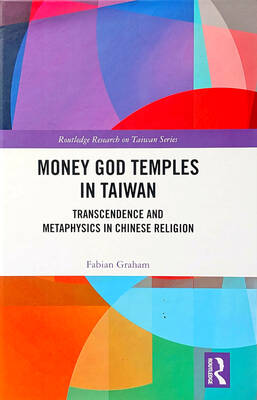
As someone who normally steers clear of books with “transcendence” or “metaphysics” in their subtitles, this reviewer — a casual observer of local belief systems since the 1990s — found Fabian Graham’s Money God Temples in Taiwan a challenging read. Those who’ve only dipped their toes into temple culture will likely need to parse several sections with special care if they’re to keep up with the author, a British ethnographic researcher whose previous books have investigated religious practices among ethnic Chinese in Southeast Asia. This scholarly volume examines a facet of Taiwan’s religious landscape that didn’t exist a century ago, and


 RSS
RSS