


IT was only the lucky few, fortunate enough to be in the know, who last month saw a spectacular, charming, and disturbing production of Oscar Wilde's one-act drama Salome in a cafe-theater off Hoping East Road. Taipei has probably not seen anything as powerful, or as exotic, in years.
The group responsible was Thalie Theatre, a company established in 1997 with the aim of bringing English-language theater to Taipei on a regular basis.
Its founder, and the director of all its subsequent productions, is an Icelander, Daniel Ingi Petursson. Trained in theater in Paris at the Ecole Jacques Le Coq, and at the Ecole Philippe Gaulier, Petursson worked briefly in London before moving to Asia. Since setting up Thalie, he has directed productions of classics by Chekhov, Strindberg, and Pinter, together with several smaller-scale pieces.
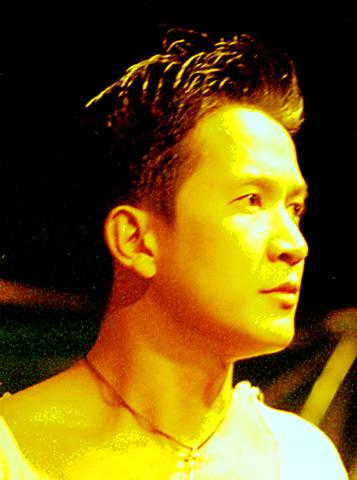
PHOTO: BRADLEY WINTERTON
By concentrating on established classics of the European tradition, Thalie Theatre has seen to it that it is firmly rooted in established quality, while at the same time offering its audiences highly novel styles of presentation.
Even the physical settings are often a surprise. The company's debut (Chekhov's The Bear) was performed one Sunday afternoon on the roof of an inner-city building, while Strindberg's Miss Julie was played to considerable effect along a very broad acting area, with the audience deployed in just two long rows of seats.
In order to understand Thalie Theater's distinctive way with the classics, it's necessary to recall just what kind of a production Salome was.
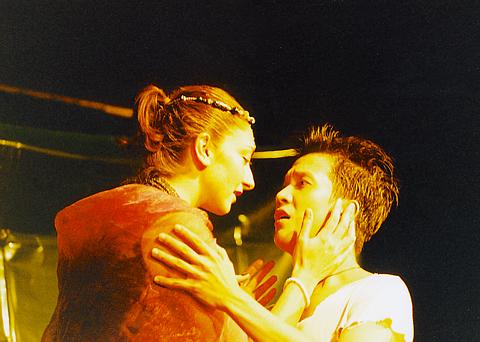
PHOTO: BRADLEY WINTERTON
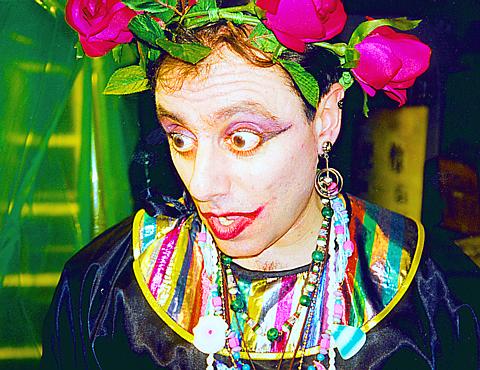
In a bizarre vision of Jerusalem under Roman rule 2,000 years ago, we were offered a cigarette-smoking, campy King Herod with painted lips, rouged cheeks, and a brow wreathed in roses; contentious female Jewish rabbis wearing sunglasses and snorkelling masks; soldiers with toy Kalashnikovs that flashed multi-colored lights; a harlequin dancer, carrying with equal unconcern, glasses of wine and John the Baptist's severed head; and a Baptist himself who seemed as eager to rape Salome as to resist her already direct advances.
Yet in contrast to these playfully grotesque portrayals was a Princess Salome played without a shred of comedy, and indeed with genuinely tragic overtones. And the whole thing was placed, with considerable deftness and insight, against the background of a omen-plagued ancient Mediterranean world, where popular delight in cruelty was all-but universal, and the sight and taste of blood relished almost as much as feared.
The show's music was no less eclectic than its visual style. We had Marlene Dietrich singing "The Boys in the Back Room," Puccini's "Nessun Dorma," Gipsy Kings, Dalida's "Bambino," and Purcell's Music for the Funeral of Queen Mary. The effect of this combination was partly to give a feeling of kitsch, and partly one of high tragedy, a mixture typical of the production style as a whole.
N
These, then, were the key elements of what was by any standards a very unusual theatrical event.
"Most of the actors came together through regular workshops I've been holding in Taipei over the years," says Petursson. "Quite a few of them have professional backgrounds in their own countries but have found it hard to get theatrical work here in Asia. The result is a far higher standard of performance than you'd really have any right to expect."The company is now in the enviable position of being able to draw on an acting team that includes members from Taiwan, Italy, Sweden, the USA, Australia, and the Philippines. Their backgrounds are as varied as their acting styles.
The juxtaposition of the playful and the dramatic has always been a feature of the company's style. In Miss Julie the transparency of the desires of the leading character did nothing to prevent her also being portrayed as a lonely and pitiable individual. And in The Bear, the extravagant advances of the male lead were off-set by the absurd convolutions of a servant.
But the actors are never allowed to become the play-things of a modishly post-modern presentation style. Indeed, from the beginning, strong acting has been Thalie Theatre's trump card.
As Herod in Salome, for instance, Maurice Harrington portrayed a man equally ineffectual in his lust and in his hold on power, salivating over his step-daughter's body as if the more easily to get his tongue round Wilde's lavishly ornamental words. Originally from Adelaide, Harrington devotes his time in Taipei to teaching English and acting theater in roughly equal proportions.
Rome-born Manuela Mercandelli, who played Salome, is a former member of Turin's Stabile Theatre, while Jerome Co (John the Baptist) is a talented actor whose first experience of theater was two years ago in one of Petursson's Sunday afternoon drama workshops.
Milly Chang, who gave a kittenishly erotic portrayal of the title role in Miss Julie, is about to graduate in English from Taipei's Soochow University.
Thalie Theatre's work can in part be understood against the background of the small-theatre renaissance that has been making its way in Taipei over the last few years. Instead of large, traditional venues, these companies play in small and often unusual spaces: a former prison off Hoping West Road, a disused wine factory on Pateh Road, and specially-equipped mini-theatres such as the one at Cafe Neruda (the venue for Salome).
The underlying philosophy of the movement is that a situation has arisen in which many Taiwan people have been awash in a TV-based pop culture. It consequently aims to counter the dominance of bland and predictable game-shows in as vigorous, and if necessary shocking, a way as possible.
Excitement and unexpectedness are the hallmarks of this scene. An audience of 50 or 75 huddled together in an "alternative" venue has a more immediate experience of the ancient art of drama than one can ever hope to have in the National Theater, giving afficionados the feeling of being adherents of some secret religion.
Thalie Theatre's next presentation will be Tennessee Williams' A Streetcar Named Desire, scheduled for late June at Cafe Neruda. Though this is an established American classic, set in New Orleans and first performed in 1947, Petursson says he has been most influenced by the play's early productions in Europe.
"I have been most inspired by photos of the first French production, by Jean Cocteau," he says. "Those, together with pictures of Laurence Olivier's London version, are what first showed me the play's imaginative possibilities."
Both Chang and Co plan to further their theatrical careers in London later in the year. By way of farewell, they will be taking the leading roles in Streetcar.
Chang will play the alcoholic Blanche, while Co will be her unsuspecting victim Stanley. Quar Chen (the harlequin dancer in Salome) will be Steve, while Harrington, who is involved in another project, will make a cameo appearance in the role of the doctor.
"Losing two such talented performers will certainly leave a gap," says Petursson. "But I'm sure the next series of workshops will reveal fresh talent. People develop their theatrical personalities in these situations, and sometimes you get a sudden flash of insight into on-stage potential that's totally unexpected. There are few more wonderful experiences than that."
Thalie Theatre's drama workshops will resume on Sunday afternoons later this month. A decision is pending on the final date and venue for Streetcar. For more information, page 0943-281056 and leave a contact number.

Taiwan’s English education system is being pulled apart by three opposing forces. Bilingual Nation 2030 pulls students toward English and global communication. Artificial Intelligence (AI) readiness pulls them toward digital judgment, verification and AI-mediated work. But Taiwan’s old exam culture pulls them back toward memorization, grammar drills, timed reading and correct answers. If the education system keeps using old exams to define success, it risks producing graduates who are neither genuinely bilingual nor genuinely AI-ready, but trained for tasks machines can already perform. The first force is Bilingual Nation 2030. Launched in 2018, the policy aimed to “help Taiwan’s workforce connect

“Taiwan’s Opposition Leader Comes to US With a Message Straight Out of Beijing” read a May 31 headline in the Wall Street Journal. Top US administration officials and members of Congress almost certainly read the WSJ, and if there was a bullet point takeaway that people in Washington should absorb ahead of Chinese Nationalist Party (KMT) Chair Cheng Li-wun’s (鄭麗文) arrival in DC on June 9, that headline is it. The last few columns have discussed this very topic, and the timing is not coincidental. While those top officials likely do not read the Taipei Times, judging by the number

With weighty, anxiety-inducing geopolitical topics dominating the headlines, checking in on the wild and weird state of local politics can take some of the edge off. This November’s elections will determine who will be in charge of fixing potholes in your neighborhood, not the potholes in Taiwan’s complicated geopolitical space. Recently, after an online interview with a Taipei-based journalist, I commented that Taipei journalists never go further than the MRT can take them. He laughed and agreed. Naturally, the Taipei mayoral race is eating up much of the press attention. TAIPEI CITY Democratic Progressive Party (DPP) candidate Puma Shen (沈伯洋) has
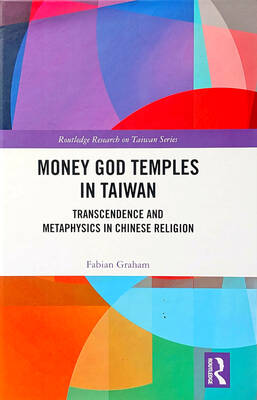
As someone who normally steers clear of books with “transcendence” or “metaphysics” in their subtitles, this reviewer — a casual observer of local belief systems since the 1990s — found Fabian Graham’s Money God Temples in Taiwan a challenging read. Those who’ve only dipped their toes into temple culture will likely need to parse several sections with special care if they’re to keep up with the author, a British ethnographic researcher whose previous books have investigated religious practices among ethnic Chinese in Southeast Asia. This scholarly volume examines a facet of Taiwan’s religious landscape that didn’t exist a century ago, and


 RSS
RSS