


The women of Taipei's theater circle are seizing upon spring as the time to renew a festival, dormant now for four years, that will showcase their performance art.
The Blossom in Spring Women Festival (萬花戲春-女節聯演) will draw from a variety of genres for the performances, all of which were created by local women from the theater. There will be a drama adapted from Chinese classic literature (but spoken for the first time in Taiwanese), a solo dance in memory of the 921 earthquake, a blend of Taiwanese opera (歌仔戲) and Shakespearean theater, and an aboriginal-influenced improvisation of body movement.
Most of the women behind the revival of the festival gained exposure during Taiwan's Little Theater Movement in the late 80s, emerging from experimental theaters and the so-called little theaters. For the next decade, most gained further experience by joining various troupes around the island, eventually working their way into prominent positions as troupe leaders or theater teachers in art schools.
The eight plays being presented during the one-month festival can therefore be seen as the fruits of this earlier movement in women's theater.
The first week's performances include a play co-written by Wu Wen-tsuai (吳文翠) and Germany's Heike Gaessler; it's titled The Ghost Place - Mountain Ghost Project I.
As an artist well versed in Qi Gong and Tai Chi, Wu uses body language to present a conversation between an old house in Taipei and the ghost that haunts it, an interaction laced with memories and emotions. The director, Gaessler, who is researching Asian theater, says the play attempts to cover a range of issues from social to psychological and philosophical. These will be represented in the play by three characters time, memory and shadow all played by Wu.
In the second week, southern Taiwan will become the focus of the shows. Tainan's Wu Hsing-chiu's (吳幸秋) A Tale of a Jealous Woman (妒婦津) conveys a retrospective view on feminine desire as well as affection toward Tainan City and its people. The play talks about a husband's fear of his wife's ghost, which haunts him after she drowns herself in a river created out of jealousy for her husband's adoration with the Goddess of Water. Extremely wary of the ghost, the husband dreads crossing the river.
"I want to transfer the stereotype of women's jealousy, and to talk about women's persistence and men's escapism," says Wu in the playbill.,p.
To make this play, Wu not only adapted the philosophies, but transcribed the language of the original work. The story's origin comes from "Bean Shack Stories" (豆棚閒話), a classic of Chinese literature, but Wu took the ancient literary Chinese prose in the play and converted it into Taiwanese poetry. Digital image projection will be used to present the bridge, the water and the main characters.
Also using elements of Taiwan's traditional culture is 毧ook Up Taiwanese Opera (胡撇歌仔戲), scheduled for week four. Senior Taiwanese Opera actress Hsiao Min-ming (小明明) will be leading Chan hui-ling and other Shakespeare-trained actresses to "sing" an old repertoire for Taiwanese Opera titled "Courtship Competition" (搶親) Using modern theater dialogues and Taiwanese songs, it is a play expected to interest a wide-ranging audience.
It has been four years since the last Women's Festival. In the 1996 event, the joint performances brought fame to young Wei Ying-chuan (魏瑛娟), who is now director of Shakespeare's Sister Theater Troupe (莎士比亞的妹妹劇團). And this time, organizer Hsu Ya-hung (許雅紅) and Lucie Fu (傅裕惠) intend to demonstrate more art styles and regional features in the showcase. "Blossom in Spring is a carnival of Taiwan women's theater writing," said Fu. Both hope to turn the festival into an annul event.

Taiwan’s English education system is being pulled apart by three opposing forces. Bilingual Nation 2030 pulls students toward English and global communication. Artificial Intelligence (AI) readiness pulls them toward digital judgment, verification and AI-mediated work. But Taiwan’s old exam culture pulls them back toward memorization, grammar drills, timed reading and correct answers. If the education system keeps using old exams to define success, it risks producing graduates who are neither genuinely bilingual nor genuinely AI-ready, but trained for tasks machines can already perform. The first force is Bilingual Nation 2030. Launched in 2018, the policy aimed to “help Taiwan’s workforce connect
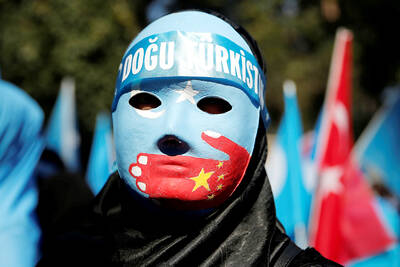
It seems every few days one bumps into one of those “real man” comments in which Taiwan is urged to “face reality” or similar, and “make a deal,” with the speaker implying that soon it will be too late. “Deal” advocates always present themselves as having a superior grip on reality, and the manly ability to make the “hard choice.” Their testosterone-laden language often echoes that of Taiwan sellout advocates. Note that such commentary always specifies a process (“make a deal, work with, make progress”), never the end state of what occupation by a violent authoritarian colonialist state will entail. In

“Taiwan’s Opposition Leader Comes to US With a Message Straight Out of Beijing” read a May 31 headline in the Wall Street Journal. Top US administration officials and members of Congress almost certainly read the WSJ, and if there was a bullet point takeaway that people in Washington should absorb ahead of Chinese Nationalist Party (KMT) Chair Cheng Li-wun’s (鄭麗文) arrival in DC on June 9, that headline is it. The last few columns have discussed this very topic, and the timing is not coincidental. While those top officials likely do not read the Taipei Times, judging by the number
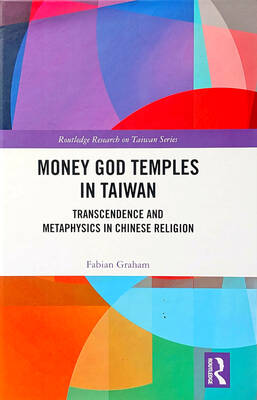
As someone who normally steers clear of books with “transcendence” or “metaphysics” in their subtitles, this reviewer — a casual observer of local belief systems since the 1990s — found Fabian Graham’s Money God Temples in Taiwan a challenging read. Those who’ve only dipped their toes into temple culture will likely need to parse several sections with special care if they’re to keep up with the author, a British ethnographic researcher whose previous books have investigated religious practices among ethnic Chinese in Southeast Asia. This scholarly volume examines a facet of Taiwan’s religious landscape that didn’t exist a century ago, and


 RSS
RSS