


Ties That Bind is an experiment in oral history that works, and longtime Taipei resident Richard Vuylsteke deserves praise for putting it together. Interviews with 150 people connected with the Taipei American School (TAS) -- students, parents, faculty, administrators and staff -- comprise the core of the book and they make a fascinating read, even for people who have no knowledge of the school or its students.
Covering the first 50 years of TAS, from 1949 to 1999, Ties That Bind provides the reader with glimpses of Taipei life that have never been set down in print before. As the author says in a preface, oral history "is not designed to give a complete, integrated view of the past." The book that Vuylsteke has weaved together from tapes, conversations, notes and research is a kind of an oral history jigsaw puzzle, and the reader can put it together in several different ways, depending on personal inclination.
One can read it in one sitting, in a linear way, beginning with chapter one and ending 79 interviews later; or one can read it piecemeal, a few pages here, a few pages there, putting the puzzle together as one wishes and looking for observations and comments about TAS that resonate with one's own experiences in Taipei.
For former TAS students and staff -- and TAS students of today -- the book is filled with nostalgic impressions of the past, things that must be special to those connected to the school. And that is probably the main audience that Vuylsteke was trying to reach when he set out to produce this book.
But for people with no connection to the school, the book still makes fascinating reading. A smorgasbord of Taipei lore and Taiwanese life, one picks up a new understanding of what life was like in the capital city during the last 50 years. Life in Taipei, life at TAS.
Almost like a special kind of high school yearbook put together by a professional editor with an eye and ear for poignant details, Ties That Bind is a unique book that might serve as inspiration for other international schools that wish to document school history and changing student sentiment over the years.
Of course, not every high school has the resources or funds to undertake such an oral history so Ties That Bind stands out as a one-of-a-kind opus. It's something you read slowly in your living room or in a public library reading room, chapter by chapter, interview by interview, at one's own pace, following one's own page directions and inclination.
There is a beginning and end to the Ties That Bind, but you don't have to read it that way. Open it up in the middle, as this reviewer did, and enjoy the panoramic show -- the old photographs, the student commentaries, the staff memories, the historical asides.
It's a book that will make a mark on TAS and perhaps even set the stage for a companion volume, 50 years hence. Of course, there will be a new historian to record the tapes and an entire new generation to interview.
But for the time being, in Ties That Bind, Richard Vuylsteke has set the pace.
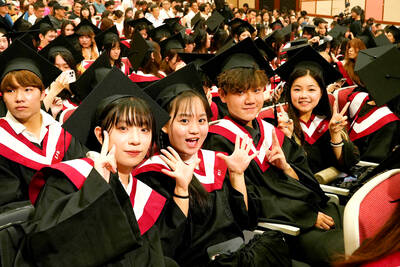
Taiwan’s English education system is being pulled apart by three opposing forces. Bilingual Nation 2030 pulls students toward English and global communication. Artificial Intelligence (AI) readiness pulls them toward digital judgment, verification and AI-mediated work. But Taiwan’s old exam culture pulls them back toward memorization, grammar drills, timed reading and correct answers. If the education system keeps using old exams to define success, it risks producing graduates who are neither genuinely bilingual nor genuinely AI-ready, but trained for tasks machines can already perform. The first force is Bilingual Nation 2030. Launched in 2018, the policy aimed to “help Taiwan’s workforce connect
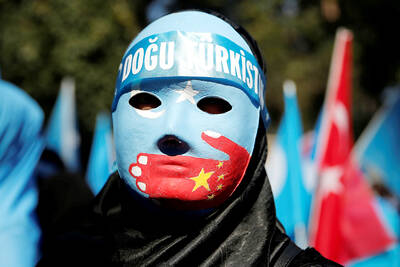
It seems every few days one bumps into one of those “real man” comments in which Taiwan is urged to “face reality” or similar, and “make a deal,” with the speaker implying that soon it will be too late. “Deal” advocates always present themselves as having a superior grip on reality, and the manly ability to make the “hard choice.” Their testosterone-laden language often echoes that of Taiwan sellout advocates. Note that such commentary always specifies a process (“make a deal, work with, make progress”), never the end state of what occupation by a violent authoritarian colonialist state will entail. In

“Taiwan’s Opposition Leader Comes to US With a Message Straight Out of Beijing” read a May 31 headline in the Wall Street Journal. Top US administration officials and members of Congress almost certainly read the WSJ, and if there was a bullet point takeaway that people in Washington should absorb ahead of Chinese Nationalist Party (KMT) Chair Cheng Li-wun’s (鄭麗文) arrival in DC on June 9, that headline is it. The last few columns have discussed this very topic, and the timing is not coincidental. While those top officials likely do not read the Taipei Times, judging by the number
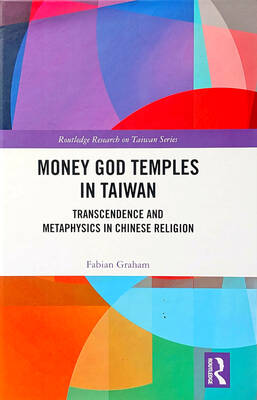
As someone who normally steers clear of books with “transcendence” or “metaphysics” in their subtitles, this reviewer — a casual observer of local belief systems since the 1990s — found Fabian Graham’s Money God Temples in Taiwan a challenging read. Those who’ve only dipped their toes into temple culture will likely need to parse several sections with special care if they’re to keep up with the author, a British ethnographic researcher whose previous books have investigated religious practices among ethnic Chinese in Southeast Asia. This scholarly volume examines a facet of Taiwan’s religious landscape that didn’t exist a century ago, and


 RSS
RSS