


Editor's note: Wang Ching-hsian is a composite based on the experiences of two patients. Photographer Hou Tsung-hui took these photos nearly 20 years ago. He is a former patient at Lungfatang.
The first day Wang Ching-hsian arrived at Lungfatang, the Master shaved his head and fixed a chain around his waist that linked him to another mentally ill patient. Every day, Wang went with this other man to tend the pigs, to feed the chickens, to eat and to bathe.
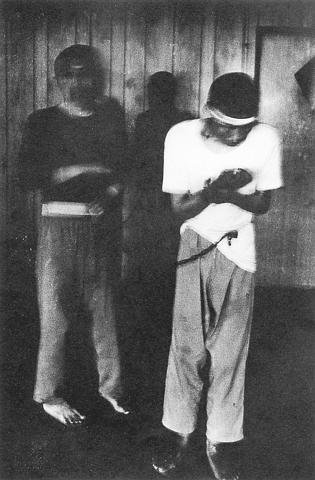
Photo by Hou Tsung-hui
At first, going to the toilet together was the hardest part to get used to, but everyone else did it. After a while, Wang became so accustomed to the routine that he now instructs new mentally ill patients on living with the chain, showing them how and where to stand and when to sit.
Fifteen years have passed, in the blink of an eye, since Wang came to Lungfatang (龍發堂), a psychiatric ward cum Buddhist temple in Kaohsiung County. His family sent him here shortly after his release from prison, where he served only 3 1/2 years of a 15-year sentence for murdering his wife. From the first day he entered this place, he knew he could never go home.
"People like us have been abandoned by society," Wang says in a video produced by the temple. "People who are healthy and normal can never understand how painful it is to be ill. Before, I didn't even know who I was. Now, not only do I have self-confidence, but also I am quite satisfied with myself. It was the Master who saved me."
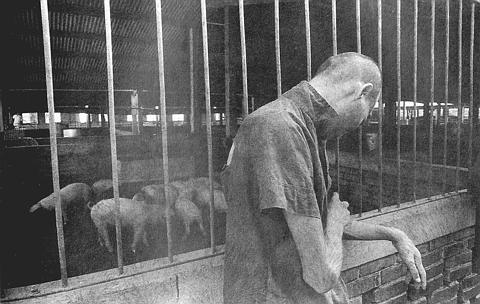
Photo by Hou Tsung-hui
In the temple's promotional video, Wang and others attest to the "miracle" of this place and the temple's Master Hieh Kai Feng, whose original name is Lee Kun-tai. For 30 years, Kaohsiung County's Lungtafang has taken in mentally ill and retarded patients whose families no longer were able or willing to care for them. The patients collectively operate the largest chicken farm in Taiwan, living and working the farm together while chained in pairs.
The temple's approach to assisting and caring for its patients is supported by many of the families, but has been at the center of controversy many times in the past. Criticism has included allegations of financial impropriety and profiteering as well as harsh denunciations of the temple's treatment methods by the Taiwanese psychiatric community.
The most recent controversy surfaced last week, when six patients alleged that Lungfatang was more of a "black jail" than a psychiatric ward within a Buddhist temple. The patients claimed that they had been physically abused by the temple's staff, who they say chained them to beds naked and beat the soles of their feet with bamboo sticks, allegations that temple officials deny.
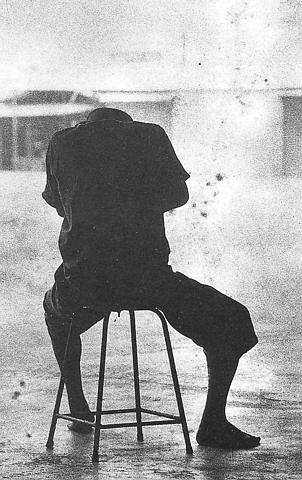
Photo by Hou Tsung-hui
Birth of the Chain
The story of Lungfatang begins with Hieh Kai Feng, who in fact built the temple into what it is today almost by accident. When he first became a monk, Hieh Kai Feng already had a wife and children. He set up a thatched hut in front of his house and began his religious practice. One day a woman came to him, bringing her son, and asked him to adopt the son as a disciple. As Hieh Kai Feng relates, "At the time I didn't know I was taking in a mental patient. As the mother was about to leave, she told me `Master, be careful, my son likes to play with fire.' I thought to myself, `I have just built my thatched hut and I can't have him burning it down.' So I got a cord and tied the two of us together." From then on, wherever Hieh Kai Feng went, his first "disciple" went along with him.
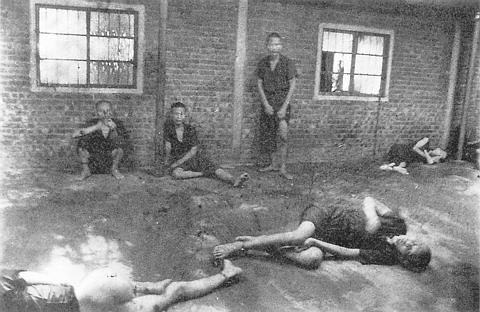
PHOTO: HOU TSUNG-HUI
As the days went on, this apparently dim-witted "disciple" learned to grow vegetables, and people hailed it as a miracle. As word spread, families with similarly afflicted relatives started to bring them to Hieh Kai Feng. The "disciples" shaved their heads, and went with him to grow vegetables, raise pigs and make some handicrafts, creating a self-sufficient life style.
Since that day in June 1970, the cord has evolved into Lungfatang's "chain of compassion." Despite all the criticisms from doctors, families, and the health authorities for violating human rights, Lungfatang still bears this chain as a mark of pride.
Hieh Kai Feng explains that he links together those with violent temperaments with those who have milder personalities and those who don't speak much with more outspoken ones.
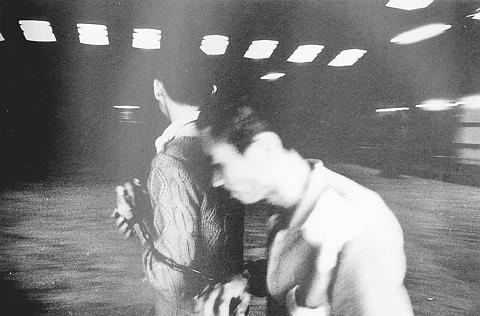
PHOTO: HOU TSUNG-HUI
The temple cares for more than 600 patients, most of whom are linked in such pairs and allegedly suffer from schizophrenia. "Through the use of the chain that I have invented," says Hieh Kai Feng, "although they cannot be said to be completely cured, their conditions have stabilized."
The use of this so-called "linked therapy" is proudly described in Lungfatang's promotional video: "Without pills, without shots, Lungfatang has created a miracle in Taiwanese psychiatry."
Medical criticism
But this so-called "miracle" is hardly embraced by the Taiwanese psychiatric community; in fact, the temples methods are harshly denounced by many leaders in the field, including some who have studied them in detail.
Dr Billy Pan, a psychiatrist at Taipei's Wangfang Hospital, says Lungfatang signifies the deep ignorance of mental illness exhibited by many Taiwanese. "The existence of Lungfatang is a disgrace for Taiwanese psychiatry as it demonstrates that the understanding of the mentally ill among Taiwanese society is still stuck in the Middle Ages," he says.
"Not all those with mental symptoms are schizophrenic. One in ten suffers instead from epilepsy, a brain tumor, an electrolyte imbalance, thyroid, liver or kidney defects or misuse of medications. All of these conditions can cause hallucinations, violent behavior, and other mental symptoms. But, given diagnostic treatment, none of these need be mistakenly identified as mental illness or insanity. Although treatment may be slow, it does bring improvement over time, but at Lungfatang there will be no improvement."
Pan contends that, not only is the temple practicing a form of crass exploitation but it is also full of hubris, setting up these patients as "incurable" and then proclaiming any improvement in their condition as a proud "achievement." He further states that many new medicines available have been proven effective for serious cases with few side effects. For Lungfatang to take the absence of medicine as a mark of pride, while restricting even telephone use by the patients, is not only incredible but also violates the human rights of the patients, he says.
In 1983, the renowned Taiwanese psychiatrist Dr Wen Jung-kwang, the director of psychiatry at Kaohsiung Chang Gung Memorial Hospital, conducted the earliest scientific research on Lungfatang.
After a yearlong study, in a report that roundly criticized the temple's methods, Wen concluded that chaining two patients together had only one small benefit: restricting their ability to run away.
Moreover, Wen concluded that many of the patients at Lungfatang did not suffer from extremely serious conditions, but had been sent there because their families could no longer take care of them. He estimated that roughly half of those living in the temple could return to their families and to society if Lungfatang made use of modern medical techniques with the assistance of effective, continued medication and counseling.
Dr Pan says Lungfatang's continued existence is connected to the uneven distribution of clinical resources, which is compounded by the government's fear of challenging the temple (see sidebar on page 17). In short, he says, "it's a political problem."
Life on the Farm
Every day the patients wake at 4am to feed the million or so chickens at the temple's farm. Others collect eggs. Some handle the odious task of sweeping up ankle-deep guano. It's the chicken farm -- by far the largest in Taiwan -- that helps provide income to cover the patients' needs. That and donations that are allegedly required before families can leave their relatives at the temple.
For the past 30 years, Lungfatang has repeatedly come under fire for its financial practices and the "fees" it charges. Some reports have claimed the latter run from NT$200,000 to more than NT$2.4 million for each patient, but Hieh Kai Feng is unwilling to discuss how much money he has actually received.
Instead, he points out that everybody cites cases when families give money, but they never mention that many families give nothing, and that he has never gone out asking for alms. "For 30 years, who cared for all these people? Without everybody's support, how long could Lungfatang remain open? Everyone criticizes Lungfatang as avaricious, but is there anyone who cares whether our patients have enough to eat?"
The founder adds: "When families give money, it covers all the support for that person for the rest of their life, from their meals to their funerals. Why must people talk so? In other families, does not the food for the children cost money? ... What wrong has been done? If I were to sell my family's property, where would all these people go? Anyway, only those families that feel Lungfatang is worthy of the donation are willing to part with their money."
Even more, as Hieh Kai Feng points out, the families who bring their relatives to Lungfatang all know that everyone has to start off linked to another by a metal chain, but they all still want to donate money.
However, the chicken farm is certainly the true source of the bulk of Lungfatang's income. Hieh Kai Feng scoffs at claims that he is exploiting his patients for profit, saying that instead he has taken a group of unproductive people and turned them into the workforce of the biggest chicken farm in Taiwan. "Without seeing it for oneself, one would never believe it," he says.
According to Hieh Kai Feng, "These people have all undergone treatment at all kinds of hospitals and are all serious cases that cannot be cured by taking drugs. When their families have no where to turn, they bring them here."
This is exactly the point that many families seize upon. Chen Yue-hsiang, the secretary-general of the Friends of Recovery Alliance, an organization of the relatives of mental patients, flatly states, "Lungfatang doesn't attract the patients, it appeals to the families."
A family can take the sick member to Lungfatang and he or she will never return home, won't call on the telephone or be a nuisance. Nobody has to know that your family has been afflicted with a mental illness. "This is heartless," Chen says, "but these families have already lost their sense of shame."
On Monday, Taipei Times reporter William Ide tells the story of three former patients who recently escaped from Lungfatang, delving further into the controversy that surrounds the institution.
(See Also:Lungfatang inside)

Taiwan’s English education system is being pulled apart by three opposing forces. Bilingual Nation 2030 pulls students toward English and global communication. Artificial Intelligence (AI) readiness pulls them toward digital judgment, verification and AI-mediated work. But Taiwan’s old exam culture pulls them back toward memorization, grammar drills, timed reading and correct answers. If the education system keeps using old exams to define success, it risks producing graduates who are neither genuinely bilingual nor genuinely AI-ready, but trained for tasks machines can already perform. The first force is Bilingual Nation 2030. Launched in 2018, the policy aimed to “help Taiwan’s workforce connect

“Taiwan’s Opposition Leader Comes to US With a Message Straight Out of Beijing” read a May 31 headline in the Wall Street Journal. Top US administration officials and members of Congress almost certainly read the WSJ, and if there was a bullet point takeaway that people in Washington should absorb ahead of Chinese Nationalist Party (KMT) Chair Cheng Li-wun’s (鄭麗文) arrival in DC on June 9, that headline is it. The last few columns have discussed this very topic, and the timing is not coincidental. While those top officials likely do not read the Taipei Times, judging by the number

With weighty, anxiety-inducing geopolitical topics dominating the headlines, checking in on the wild and weird state of local politics can take some of the edge off. This November’s elections will determine who will be in charge of fixing potholes in your neighborhood, not the potholes in Taiwan’s complicated geopolitical space. Recently, after an online interview with a Taipei-based journalist, I commented that Taipei journalists never go further than the MRT can take them. He laughed and agreed. Naturally, the Taipei mayoral race is eating up much of the press attention. TAIPEI CITY Democratic Progressive Party (DPP) candidate Puma Shen (沈伯洋) has
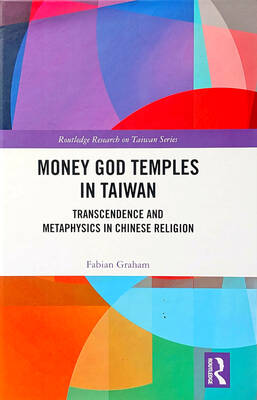
As someone who normally steers clear of books with “transcendence” or “metaphysics” in their subtitles, this reviewer — a casual observer of local belief systems since the 1990s — found Fabian Graham’s Money God Temples in Taiwan a challenging read. Those who’ve only dipped their toes into temple culture will likely need to parse several sections with special care if they’re to keep up with the author, a British ethnographic researcher whose previous books have investigated religious practices among ethnic Chinese in Southeast Asia. This scholarly volume examines a facet of Taiwan’s religious landscape that didn’t exist a century ago, and


 RSS
RSS