


When the Italian Jesuit missionary Matteo Ricci set off for China in 1583 it was a risky undertaking.
More than 350 years later, a group of Jesuit fathers, following the spirit of Matteo Ricci, embarked on another adventure, this time exploring the diversity of the Chinese language and culture. It is an adventure that, against all odds, has culminated in the publication of what is being hailed as the largest Chinese-Western language dictionary ever. Released in Paris in December 1999, the dictionary will be released locally this week.
The Dictionnaire Ricci des caracteres Chinois (

Courtesy of the Ricci Institute
While the majority of modern dictionaries are made for the business of simple communication, the 1999 Ricci dictionary goes beyond the merely functional, says Benoit Vermander, director of the Ricci Institute for Chinese Studies in Taipei.
"Our dictionary says in some sense that it is extremely important to go within the language at its deepest level," said Vermander, who joined the dictionary project four years ago.
Father Jean Lefeuvre, who is a specialist in early Chinese, as engraved on oracle bones and bronze vessels, agrees. "To understand a language thoroughly, one has to trace back to the sources of the language," he says in his study room at a Catholic center in downtown Taipei.

Photo: george tsorng, Taipei times
Seated amongst piles of manuscripts for the dictionary, marked in red and black, the 77-year-old French father continues in fluent Mandarin: "The oracular inscriptions and the inscriptions engraved on bronze vessels can help you understand the Chinese language."
Paris launch
"It was even better than expected," says Amnon Yaish, a staffer at the Ricci Institute in Paris in charge of the layout and the computerizing of the work. "We thought that only some specialists and academic people would buy it, but actually we found that many people who were neither Sinologists nor scholars just bought it as a Christmas present."

Photo: george tsorng, Taipei times
Dubbed by a French magazine as "the work of the century," the 1999 Ricci dictionary is a prelude to the realization of a greater Ricci ambition -- the so-called Le Grand Ricci, an encyclopedic dictionary, expected to be available in 2001.
Covering about 200 branches of knowledge, the Grand Ricci will include more than 14,000 single characters and 300,000 Chinese compounds. It will run to around 10,000 pages, and will weigh around 15kgs.
Talking of the Grand Ricci, Vermander points out:"It's an encyclopedic dictionary ... a dictionary that helps someone enter ... Chinese culture"

Photo: george tsorng, Taipei times
He illustrates his point with an example: "Kongxin" (
By putting Chinese words into different cultural contexts, the dictionary itself, according to Vermander, is an illustration of the"diversity of Chinese culture."
"Its interesting because it goes against the myth of one, unified Chinese culture," he says.

The Taiwan connection
The Ricci dictionaries published or to be published at the turn of the new century are joint Taiwanese-French products, the accumulation of more than fifty years of endeavors by Jesuit fathers as well as Taiwanese collaborators and assistants.
"It's an interesting story because it's a story of fifty years of cooperation between Taiwan and France," said Vermander.

Father Lefeuvre is more direct.
"Oracular bones and inscriptions on bronze vessels are mainland Chinese things, but we [Jesuit fathers] cooperated with scholars in Taiwan who had helped us a lot. It should be reckoned as [the result of] our endeavors in Taiwan," he says.
The Ricci Dictionary project was the brainchild of Father Eugune Zsamar, a Hungarian father, who had an idea for an encyclopedic polyglot dictionary in the 1940s. He planned to translate Chinese into five other languages: Latin, Hungarian, Spanish, French and English.
After the Chinese civil war, the Jesuits in China fled to Macau and then moved to Taiwan, bringing with them around 200 dictionaries or related works saved from the turbulence in the mainland. In 1953, the team set up a base in Taichung. The preliminary work involved making an inventory of about 18,000 characters and compounds, culminating in a total of 2 million index cards, now stored at the Ricci Institute in Taipei.
In 1964, the team had already produced a manuscript that ran to some 40 volumes, which contained the full text of the Chinese-French dictionary.
But the way ahead was a bumpy road. As Father Yves Raguin recalled in an article in the 1999-2000 issue of the Ricci Bulletin, nobody but the Society of Jesus gave financial support to the project prior to the 1980s.
"Nobody wanted to invest money in a project that could end, almost certainly, in failure," he wrote.
But financial difficilties were not the only challenge facing the project. The sheer size of the undertaking, and deaths and departures of Jesuit fathers from the project, made progress less than ideal, say insiders.
"After a few years [of their arrival in Taiwan], many of them went in different directions, such as teaching in universities. Most of the fathers who stayed were French," says Vemander, who himself hails from France.
Zsamar's ambition to produce a multi-lingual dictionary was in this way foiled, and the project became principally focused on French.
Money troubles
It was the Ricci Institute in Taipei that produced the first version of this French dictionary in 1976, (a Spanish dictionary was published at the same time) having inherited the project from Taichung 10 years earlier. The first Chinese-French Ricci dictionary contained 6,031 Chinese single characters.
More than 30 Jesuit fathers and their Taiwanese collaborators and assistants had labored to produce it. And its publication came as "a surprise" to many outsiders, Raguin recalled, because the dictionary, seen by many as a failure-to-be, was not only completed but was done without any financial support from outside the Society of Jesus.
The brand name of the Ricci Chinese-French dictionary soon won recognition in French circles worldwide and became an indispensable tool for Chinese-language majors in Europe.
When asked if she has heard of the dictionary, Stephanie Bourreau, a French resident in Taipei, describes it as the Chinese-French dictionary. Jacques Picoux, a veteran French lecturer at the National Taiwan University, says he worked with the 1976 Ricci dictionary until several days ago when he got hold of a copy of the new Ricci, which he describes as "extremely good."
Despite the popularity of the small Ricci, fundraising for a time became a major issue. Luckily, Taiwanese government agencies such as the Council for Cultural Affairs and the Ministry of Education lent a hand to the project financially, as did the French government, along with some academic institutions.
Meanwhile, the Ricci Institute in Paris, assisted by Sinologists such as Elisabeth Rochat de La Vallee, set up a non-profit association in 1987 to revive the Dictionary project. At the same time, the Ricci Institute in Taipei began to update the 40 volumes of manuscript produced in 1964. As a result, about 70,000 compounds were added to the original vocabulary pool.
Digital difficulties
Computerizing the project was another major challenge. Keying in the 40 volumes of manuscript into the DOS operating system alone took four secretaries working full time four years to complete, Amnon Yaish says. And then there were technical difficulties in transferring the data from a DOS environment to the Macintosh computers the book was to be laid out in, a problem that was eventually solved by programmers at the computer science department of the University of Laussane in Switzerland.
Worse still, computer experts in Paris had to solve another puzzle -- how to input ancient Chinese characters not included in standard computer character sets.
In addition, the fact that the vocabulary pool for the project is divided into 200 branches of knowledge is another complicating factor, say insiders.
"This means we have to ask around 100 Sinologists and specialists [scattered in France, Taiwan and China] to check the specialized lexicons. And this takes many years," says Vermander, adding that a majority of the scholars invited for the task worked on a voluntary basis.
But now, as the final chapter of the Ricci Dictionary project nears completion, insiders see the adventure as an unprecedented exploration of the cultural labyrinth of China, and one which they hope will enhance outsiders' understanding of the ancient civilization.
Will it be a commercial success?
Yaish has his own view. "For such an unprecedented work, the amount of copies sold is not the main thing. Because it's the kind of work that gets published once every fifty or one hundred years.
"Fifty years from now, people will still be using it," he predicts.

Taiwan’s English education system is being pulled apart by three opposing forces. Bilingual Nation 2030 pulls students toward English and global communication. Artificial Intelligence (AI) readiness pulls them toward digital judgment, verification and AI-mediated work. But Taiwan’s old exam culture pulls them back toward memorization, grammar drills, timed reading and correct answers. If the education system keeps using old exams to define success, it risks producing graduates who are neither genuinely bilingual nor genuinely AI-ready, but trained for tasks machines can already perform. The first force is Bilingual Nation 2030. Launched in 2018, the policy aimed to “help Taiwan’s workforce connect
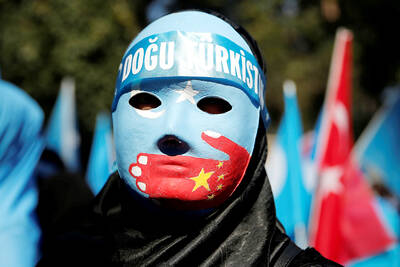
It seems every few days one bumps into one of those “real man” comments in which Taiwan is urged to “face reality” or similar, and “make a deal,” with the speaker implying that soon it will be too late. “Deal” advocates always present themselves as having a superior grip on reality, and the manly ability to make the “hard choice.” Their testosterone-laden language often echoes that of Taiwan sellout advocates. Note that such commentary always specifies a process (“make a deal, work with, make progress”), never the end state of what occupation by a violent authoritarian colonialist state will entail. In

“Taiwan’s Opposition Leader Comes to US With a Message Straight Out of Beijing” read a May 31 headline in the Wall Street Journal. Top US administration officials and members of Congress almost certainly read the WSJ, and if there was a bullet point takeaway that people in Washington should absorb ahead of Chinese Nationalist Party (KMT) Chair Cheng Li-wun’s (鄭麗文) arrival in DC on June 9, that headline is it. The last few columns have discussed this very topic, and the timing is not coincidental. While those top officials likely do not read the Taipei Times, judging by the number
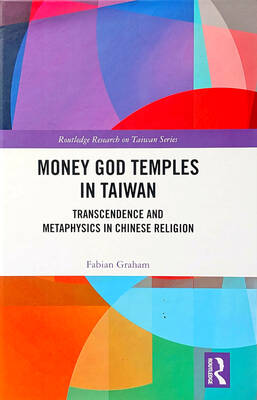
As someone who normally steers clear of books with “transcendence” or “metaphysics” in their subtitles, this reviewer — a casual observer of local belief systems since the 1990s — found Fabian Graham’s Money God Temples in Taiwan a challenging read. Those who’ve only dipped their toes into temple culture will likely need to parse several sections with special care if they’re to keep up with the author, a British ethnographic researcher whose previous books have investigated religious practices among ethnic Chinese in Southeast Asia. This scholarly volume examines a facet of Taiwan’s religious landscape that didn’t exist a century ago, and


 RSS
RSS