


Among the many fascinating items on display in the 3rd-floor permanent exhibition of Safe C.F. Lin's Sheng Ye Museum of Formosan Aborigines is a shell-bead jacket decorated with more than 80,000 hand-polished beads. Although in later periods such a garment functioned as a form of currency, in ancient times, only a warrior who had hunted at least five enemy heads could have worn it.
Nowadays, of course, headhunting is a thing of the distant past; it's also the kind of stereotype that Taiwan's aborigines wish to avoid being pegged with.
When he founded his museum in 1994, Lin was also keenly aware of the risks of presenting majority perspectives on minority cultures. And, while maintaining a "glass-case" permanent exhibit, he was cautious about maintaining a museum that -- like too many others -- froze its subject matter.
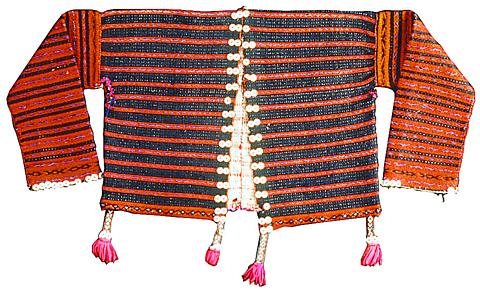
PHOTO: COURTESY SHENG YE MUSEUM
For this reason he left half of one floor empty for use by individual Aboriginal groups. It was space that might have been used for parking, but Lin preferred to create a performance plaza were world-renowned Bunan eight-part harmonies, dances by members of the Ami tribe and other aspects of living aboriginal cultures might be shared with the rest of Taiwan.
What's more, the exhibitions, activities and performances that took place in the space would be planned, designed and executed by the same aborigines who were presenting their cultures to museum visitors.
From today until Jan. 20 , it is the turn of the Megesya community of the Atayal people. The Atayal are Taiwan's second largest group of indigenous peoples with some 91,000 members in tribes scattered across much of central and northern Taiwan. The Atayal are most famous for their facial tattoos, headhunting and weaving skills.
It is hardly surprising that they have concentrated on displaying their spinning, dyeing and weaving techniques for this exhibition. (The Taiwan Museum is showing an exhibition of Atayal facial tattoos until Jan. 16.) Although the exhibition was planned long ago, it is given extra poignancy by the fact that the Megesya community in Ta'anhsi on the Miaoli-Taichung border was badly damaged by the 921 earthquake. In their own language, the village is called Liung-penox after the tribe's legendary ancestor.
"Liung-penox and his sister survived a great flood which devastated the Megesya people in ancient times," explains Yuma Taru, one of the weavers leading this event. "Ours is not a written history," she continues, "but it is not entirely oral either. The patterns we weave and embroider onto our textiles record our history and culture."
Two of the most commonly recurring motifs in Atayal cloth are rhombi and rainbows. A rhombus represents the eye of a beneficial spirit keeping watch over its wearer, while the rainbow has a connection with the after life.
"Rainbows," explains Yuma Taru, "are the bridges by which dead people pass to the after life. Only if a man had been a brave and successful headhunter or a woman had been a skilled weaver could they complete this journey to paradise."
For Yuma Taru, "the similarity between this mythology and Christian ideas makes it easy for Atayal to convert." Almost everyone in the community is Catholic, she says.
"The tribe is currently facing the heartrending decision of whether to relocate our whole village. Recent events have also been a severe test for traditional practices already under threat." Against such a background, the event is aptly subtitled 'Rebuilding spirits, homes and culture.' The two months' residence at the Sheng Ye Museum in northern Taipei will be a celebration not a wake, however.
It kicked off with a weekend of interactive events. Screenings of 'The Story of the Rainbow' and 'Seasonal Rituals of the Megesya Atayal,' documentary films recording traditional Atayal textile manufacture, from sowing and cultivating of hemp, to harvesting, preparation, spinning, dyeing and weaving, took place on Friday and Saturday, and were followed by panel discussions.
Meanwhile, over the next couple of months, activities will include introductions to the tools used for facial tattoos, construction of bamboo harmonicas, and baking of millet cakes. Workshops will also be offered on a first-come first-served basis.
Traditional Atayal dances and songs will be performed and, of course, there will be demonstrations of traditional weaving by Ms. Taru and her colleagues.
Traditional weaving is executed on horizontal back-strap looms similar to those found widely amongst the Austronesian Peoples who inhabit almost half the earth's surface from the Easter Islands and Hawaii in the Eastern Pacific to Madagascar off the African coast.
Visitors wishing to purchase souvenirs can do so today, when a fundraising bazaar is being held from 9am to 5pm. In addition to hand-made artifacts such as cloth, clothing, mouth harps and decorative accessories, there will also be stalls selling agricultural produce and traditional food such as millet cakes.
The textile exhibition, which forms the main focus of this event, introduces Megesya life, people, objects and geography. Thorough research into weaving art and techniques attempts to trace hidden aspects of Atayal culture and gain a greater understanding of the group's history.
It also gives tribal members an opportunity to decide which aspects of their traditional ways of life, if any, they wish to retain or recreate. They see the present era as a crucial one, and see themselves as part of the New Taiwanese people on the threshold of a new age.
The exhibition divides itself into three parts: past, present and future. It is a measure of the museum's success that the present seems but a promise of the future.
If one asks Taiwanese why house prices are so high or why the nation is so built up or why certain policies cannot be carried out, one common answer is that “Taiwan is too small.” This is actually true, though not in the way people think. The National Property Administration (NPA), responsible for tracking and managing the government’s real estate assets, maintains statistics on how much land the government owns. As of the end of last year, land for official use constituted 293,655 hectares, for public use 1,732,513 hectares, for non-public use 216,972 hectares and for state enterprises 34 hectares, yielding

The small platform at Duoliang Train Station in Taitung County’s Taimali Township (太麻里) served villagers from 1992 to 2006, but was eventually shut down due to lack of use. Just 10 years later, the abandoned train station had become widely known as the most beautiful station in Taiwan, and visitors were so frequent that the village had to start restricting traffic. Nowadays, Duoliang Village (多良) is known as a bit of a tourist trap, with a mandatory, albeit modest, admission fee of NT$10 giving access to a crowded lane of vendors with a mediocre view of the ocean and the trains

The March/April volume of Foreign Affairs, long a purveyor of pro-China pablum, offered up another irksome Beijing-speak on the issues and solutions for the problems vexing the People’s Republic of China (PRC) and the US: “America and China at the Edge of Ruin: A Last Chance to Step Back From the Brink” rang the provocative title, by David M. Lampton and Wang Jisi (王緝思). If one ever wants to describe what went wrong with US-PRC relations, the career of Wang Jisi is a good place to start. Wang has extensive experience in the US and the West. He was a visiting

One of the challenges with the sheer availability of food in today’s world is that lots of us end up spending many of our waking hours eating. Whether it’s full meals, snacks or desserts, scientists have found that it’s not uncommon for us to be mindlessly grazing at some point during all of our 16 or so waking hours. The problem? As soon as this food hits the bloodstream in the form of glucose, it initiates the release of the hormone insulin. This in turn activates a switch present in every one of our cells, which is responsible for driving cell


 RSS
RSS