


"Where's the 'Red-Haired Fort,'" I asked at the ticket office of the Tamshui MRT station, having vainly hunted for a map that hinted at its existence. I would have asked sooner, but as a foreigner who speaks Chinese, I'd delayed asking the question, mostly because I found the name vaguely embarrassing. The "red haired" (hongmao) is a contraction of hongmao fan -- "foreign barbarians" -- that was in common parlance long before we became laowai -- "respected outsiders."
Still, the ticket clerk, who was obviously not as sensitive to the issue as I was, didn't bat an eyelid.
"It's a little bit far," he said. "You'd be better off taking a bus."
PHOTO: CHRIS TAYLOR, TAIPEI TIMES
"Which bus?"
"Oh, any of the south-going buses. They leave from the other side of the road. Any of them will do. Or nearly any of them." He hesitated and
frowned. "Most of them. Get off after two stops." He gave me a "have a nice day" smile.
PHOTO: CHRIS TAYLOR, TAIPEI TIMES
The "nearly any of them" worried me. I took a taxi.
When we pulled to a standstill, NT$100 and five minutes later, the only clue that we'd arrived was an arched doorway set in a wall and a chattering
cluster of Japanese tourists. If nobody pointed it out to you, you might easily walk past without knowing it was the entrance to one of Taiwan's
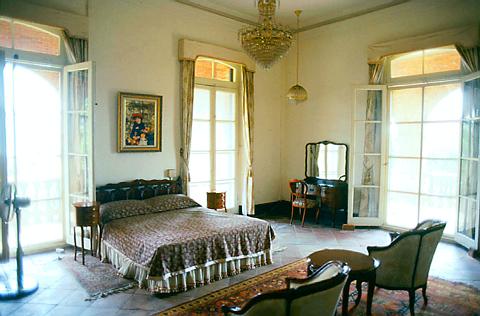
PHOTO: CHRIS TAYLOR, TAIPEI TIMES
oldest buildings, a structure that encapsulates much of Taiwan's history.
And therein lies the challenge of sightseeing in Tamshui. Along with a handful of other destinations in Taiwan, like Keelung and Tainan, it has some
fascinating reminders of the early contact between the West and Taiwan preserved in its architecture. The trouble is finding them.
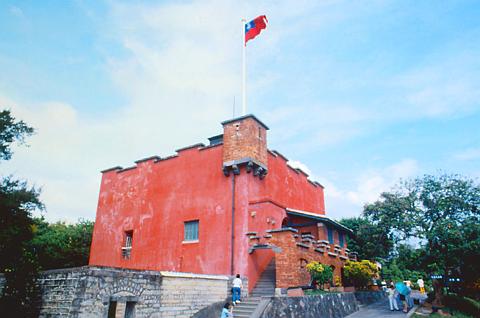
PHOTO: CHRIS TAYLOR, TAIPEI TIMES
But, for the most part, as in the case of the Hongmao Cheng, it's worth the trouble. First built by the Spanish, rebuilt by the Dutch, taken over by
Chinese Ming and Qing dynasty administrations, it became the British consulate in the late 19th and early 20th century.
It's small, but nevertheless a fascinating place to explore. You stroll through leafy grounds until suddenly you see the squat, box-like structure of
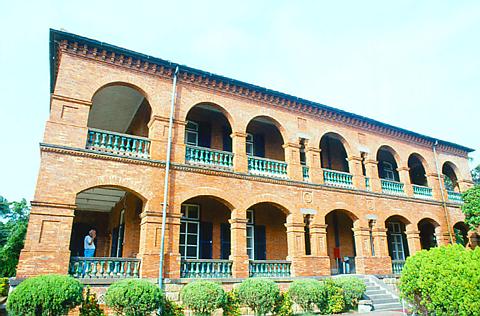
PHOTO: CHRIS TAYLOR, TAIPEI TIMES
Fort San Domingo. How much it resembles its original namesake, built by the Spanish in 1629 before falling, as my souvenir pamphlet put it, to "the
superior Dutch," is difficult to say because the Dutch rebuilt it.
It's also difficult not to wonder whether it started out its days red, or whether this isn't a case of later Taiwanese renovations taking a lead from the
fort's popular name. Still, it's not without it's charm.
Mind you, despite the fact that most travel writers are forced to use words like "redoubtable," it's difficult to take its "fort" pretentions all that
seriously. True, it's built on a hill. It has castle-like humps on its flat roof and narrow windows that the tourist is assured were designed for shooting
out of. But inside it looks more like the residence of a well-off family in Hong Kong's mid-levels. If this was the best the "superior Dutch" could do,
I found myself thinking, no wonder the famous Ming dynasty explorer Cheng Cheng-kung and his forces expelled them in 1668, just 27 years after
they had wrested it from the Spanish.
I wandered around the interior of the structure gazing at old maps of Tamshui, replicas of trade treaties and old photographs of the fort and its
nearby British consulate. All the while I was trailed by a couple of teenage Taiwanese boys with greased-back hair who took seriously posed
photographs of each other in every corner of the building.
A group of Japanese filed past with gravely whispered "soo desu-ne"s. "Gia!" cried the Taiwanese tourists every time somebody stopped for
more than a few seconds. A Hong Kong group whooped "Ai-ya!"s.
After a while I began to get the feeling that perhaps I was taking it all too seriously, so I strode on to the British consular building, which was built as
an annex in 1867, when the British took out a lease on the fort from the Qing dynasty government.
It's a splendid two-story structure, collonaded, cooled by sea breezes that flow from one flung-open bay window to the next, the empty
fire-places hinting at an insulated ex-patriate coziness through the brief winter months. As you gaze on the dining room, and the well preserved
bedrooms, it's easy to imagine the lives of the consular staff who were posted here in days when there were no quick flights to more exotic
destinations, and a journey home took weeks.
The town they were surrounded by, a busy Taiwanese trading port in which the locals regarded the residents on the hill as "red-haired barbarians"
can be seen pictured in black and white photographs labeled only in Chinese in various rooms around the building.
Some of those buildings, according to my Chinese guidebook, still exist. Later that afternoon I set off in search of them. I took what looked to be
promising alleys off the busy Chungshan and Chungcheng roads and found myself outside schools and noodle shops. I wandered along the
waterfront of the Tamshui river. I doubled back to Chungshan and there I spied a leafy stone staircase that looked like it had been left to nature. At
the end of a steep climb, I found myself, hot and sweaty, in a deserted square with a wall at the end of it covered with moss and creepers. Perhaps,
at last, I had stumbled on one of the buildings I was looking for.
Then again, perhaps I hadn't. It was, I concluded, a Tamshui. thing.

For many people, Bilingual Nation 2030 begins and ends in the classroom. Since the policy was launched in 2018, the debate has centered on students, teachers and the pressure placed on schools. Yet the policy was never solely about English education. The government’s official plan also calls for bilingualization in Taiwan’s government services, laws and regulations, and living environment. The goal is to make Taiwan more inclusive and accessible to international enterprises and talent and better prepared for global economic and trade conditions. After eight years, that grand vision is due for a pulse check. RULES THAT CAN BE READ For Harper Chen (陳虹宇), an adviser
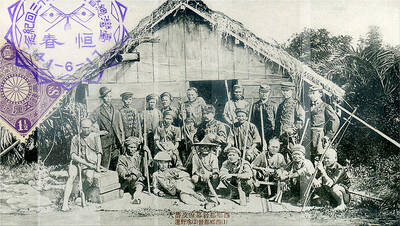
Traditionally, indigenous people in Taiwan’s mountains practice swidden cultivation, or “slash and burn” agriculture, a practice common in human history. According to a 2016 research article in the International Journal of Environmental Sustainability, among the Atayal people, this began with a search for suitable forested slopeland. The trees are burnt for fertilizer and the land cleared of stones. The stones and wood are then piled up to make fences, while both dead and standing trees are retained on the plot. The fences are used to grow climbing crops like squash and beans. The plot itself supports farming for three years.
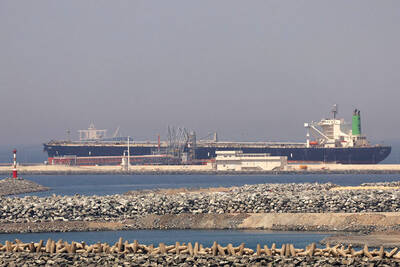
The breakwater stretches out to sea from the sprawling Kaohsiung port in southern Taiwan. Normally, it’s crowded with massive tankers ferrying liquefied natural gas from Qatar to be stored in the bulbous white tanks that dot the shoreline. These are not normal times, though, and not a single shipment from Qatar has docked at the Yongan terminal since early March after the Strait of Hormuz was shuttered. The suspension has provided a realistic preview of a potential Chinese blockade, a move that would throttle an economy anchored by the world’s most advanced and power-hungry semiconductor industry. It is a stark reminder of

May 4 to May 10 It was once said that if you hadn’t performed at the Sapphire Grand Cabaret (藍寶石大歌廳), you couldn’t truly be considered a star. Taking the stage at the legendary Kaohsiung club was more than just a concert. Performers were expected to entertain in every sense, wearing outlandish or revealing costumes and staying quick on their feet as sharp-tongued, over-the-top hosts asked questions and delivered jokes that would be seen as vulgar, even offensive, by today’s standards. Opening in May 1967 during a period of strict political and social control, Sapphire offered a rare outlet for audiences in


 RSS
RSS