

The promise and peril of soccer diplomacy during the soccer World Cup that starts on June 11 were already on display in December, during the draw that took place in Washington’s Trump Kennedy Center.
Three world leaders shared the stage, representing the tournament’s co-hosts in this first-ever trinational cup: US President Donald Trump, Mexican President Claudia Sheinbaum and Canadian Prime Minister Mark Carney. There was no love lost between Trump and the other two after he had hinted at military intervention in Mexico and the annexation of Canada, in keeping with his claim to dominate the whole Western Hemisphere, from Venezuela and Cuba to Greenland.
When FIFA, the international federation of soccer associations, awarded the 2026 cup to the three co-bidders during Trump’s first term, their cooperation was supposed to highlight the integration of the North American continent. An early and optimistic slogan was “United As One.”
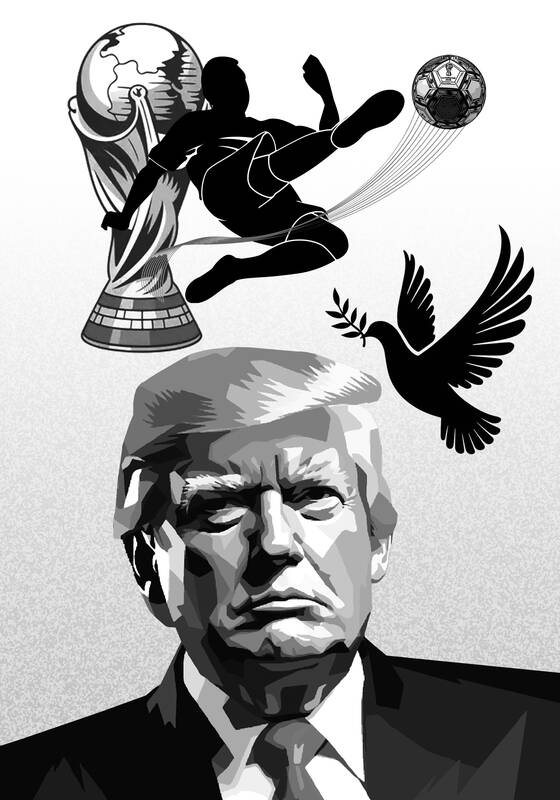
Illustration: Constance Chou
That does not sound right anymore in Trump’s neo-imperialist second term, when intermittent trade wars have replaced the old dreams of a free-trade area. (The official FIFA slogan is now “WE ARE 26.”) Continental politics have entered an ice age, and Carney has become something of a leader in the global resistance against Trumpism.
And yet soccer presents diplomatic opportunities that no other forum — neither the UN, NATO, the World Bank, the G20 nor anything else of that ilk — can provide. So it did during that draw. Sheinbaum and Carney performed gamely next to Trump, pulling country names for the group assignments as though they were on a game show. The trio then retreated to a private room for a trilateral chat.
In that way, soccer is ideal for providing what diplomats call “structured informality.” Table tennis, cricket and other sports have also bridged gaps of animosity, but soccer is unique because so much of humanity loves it. In the stands and on the pitch, fans and players are “divided by jerseys, united by their passion through sports,” said Travis Murphy, a veteran of the US State Department who now runs a company that promotes sports diplomacy. Up in the VIP suites, he added, soccer is “the most reliable convening instrument that we have on the international stage.”
However, leaders still have to recognize the instrument as such, and even then they need a flair for wielding it. The worry with Trump is that he misinterprets the World Cup — like the celebrations for the US’ 250th birthday and practically everything else — as being all about him. The same ceremony in December already provided a bad omen, as FIFA’s fawning president awarded Trump a newly invented (and gaudily gilded) “peace prize.”
The point of that gesture was to flatter Trump, of course, especially after he had just lost his bid for the real peace prize awarded in Oslo. However, the global soccer community was embarrassed by the hammy kowtow. It has aged especially badly since Trump has dropped his irenic guise and started waging war from the Caribbean to the Middle East.
Soccer diplomacy can also backfire, Heather Dichter told me. She is a professor at the UK’s De Montfort University and literally edited the book on soccer diplomacy. Just as sport can humanize adversaries and thaw cold wars, it can also inflame narcissistic and nationalist passions. When Trump hosts other world leaders in the stadiums, he could be greeted with boos, she said.
History has plenty of examples of good and bad outcomes, but more of the good. Soccer first proved its power to sublimate national conflicts during the famous “Christmas truce” of 1914, when German and British soldiers in World War I temporarily stopped shooting and played an amicable game between the trenches. Since then, many nations have used soccer to overcome old hatred.
In 2008, Turkey and Armenia had no diplomatic relations and were bitterly divided over the genocide committed in the Ottoman Empire. Then the Armenian president invited his Turkish counterpart to watch the qualifier between their countries for the upcoming World Cup. That led to the first exchange of official visits and the so-called Zurich Protocols that began the normalization of bilateral relations.
Similar thaws followed matches between the two Koreas and the two Germanys during and after the Cold War. The symbolism of co-hosting packs a particular punch: It has only happened once before, when Japan and South Korea teamed up for the 2002 cup, overcoming a painful history of strife and setting the stage for their evolving partnership.
Perhaps the most heartwarming example in the context of the ongoing war in the Middle East is a match during the 1998 World Cup in France between the US and Iran, which were enemies then as now. Players entered the stadium amid huge public anxiety. The two teams mingled for a joint photo, and the Iranians gave the Americans white roses. Everyone inside and outside the stadium, except perhaps the ayatollahs, felt a humanizing glow. The score was 2-1 to Iran, but the victor was soccer.
When things go wrong, though, they go very wrong. In 1969, the teams of Honduras and El Salvador met in Mexico City’s famed Azteca Stadium, the same one that is to host this year’s opening match between Mexico and South Africa. Relations were already tense between the two neighbors, as dispossessed farmers in El Salvador migrated to Honduras in search of scarce land. After El Salvador eked out a 3-2 win in overtime, passions flared so much that the countries went to war for four days.
For the 2026 cup, Trump has certainly shortened the odds of diplomatic disappointment. He continues to wage his phony war against Iran, which has led to an unusual arrangement in which the Iranian players will stay in Mexico during the tournament, and commute to their three matches in the US. He has also tightened visa regulations and other restrictions on fans from many of the countries that are competing.
He has created a climate of fear — with ICE raids, arbitrary arrests and mass detentions — that has prompted Amnesty International to issue the kind of human rights warning that usually concerns tin-pot dictators. All this, plus high ticket prices, might explain why most of the 11 US host cities are reporting far fewer bookings than expected for the World Cup.
The US has already lost soft power under Trump. Dichter told me she would not be surprised if Canada and Mexico now gain in global rizz while the US ends up looking ugly. (The US hosts 78 of the matches, Canada and Mexico 13 each.)
And yet, soccer has achieved far unlikelier feats of harmonization. Trump, Carney, Sheinbaum and many of the other leaders who would come to cheer on their teams could still use this World Cup to start conversations that could make the world more peaceful.
The condition is that they all recognize that sport is about fellowship rather than dominance, and about celebrating humanity rather than flattering a particular leader’s ego.
Andreas Kluth is a Bloomberg Opinion columnist covering US diplomacy, national security and geopolitics. Previously, he was editor-in-chief of Handelsblatt Global and a writer for The Economist. This column reflects the personal views of the author and does not necessarily reflect the opinion of the editorial board or Bloomberg LP and its owners.
The “quiet revolution” of Taiwan’s democratization took shape during the 12 years that followed Lee Teng-hui (李登輝) simultaneously becoming chairman of the Chinese Nationalist Party (KMT) and president of the Republic of China (ROC). Chen Shui-bian (陳水扁) of the Democratic Progressive Party (DPP) then took the presidential helm in 2000, bringing an end to one-party rule in the ROC, and was re-elected in 2004. He was followed by the KMT’s Ma Ying-jeou (馬英九), who served two four-year terms; the DPP’s Tsai Ing-wen (蔡英文), who also served two terms; and the DPP’s William Lai (賴清德), currently in his first term. Having
Chinese hackers are ramping up attacks after integrating DeepSeek and other open-source artificial intelligence (AI) models into their operations, demonstrating attackers’ ability to leverage basic AI tools to hit targets abroad. State-affiliated cyberwarfare groups more than doubled the amount of attacks they carried out since they began delegating mundane tasks to AI and using it to develop advanced malicious software, according to TeamT5, a Taiwanese research firm. Researchers said it was not always possible to identify the AI model they used, but in general DeepSeek’s offerings are popular among hackers in China because of its high performance and ability to be
In the rush to summer vacation, some readers might have missed the launch of the renamed Diet members group supporting Taiwan. Indeed, the decision by Japan’s largest pro-Taiwan parliamentary organization to rename itself received only modest media attention. Yet historians might eventually view it as one of the most revealing symbolic acts in the evolution of post-World War II Taiwan-Japan relations. For the longest time, the group, founded in 1973, was called the Nikka Giin Kondankai (Japan-ROC Diet Members’ Consultative Council). However, after more than five decades, the organization on June 11 adopted a new name — the Japan-Taiwan Diet Members’
A disturbing incident in Taichung this month has raised difficult questions about safety, inclusion and responsibility in schools. A junior high-school teacher was seriously injured after a student reportedly broke a broom and attacked her with the handle. The severity of her injuries generated concern among teachers and the wider public. However, incidents such as this require careful interpretation. They should not be used to suggest that students with disabilities, autism or other forms of neurodivergence are inherently dangerous. They are not. Nor should a single act of violence become an argument for retreating from inclusive education. The more important question is


 RSS
RSS