


The longer the Ma Ying-jeou Foundation crisis goes on, the more intense it becomes, with former aides, associates and relatives of former president Ma Ying-jeou (馬英九) all offering conflicting accounts and allegations.
To outsiders, the situation remains unclear. Some statements regarding Ma’s comments have prompted claims that the former president may be experiencing cognitive decline.
The matter has now moved into judicial proceedings, which some interpret as an effort to “clean up” his affairs.
For a leader once associated with integrity and clean governance, this is an uncomfortable moment.
The dispute was triggered by Ma questioning the financial discipline of former foundation personnel, including former Ma Ying-jeou Foundation CEO Hsiao Hsu-tsen (蕭旭岑), over allegations that donations were received but not properly recorded in official accounts.
For the Chinese Nationalist Party (KMT), the situation is particularly awkward, as a former president and party chairman is publicly clashing with Hsiao, an incumbent vice chairman who has played a key role in facilitating cross-strait exchanges for the current leadership.
The ruling party, meanwhile, has shown restraint. It has neither commented on the foundation’s internal affairs or Ma’s personal matters nor sought to exploit the controversy politically. That is a commendable approach.
However, former National Security Council secretary-general King Pu-tsung (金溥聰) recently released a photo showing Xiamen Taiwan Businessmen Association chairman Han Ying-huan (韓螢煥) and Hsiao exchanging what appeared to be a large sum of money.
King questioned why the cash had not been properly accounted for and accused Hsiao of violating financial discipline.
In response, Hsiao said that after President William Lai (賴清德) was elected in 2024, many Taiwanese businesses overseas feared scrutiny from authorities and chose to make personal donations to Ma rather than to the foundation.
It is an explanation typical of those who never miss an opportunity to blame Lai or the Democratic Progressive Party (DPP) for any issue, large or small.
However, the timeline raises obvious questions. Are we to believe that Hsiao predicted Lai’s victory in the 2024 presidential election when the photograph was taken in October 2023? Why would someone so worried about an investigation be so eager to pose for a photograph while holding a large wad of cash?
The final flaw is that the foundation is a registered legal entity under New Taipei City. Any allegations of financial misconduct would therefore fall under the jurisdiction of the city government led by the KMT’s own Hou You-yi (侯友宜), not an administration that was not even in office at the time.
The attempt to blame Lai for Hsiao’s predicament is little more than desperation. The DPP need not respond further; it can simply sit back and watch.
Chen Wen-ching works in environmental services.
Translated by Gilda Knox Streader
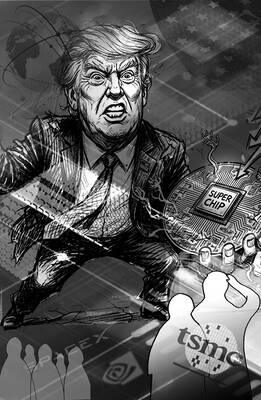
The White House’s decision to take a 9.9 percent stake in Intel Corp is looking like very shrewd business indeed. Since the government bought in at US$20.47 a share last August, the US chipmaker’s surging stock price has delivered the US a US$43 billion return. One of the reasons the investment has so far proved so sound is that the White House has made sure of it. According to The Wall Street Journal, Howard personally pushed deals on Intel’s behalf with some of the most lucrative clients imaginable. They include Nvidia Corp, the company at the heart of the AI
A single photograph can cut through a lot of noise, but it can also be used to misrepresent the truth. At the very least, it can concentrate the mind on something that requires further investigation. On Monday last week, Ma Ying-jeou Foundation CEO Tai Hsia-ling (戴遐齡) and former National Security Council secretary-general King Pu-tsung (金溥聰) held a news conference in which they showed a photograph of former foundation CEO Hsiao Hsu-tsen (蕭旭岑), now Chinese Nationalist Party (KMT) deputy chairman. In the image Hsiao is seated next to Xiamen Taiwan Businessmen Association chairman Han Ying-huan (韓螢煥). The two men were holding
I first met Professor Ray Jiing (井迎瑞) as a film and documentary student at Shih Hsin University’s (SHU) Department of Radio Television and Film in 1988. The following year, he went on to become the director of the Chinese Taipei Film Archive — forerunner of the Taiwan Film and Audiovisual Institute (TFAI). Over his eight-year tenure, Jiing rescued and restored over 200 classic Taiwanese films. In 1997, he established the Graduate Institute of Studies in Documentary and Film Archiving at Tainan National University of the Arts (TNNUA), and I joined the program in his third cohort of students. Beyond a
A recent report concerning a student who is suing his teacher posed the question in its headline: Does failing a student in two subjects constitute bullying? The college student in Chiayi County apparently sought NT$2 million (US$63,603) in state compensation, but a court dismissed the case. The first reaction of many might have been to ask: What has happened to students nowadays? Some say that teachers have lost their authority, while others say students are overindulged. Some even start reminiscing over the days when “whatever the teacher says goes.” However, the real issue might be overlooked if emotional reactions like that are the


 RSS
RSS