


The bringing forward of new mandates for nurse-to-patient ratios to be enacted in May next year should represent a turning point for the chronically overstretched profession.
However, not long after the legislation’s fast-tracking was announced, a number of leading medical centers began floating the idea of “same-day surgeries,” which would see some patients being sent home instead of being kept for an overnight stay in the hospital. This should be a reminder for us to keep interrogating why we continue to insist on treating the symptoms, not the cause, of the healthcare system’s most fundamental problems?
Undeniably, there is a place for same-day surgeries, especially given improvements in anesthesia safety, minimally invasive procedures and post-operative care. However, patients have traditionally been kept for observation to manage pain, monitor bleeding or infection risks and track vital signs. If these patients are instead sent home, there must be clear and transparent screening standards, ER return and hospital readmission data, side-effect monitoring mechanisms and post-discharge care. Otherwise, the initiative would simply shift pressure from hospital wards to ERs, clinics, families and patients themselves.
It is a prime example of what I have called “chessboard governance.” Government policy mandates safer nurse-to-patient ratios, and hospitals respond by introducing same-day surgeries, replacing in-ward observation with ER-administered antibiotics, clinic follow-ups and home-based care. On the surface, occupied beds fall and nurse-to-patient ratios improve. In reality, care needs remain.
Healthcare policy is no stranger to this governing logic. Government designated Urgent Care Centers for weekends and public holidays are another example. Policymakers assumed that setting up a few service points and staffing schedules could ease ER overcrowding, but failed to address the deeper structural issues of bed shortages, nursing staff losses and disconnect between the long-term care and social welfare systems. It was essentially adding another chess piece to the board, but without formulating a strategy for addressing the root causes of ER congestion.
What nurse-to-patient ratio legislation should really address is why nurses are leaving hospital wards, why they are unwilling to stay on night shifts, and why pay, risk and responsibility have remained out of proportion for so long.
If healthcare authorities only require hospitals to meet targets without investing sufficient resources to improve working conditions, increase staffing and reduce unnecessary administrative burdens, hospitals would naturally develop their own coping strategies. The likely outcome might be shorter hospital stays, faster discharges, more patients returning to emergency departments and greater caregiving anxiety shifted onto families.
.
Lu Chun-wei is a dermatologist and assistant professor at Chang Gung Memorial Hospital.
Translated by Gilda Knox Streader
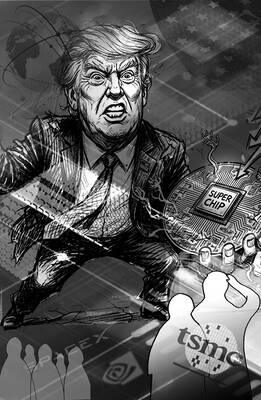
The White House’s decision to take a 9.9 percent stake in Intel Corp is looking like very shrewd business indeed. Since the government bought in at US$20.47 a share last August, the US chipmaker’s surging stock price has delivered the US a US$43 billion return. One of the reasons the investment has so far proved so sound is that the White House has made sure of it. According to The Wall Street Journal, Howard personally pushed deals on Intel’s behalf with some of the most lucrative clients imaginable. They include Nvidia Corp, the company at the heart of the AI
A single photograph can cut through a lot of noise, but it can also be used to misrepresent the truth. At the very least, it can concentrate the mind on something that requires further investigation. On Monday last week, Ma Ying-jeou Foundation CEO Tai Hsia-ling (戴遐齡) and former National Security Council secretary-general King Pu-tsung (金溥聰) held a news conference in which they showed a photograph of former foundation CEO Hsiao Hsu-tsen (蕭旭岑), now Chinese Nationalist Party (KMT) deputy chairman. In the image Hsiao is seated next to Xiamen Taiwan Businessmen Association chairman Han Ying-huan (韓螢煥). The two men were holding
I first met Professor Ray Jiing (井迎瑞) as a film and documentary student at Shih Hsin University’s (SHU) Department of Radio Television and Film in 1988. The following year, he went on to become the director of the Chinese Taipei Film Archive — forerunner of the Taiwan Film and Audiovisual Institute (TFAI). Over his eight-year tenure, Jiing rescued and restored over 200 classic Taiwanese films. In 1997, he established the Graduate Institute of Studies in Documentary and Film Archiving at Tainan National University of the Arts (TNNUA), and I joined the program in his third cohort of students. Beyond a
A recent report concerning a student who is suing his teacher posed the question in its headline: Does failing a student in two subjects constitute bullying? The college student in Chiayi County apparently sought NT$2 million (US$63,603) in state compensation, but a court dismissed the case. The first reaction of many might have been to ask: What has happened to students nowadays? Some say that teachers have lost their authority, while others say students are overindulged. Some even start reminiscing over the days when “whatever the teacher says goes.” However, the real issue might be overlooked if emotional reactions like that are the


 RSS
RSS