


Yang Haiming did not stop working when he retired from the coal mines at age 60. Instead, he jumped into a new industry.
Yang is part of a generation of workers that powered China’s growth by digging coal from underground mines in Datong, a city known as China’s coal capital in the northern province of Shanxi. As China prioritizes renewable energy over coal, Yang is ahead of the change his fellow workers are being forced to confront.
He now runs a restaurant that sells lamb skewers to tourists visiting the Yungang Grottoes, a historically significant sixth-century site featuring Buddhist carvings in caves that draws millions of visitors a year.
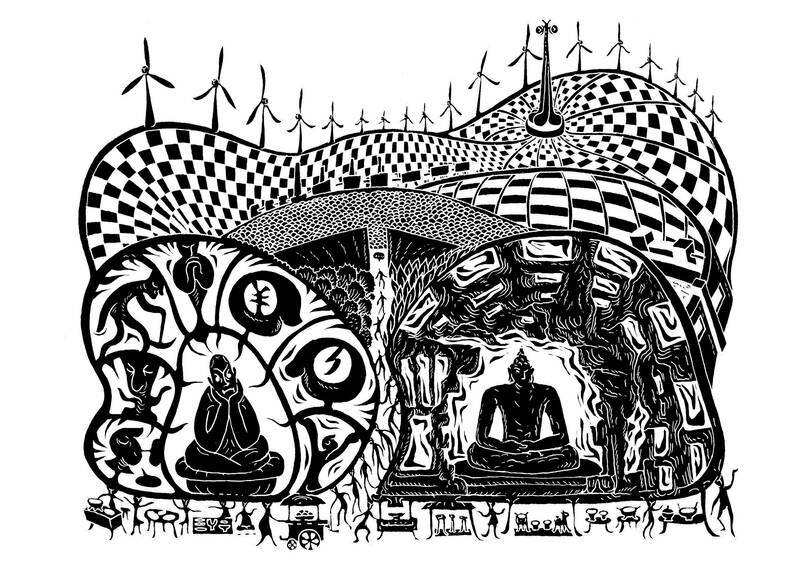
Illustration: Mountain People
Shanxi Province would be the world’s larger producer of coal if it were its own country. Its roughly 800,000 miners dug 1.3 billion tonnes last year, or nearly one-third of China’s coal. A few million more people work in jobs that rely indirectly on coal, ranging from logistics to restaurants. The province would see crucial change as China adds renewable energy so fast it covered almost all of the nation’s growth in power demand last year, and growing tourism is a major goal.
Experts said it is vital to make sure coal workers do not get left behind — a worry for many.
“It doesn’t feel like money’s coming into this industry,” coal miner Zhou Hongfei said.
As is typical for China’s state-owned enterprises, the coal company built Yang’s village right next to the mine — called No. 9 — that its residents would work. The place once hummed with thousands of workers and their families, with a school, a daycare and a sports center. An elevated rail line passes through to carry coal to the rest of the country.
These days, the No. 9 mine is mostly a museum, although a section is still being worked. The school is empty, its gates locked. Many of the low-rise apartment blocks are only partially filled, often not by miners, but by people attracted to cheap housing.
Yang recalls prosperous years before surrounding villages were dismantled.
“There were so many people, especially during the New Year,” he said. “It was crowded everywhere. Now the bustling scenes have gone, and so has the feeling.”
Those who stayed behind, such as Yang, have tried to capitalize on visitors to the Yungang Grottoes. When reporters visited, one retired coal miner walked the street striking up conversations in hopes of bringing customers to his noodle shop. Mostly older people walked in the street, soaking up the sun.
Yang is in the minority of workers who have managed to make a transition.
There are many “who don’t know what to do, who say they don’t have the right skill sets for anyone else. All they know is to be a coal miner, or the easiest fallback option is for them to go back to farming,” said People of Asia for Climate Solutions founder Tom Wang (王曉軍), a Shanxi native.
Zhou said he thought about switching to tourism, but did not know how. And he worries about supporting his wife and eight-year-old daughter.
“To really be able to make contact with and then switch into a new industry is very hard, and the truth is, I don’t dare,” he said. “If you leave this industry, you don’t know if it’ll work out. Can I adapt? And what if this ends up being a burden for my family?”
Mining wages rise and fall with demand. Before Yang retired eight years ago, he earned up to 10,000 yuan (US$1,465) in a good month. He said he earns more now from his restaurant.
The province is trying to develop several alternative industries, from investing in coal-to-hydrogen projects to promoting its native youmai — a type of oat used by locals to make a special type of noodles.
However, Shanxi’s major focus and biggest success for life after coal has been tourism.
Yungang Research Institute director and National People’s Congress representative Hang Kan (杭侃) last year called for accelerating development of the culture and tourism industry into “a strategic pillar” that “promotes people’s welfare” in Shanxi.
His remarks came after the blockbuster video game Black Myth: Wukong, in which the lead character visits the grottoes and many nearby sites, caused a spike in visitors.
The number jumped to 4.5 million in 2024, up from 3 million the year before, state media said.
Tour guide Yan Jiali said that boom has caused rising interest in jobs such as hers, which requires a government test to become licensed.
“Even my mom’s friends would come ask me about taking this test,” she said.
Wang said he is hoping that the high-tech industries that are now the nation’s priority would help Shanxi’s transition by providing jobs.
After all, the province’s coal powered China’s transformation into an economic powerhouse, he said.
“What if DeepSeek comes over to Shanxi and says, OK, we will start a data center here? What if Baidu comes over to Shanxi?” he said, referring to China’s homegrown tech companies.
Few think Shanxi could leave coal mines behind completely. Experts see coal as a critical safety net for China’s security needs, and the Iran war has once again highlighted just how vulnerable energy supply chains are to disruptions.
The government declined to cap how much coal could be used, walking back its commitment to gradually reduce coal consumption, Centre for Research on Energy and Clean Air (CREA) analysts said.
“The confidence hasn’t grown to the point where they can entirely depend on renewable energy,” CREA analyst Qi Qin said.
In fact, China has continued to build out coal power plants at a massive scale, bringing online 78 gigawatts last year — more than India did in a whole decade. One gigawatt could power about 320,000 Chinese households for a year.
Even if demand does not fall, workers also have to worry that their mines would play out. Some of the older mines in Datong are near the end of their lives. When that happens, workers could be reassigned to other mines that might be far away and pay less.
Another coal mine worker, Xu, has taken a second job as a ride-share driver, spending about five hours a day behind the wheel after his day job ends.
Xu — who declined to give his full name for fear of repercussions from the state-owned mine — said he doubted that the benefits of the industries replacing coal would be spread evenly, whether it is tourism or renewable energy.
“This tourism industry, how do I get in there?” he asked. “For Datong, those who can enjoy the benefits of this tourism boom, it’s mostly the big hotels and maybe some restaurants, noodle shops, but what do you think regular people can get?”


Weeks into the craze, nobody quite knows what to make of the OpenClaw mania sweeping China, marked by viral photos of retirees lining up for installation events and users gathering in red claw hats. The queues and cosplay inspired by the “raising a lobster” trend make for irresistible China clickbait. However, the West is fixating on the least important part of the story. As a consumer craze, OpenClaw — the AI agent designed to do tasks on a user’s behalf — would likely burn out. Without some developer background, it is too glitchy and technically awkward for true mainstream adoption,
On Monday, a group of bipartisan US senators arrived in Taiwan to support the nation’s special defense bill to counter Chinese threats. At the same time, Beijing announced that Chinese President Xi Jinping (習近平) had invited Chinese Nationalist Party (KMT) Chairwoman Cheng Li-wun (鄭麗文) to visit China, a move to make the KMT a pawn in its proxy warfare against Taiwan and the US. Since her inauguration as KMT chair last year, Cheng, widely seen as a pro-China figure, has made no secret of her desire to interact with the Chinese Communist Party (CCP) and meet with Xi, naming it a
A delegation of Chinese Nationalist Party (KMT) officials led by Chairwoman Cheng Li-wun (鄭麗文) is to travel to China tomorrow for a six-day visit to Jiangsu, Shanghai and Beijing, which might end with a meeting between Cheng and Chinese President Xi Jinping (習近平). The trip was announced by Xinhua news agency on Monday last week, which cited China’s Taiwan Affairs Office (TAO) Director Song Tao (宋濤) as saying that Cheng has repeatedly expressed willingness to visit China, and that the Chinese Communist Party (CCP) Central Committee and Xi have extended an invitation. Although some people have been speculating about a potential Xi-Cheng

The ongoing Iran conflict is putting Taiwan’s energy fragility on full display — the island of 23 million people, home to the world’s most advanced semiconductor manufacturing, is highly dependent on imported oil and gas, especially that from the Middle East. In 2025, 69.6 percent of Taiwan’s crude oil and 38.7 percent of liquified natural gas were sourced from the Middle East. In the same year, 62 percent of crude oil and 34 percent of LNG to Taiwan went through the Strait of Hormuz. Taiwan’s state-run oil company CPC Corp’s benchmark crude oil price (70 percent Dubai, 30 percent Brent)


 RSS
RSS