


In his news briefings after the US attacks a country — a regular occurrence these days — US Joint Chiefs of Staff Chairman General Dan Caine never forgets to give a shout-out to the US Space Force and its guardians, as the service members are called and for good reason. Whether America swoops into Venezuela or bombs Iran, it first takes out the eyes and ears of its adversaries, and that invariably involves assets and technologies in space that communicate or interfere with kit on the ground.
However, neither Venezuela nor Iran is a technological peer to the US in the space domain. The question that occupies the brightest minds of space warfare is instead what the next major war would look like when the adversary is either Russia or China, or, God forbid, both simultaneously.
To peer into those scenarios, I recently talked (off the record) to insiders in Washington and Colorado Springs, home of the Peterson Space Force Base, which accommodates several integrated commands including the one for space. Herewith my own impressions, informed by these conversations.
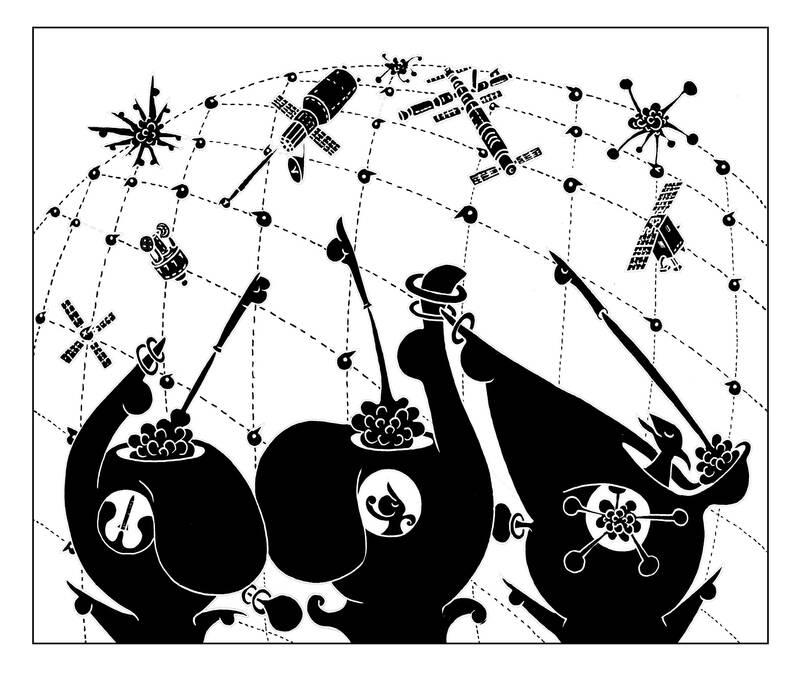
Illustration: Mountain People
One point of agreement was that the first shots of the next world war would almost certainly be fired in space — with simultaneous volleys being exchanged in cyberspace, which increasingly overlaps with the space domain. The controversy is about what form an attack would take, and whether US in particular is vulnerable to a “space Pearl Harbor.”
All major military powers today, but especially the US, China and Russia — in that order of sophistication — use space to spy on, map and track their enemies, and also to direct their own forces and firepower. That obliges them to have offensive and defensive plans, to take out the satellites and ground stations of their opponents while protecting as many as possible of their own.
At a bare minimum, this involves electromagnetic jamming, which already occurs regularly, even if it rarely makes the headlines. However, this type of interference tends to be temporary and by itself would not count as a casus belli. More hostile types of attack include directed energy such as lasers or physical missiles, fired from the same space orbit or from the ground.
An assault could also take the form of satellites ramming, swallowing or otherwise damaging other satellites. The US is keeping a close eye on Russian satellites that were described to me as nesting dolls, with one opening up to release another, which can then do peaceful repair jobs or, on command, turn into a kinetic kill vehicle. China has satellites with robotic arms that, again, could be peaceful trash collectors or become wrecking balls.
As ever in the history of war and weaponry, the accelerating innovation in space has already triggered an arms race in some orbits, especially those relatively close to Earth. Rivals are turning their satellites’ thrusters on and off in daring orbital “dogfights” that can stretch out for days.
Such skirmishes are not trivial at speeds of 28,164kph. Moreover, as of today, the US does not necessarily have the technological edge in those games. In an atmospheric analogy, US military satellites maneuver more like Boeing 747s (not all that nimbly, that is), while the US Space Force wants them to move like F-15s.
The larger defensive adjustment is architectural. Historically, the US military has favored launching relatively few, but highly engineered and expensive satellites. Those nowadays look like “large, big, fat, juicy targets,” as one general calls them, almost tempting adversaries to launch a pre-emptive strike.
Hence a trend toward “proliferation,” which aims at deliberate redundancy and decentralization, with many cheap satellites networked together in constellations, so that it becomes less worthwhile for adversaries to take out any particular node. A similar logic prompted the Pentagon in the 1960s to distribute its communications systems, which led to the modern Internet.
As the US makes its space forces more resilient, adversaries adjust their own tactics. A frightening scenario that came to US Congress’s attention in early 2024 is a Russian plan to launch a satellite with nuclear weapons. Moscow denied the reports, but my interlocutors consider them realistic and the director of national intelligence told Congress this month that Russia’s “development of a nuclear counterspace weapon poses the greatest single threat to the world’s space architecture.”
A space nuke would not kill humans on earth directly, either with its blast or its radiation. However, as Kari Bingen at the Center for Strategic and International Studies explained to me, nuclear detonations in space could overcome the resiliency of proliferated constellations by making entire orbits unusable.
The blast would first take out all the satellites in line of sight with an electromagnetic pulse that fries the electronics. It would then leave a radiation zone that destroys all the other machines in the orbit as they transit during their revolutions.
Such a weapon would be a massive breach of the Outer Space Treaty of 1967. More to the point, it would amount to a tool of coercion, a provocation and a menace that could not go unanswered. In strategic terms, it would be comparable to Soviet plans to station nukes in Cuba in 1962, which led to a crisis that nearly ended in atomic holocaust.
However, even without a space nuke, the threat of orbits becoming unusable points to another danger, a “tragedy of the commons.” As empty as space looks to the human eye, it is actually becoming perilously crowded, not only with new commercial satellites, but also with the detritus of all the dead ones.
Space watchers estimate that about 130 million pieces of junk are orbiting the Earth already, of which about 35,000 are large enough (the size of an orange, say) to be tracked. However, even pea-sized debris, travelling at space speeds, can take out a working satellite or spacecraft. Those collisions then create more flotsam, which wrecks even more satellites, and so on in a hellish cascade known as the Kessler Syndrome, which could leave entire shells of space functionally dead.
These orbits play an essential role in our daily lives. Beyond obvious uses such as our car navigation, satellites also power the communications that let us pay by credit card, fill up our gas tanks or even eat (since modern agriculture also relies on space). Make space inaccessible, and you could as well turn off the world economy.
An important strategic wrinkle is that societies rely on space to different degrees, which creates asymmetries of vulnerability. The US and its European and Asian allies are most dependent. The German defense minister recently called space his country’s Achilles’ heel. China is becoming more vulnerable as it catches up with the US. Russia is comparatively less exposed; more of its economy could keep functioning if space suddenly went dark.
This asymmetry explains why the US generally takes a different approach to space than Russia or China. Because Washington wants to preserve space as a domain, it would not launch an all-out pre-emptive war there for tactical advantage on the ground. Moscow, by contrast, might try to prevent military defeat on Earth with an initial strike in space, calculating that it would be more likely to survive what comes next.
In such a scenario, humanity could at a stroke revert to the developmental stage of the previous century, if not the pre-industrial age. The damage and suffering would be less than that following a terrestrial nuclear war, but still greater than anything we can imagine today, when the closure of just one strait in the Middle East keeps us busy.
The US, like its allies and adversaries, would of course keep honing its skills in space warfare. Even Washington’s plans for a “golden dome” — a constellation of satellites that would detect and shoot down incoming missiles from anywhere — are nothing categorically new; the only conceptual innovation would be placing interceptors in space, when they are currently only on the ground.
However, all countries, and especially the three mightiest military powers, would be wise to incorporate into their war games the lessons of nuclear strategizing, and especially the specter of mutual assured destruction: The best strategy is not the one that would let them win the next war, but the one that would prevent it.
Andreas Kluth is a Bloomberg Opinion columnist covering US diplomacy, national security and geopolitics. Previously, he was editor-in-chief of Handelsblatt Global and a writer for The Economist. This column reflects the personal views of the author and does not necessarily reflect the opinion of the editorial board or Bloomberg LP and its owners.

A recent report concerning a student who is suing his teacher posed the question in its headline: Does failing a student in two subjects constitute bullying? The college student in Chiayi County apparently sought NT$2 million (US$63,603) in state compensation, but a court dismissed the case. The first reaction of many might have been to ask: What has happened to students nowadays? Some say that teachers have lost their authority, while others say students are overindulged. Some even start reminiscing over the days when “whatever the teacher says goes.” However, the real issue might be overlooked if emotional reactions like that are the
When I visited Taiwan last summer, I called on the nation to use its status as a technology superpower to build superweapons. It is obvious to me as I return a year later that Taiwan is now answering that call. By 2030, Taiwan envisions a domestic drone hub, capable of producing large quantities of drones per year. The nation continues to tighten cooperation across the private sector, scientific researchers and the elected government, on creating new and innovative production avenues for defense, while efforts to become central to the “democratic supply chain” are only increasing. Anduril is seeing all of these positive
Singaporean former Prime Minister and current senior minister Lee Hsien- Loong(李顯龍) last month stood on Chinese soil and told Beijing that Singapore cooperates because of “shared interests”, not because of common “ethnic descent,” a significant statement that has upended China’s cognitive warfare tactics of “ethnic nationalism.” Along with using its military buildup and economic growth to expand its international dominance, China has long deployed ethnic politics to promote the idea that all ethnic Chinese around the world, regardless of citizenship, share a tight bond with the Chinese motherland, by which it means the regime of the People’s Republic of China (PRC)
Taiwan’s economic momentum, driven by demand for artificial intelligence (AI) products, remains strong, with booming demand for advanced semiconductors, servers and key components. In the first quarter, GDP expanded 14.55 percent year-on-year, the second consecutive quarter of double-digit percentage growth and accelerating from the 12.95 percent expansion in the previous quarter, the Directorate-General of Budget, Accounting and Statistics (DGBAS) reported on Friday. Net exports remained the dominant driver of growth, contributing 10.33 percentage points to Taiwan’s GDP growth in the first quarter. That came as exports rose 35.76 percent year-on-year in the first quarter, outpacing 26.34 percent growth in imports, the


 RSS
RSS