


After declaring Iran’s military “gone,” US President Donald Trump appealed to the UK, France, Japan and South Korea — as well as China, Iran’s strategic partner — to send minesweepers and naval forces to reopen the Strait of Hormuz. When allies balked, the request turned into a warning: NATO would face “a very bad” future if it refused.
The prevailing wisdom is that Trump faces a credibility problem: having spent years insulting allies, he finds they would not rally when he needs them. That is true, but superficial, as though a structural collapse could be caused by wounded feelings. Something more fundamental is at work.
Consider what the refusals actually say. German Minister of Defense Boris Pistorius put it plainly: “This is not our war; we did not start it.” France, Spain, Italy, and Japan responded similarly. These governments are not simply nursing grudges. They are pointing out that Trump launched a war without consulting them, a war that is already costing them dearly — oil above US$100 a barrel, insurance markets frozen, supply chains disrupted, forces exposed to Iranian retaliation — and now demands they bear its military risks as well.
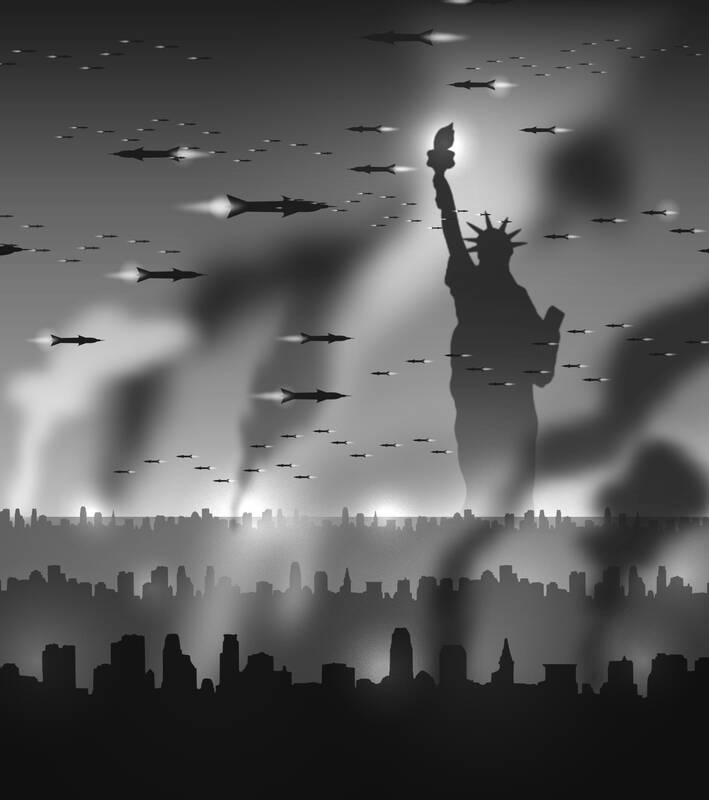
Illustration: Yusha
It is as if Trump failed to pay for fire insurance and then filed a claim for a blaze he set, without warning the neighborhood. Now the neighbors are applying his own logic.
That logic reflects Trump’s critique of the postwar alliance system. The classic critique — familiar from the left, from realists, and from anti-imperialists — held that NATO and the liberal international order never lived up to their advertising. The language of shared values was a fig leaf for American dominance.
In Trump’s telling, however, the US was not the manager of the system but its mark. Weaker states extracted US protection, treasure and military risk while contributing little in return. The “rules-based order” was not a mechanism for advancing American interests. It was a swindle. The fatal flaw of the US wars in Iraq and Afghanistan was not incompetence but altruism: America spent blood and treasure without extracting anything tangible in return. Trump’s Venezuela strategy represents the lesson learned. Forget democratization. Take the oil.
This is not cynicism in the conventional sense. A cynic assumes that moral language disguises self-interest. Trump suggests the opposite: The US’ sincerity was precisely the problem. The liberal order was not a mask but a delusion that must be discarded, not managed. Some commentators have credited him with a kind of radical candor, openly acknowledging that politics is transactional and shared values were always a polite fiction.
That diagnosis is not entirely wrong. However, to say that Trump is shedding hypocrisy is to misidentify what he has discarded. The hypocrite privately pursues self-interest while publicly professing shared values. What Trump has repudiated is more fundamental: the disposition to treat partners fairly because their future cooperation would be required.
Reciprocity of this kind is not a mask for self-interest. It is a long-term strategy for extracting cooperation from parties who cannot simply be commanded. What Trump has discarded was not a disguise but a disposition. The closed Strait of Hormuz is what that discarded disposition looks like: a system that once converted raw military and economic power into organized cooperation among states.
Alliance-building, properly understood, is a form of emergency preparedness. Showing up when the stakes are low, providing benefits before they are urgently needed, and treating partners as partners rather than freeloaders creates a reserve of goodwill that can be drawn upon when a crisis strikes. This logic is not sentimental; it is actuarial. You pay premiums when you do not need coverage, because by the time you need it, the payment window has closed.
When the UK suggested it might deploy ships once the immediate danger had passed, Trump protested that he needed them before victory, not after. He is correct. However, he could not have them then because he had long since drained the account from which such commitments are drawn. When the crisis hit, he instinctively reached for the language of alliance obligation — the very vocabulary he had spent years attacking. Even Trump understands, at some level, that raw military capacity cannot substitute for organized cooperation.
The lesson allies have drawn is even more consequential. The alliance system worked partly because it created norms constraining all parties, including potential free riders. Once the hegemon openly adopts purely extractive logic, it licenses everyone else to reason the same way. When Pistorius says, “we did not start it,” he is not betraying Trump. He has learned from him. The allies have not abandoned the logic of mutual support; they have adopted Trump’s alternative to it.
This makes Trump’s treatment of Russia all the more revealing. While berating France and Germany for not sending warships, Trump was asked about reports that Russian President Vladimir Putin is providing Iran with intelligence on US forces.
“I think he might be helping them a little bit, yeah, I guess, and he probably thinks we’re helping Ukraine, right?” Trump replied, adding, “It’s like, hey, they do it, and we do it, in all fairness.” Russia helps Iran target US soldiers, and Trump calls it fair — a predictable tit-for-tat — in the logic of self-interest.
Here, the hidden architecture of Trump’s worldview is revealed. Allies are held to unconditional obligation — show up, comply, pay — while adversaries are excused by the very reciprocity logic Trump withholds from friends. Putin gets understanding; French President Emmanuel Macron gets threats. The ally is the sucker. The adversary, in some perverse sense, is the model.
The multilateral system Trump has dismantled was not a trap laid by weaker states to fleece a credulous superpower. It was infrastructure — infrastructure that transformed military capacity into coordinated action by converting potential partners into actual ones, and by establishing a shared definition of what constitutes “our” problem.
The US had that infrastructure. Now it does not, because Trump has systematically erased that shared definition, shrinking “our” to “mine,” so that every government now calculates its own interest separately. What took decades to build has been demolished in months. Its ruins lie in the Strait of Hormuz.
Stephen Holmes, professor of law at New York University School of Law and the Richard Holbrooke Fellow at the American Academy in Berlin, is the co-author (with Ivan Krastev) of The Light that Failed: A Reckoning.
Copyright: Project Syndicate
\
The White House’s decision to take a 9.9 percent stake in Intel Corp is looking like very shrewd business indeed. Since the government bought in at US$20.47 a share last August, the US chipmaker’s surging stock price has delivered the US a US$43 billion return. One of the reasons the investment has so far proved so sound is that the White House has made sure of it. According to The Wall Street Journal, Howard personally pushed deals on Intel’s behalf with some of the most lucrative clients imaginable. They include Nvidia Corp, the company at the heart of the AI
A single photograph can cut through a lot of noise, but it can also be used to misrepresent the truth. At the very least, it can concentrate the mind on something that requires further investigation. On Monday last week, Ma Ying-jeou Foundation CEO Tai Hsia-ling (戴遐齡) and former National Security Council secretary-general King Pu-tsung (金溥聰) held a news conference in which they showed a photograph of former foundation CEO Hsiao Hsu-tsen (蕭旭岑), now Chinese Nationalist Party (KMT) deputy chairman. In the image Hsiao is seated next to Xiamen Taiwan Businessmen Association chairman Han Ying-huan (韓螢煥). The two men were holding
I first met Professor Ray Jiing (井迎瑞) as a film and documentary student at Shih Hsin University’s (SHU) Department of Radio Television and Film in 1988. The following year, he went on to become the director of the Chinese Taipei Film Archive — forerunner of the Taiwan Film and Audiovisual Institute (TFAI). Over his eight-year tenure, Jiing rescued and restored over 200 classic Taiwanese films. In 1997, he established the Graduate Institute of Studies in Documentary and Film Archiving at Tainan National University of the Arts (TNNUA), and I joined the program in his third cohort of students. Beyond a
A recent report concerning a student who is suing his teacher posed the question in its headline: Does failing a student in two subjects constitute bullying? The college student in Chiayi County apparently sought NT$2 million (US$63,603) in state compensation, but a court dismissed the case. The first reaction of many might have been to ask: What has happened to students nowadays? Some say that teachers have lost their authority, while others say students are overindulged. Some even start reminiscing over the days when “whatever the teacher says goes.” However, the real issue might be overlooked if emotional reactions like that are the


 RSS
RSS