


Taiwan Semiconductor Manufacturing Co (TSMC) chairman C.C. Wei (魏哲家) last week sparked a heated debate during his acceptance speech for an honorary doctorate at Taichung’s Asia University when he dismissed Chinese robots as “useless” and “just for show.” Some commenters said that no one should underestimate Chinese robots, while others said the core of robotics technology resides elsewhere.
What Wei was referring to were the humanoid robots dancing and performing backflips and martial arts over the Lunar New Year holiday. The movements were surprisingly smooth and balanced. However, the key to useful robots relies on semiconductor technology, he said. TSMC manufactures 95 percent of advanced chips, which help autonomous machines detect light and temperature, collect other information and enable smooth operations, he said.
Indeed, a robot without advanced semiconductors is useless. Although it can move, it cannot think or react to external stimuli, and that is the difference between a robot and a machine. Currently, humanoid robots in China operate in a way that is planned by programmers, who capture human movements, store the data and then train the robots. A more accurate description of China’s robots would be that even though they are bipedal, they are still machines performing routines. Turning humanoid robots into a productive workforce in factories still faces many hurdles and few such robots are deployed on production lines.
Even so, humanoid robots represent a critical competitive frontier among global powers, alongside advanced semiconductors and artificial intelligence (AI), due to their transformative impact on the economy. China already exhibits strong manufacturing capabilities in mechanical and electronic components essential for humanoid robots, excluding advanced logic chips. Last year, global shipments of humanoid robots surpassed 14,500 units, with China accounting for 90 percent of total sales led by Unitree Robotics and AgiBot, industry statistics showed.
It remains unclear whether a profitable business model for humanoid robots exists, as shipments do not tell the whole story. In addition, what matters to firms are robots that can make their operations more efficient with fewer risks in the workplace. What most companies do not need are robots that can dance and do backflips. While early deployments of humanoid robots would largely be for entertainment, research and industrial purposes, their applications could break into wider retail and household tasks, as well as military applications. What Wei stressed in his speech was the increasing demand for AI and robots for long-term care.
As Taiwan becomes an aging society, every household might need robots, which do not sleep, eat, or get angry and tired taking care of others, Wei said. Those robots would addresses the dilemma facing Taiwan: a declining and aging population. However, the difficulty of creating robots truly capable of caring for people far exceeds most people’s imagination, as it needs optical sensors to identify the environment and location, pressure sensors to set force boundaries, and temperature sensors to distinguish between hot and cold, he said. All these signals would be transmitted in real-time to a computing core to perform corresponding actions and ensure that humans are not harmed, he said.
A bigger challenge is that robots operate on digital logic, and making their movements resemble human movements requires extensive microelectromechanical systems to bridge the gap. However, the key to truly usable robots lies in reliability, and the yield rate and stability of semiconductors directly affect robots’ “brains” and determine whether they can perform caregiving tasks, Wei said.
At the end of his speech, Wei drew laughter and applause when he said he hoped to use robots soon and that the chips inside would all be made by TSMC, because the reliability of its components cannot be overlooked. The TSMC head used humor to express his thoughts about aging, caregiving, robots and semiconductors. The speech was insightful, as Wei set a vision for the audience that humanoid robots would have a role in Taiwan’s future. However, the technology is not yet ready, and making robots as skilled as humans is expensive, while their reliability and stability remain questionable. Wei did not promise that success would happen overnight; he just reminded us how much effort and commitment are needed to achieve it.
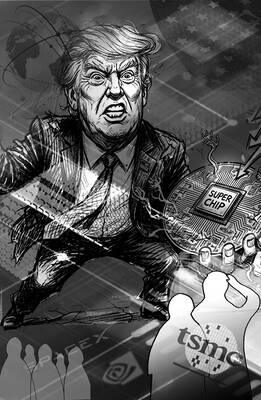
The White House’s decision to take a 9.9 percent stake in Intel Corp is looking like very shrewd business indeed. Since the government bought in at US$20.47 a share last August, the US chipmaker’s surging stock price has delivered the US a US$43 billion return. One of the reasons the investment has so far proved so sound is that the White House has made sure of it. According to The Wall Street Journal, Howard personally pushed deals on Intel’s behalf with some of the most lucrative clients imaginable. They include Nvidia Corp, the company at the heart of the AI
A single photograph can cut through a lot of noise, but it can also be used to misrepresent the truth. At the very least, it can concentrate the mind on something that requires further investigation. On Monday last week, Ma Ying-jeou Foundation CEO Tai Hsia-ling (戴遐齡) and former National Security Council secretary-general King Pu-tsung (金溥聰) held a news conference in which they showed a photograph of former foundation CEO Hsiao Hsu-tsen (蕭旭岑), now Chinese Nationalist Party (KMT) deputy chairman. In the image Hsiao is seated next to Xiamen Taiwan Businessmen Association chairman Han Ying-huan (韓螢煥). The two men were holding
I first met Professor Ray Jiing (井迎瑞) as a film and documentary student at Shih Hsin University’s (SHU) Department of Radio Television and Film in 1988. The following year, he went on to become the director of the Chinese Taipei Film Archive — forerunner of the Taiwan Film and Audiovisual Institute (TFAI). Over his eight-year tenure, Jiing rescued and restored over 200 classic Taiwanese films. In 1997, he established the Graduate Institute of Studies in Documentary and Film Archiving at Tainan National University of the Arts (TNNUA), and I joined the program in his third cohort of students. Beyond a
A recent report concerning a student who is suing his teacher posed the question in its headline: Does failing a student in two subjects constitute bullying? The college student in Chiayi County apparently sought NT$2 million (US$63,603) in state compensation, but a court dismissed the case. The first reaction of many might have been to ask: What has happened to students nowadays? Some say that teachers have lost their authority, while others say students are overindulged. Some even start reminiscing over the days when “whatever the teacher says goes.” However, the real issue might be overlooked if emotional reactions like that are the


 RSS
RSS