


Wedged between South American heavyweights Argentina and Brazil, Paraguay has long been ignored by the international community. Small, landlocked and poor, it was often seen as just a flyover country.
It is a little surprising to those in the capital and in neighboring countries that the country of 6.1 million people is suddenly having a moment.
Lured by low taxes, entrepreneurs from across Latin America are pouring in money and taking up residence, with applications surging more than 60 percent last year. Sleek towers and luxury car dealerships dot Asuncion, a city where infrastructure is still struggling to catch up. Wall Street investors are snapping up Paraguay’s bonds as its conservative president, Santiago Pena, aligns his government with US President Donald Trump’s agenda.
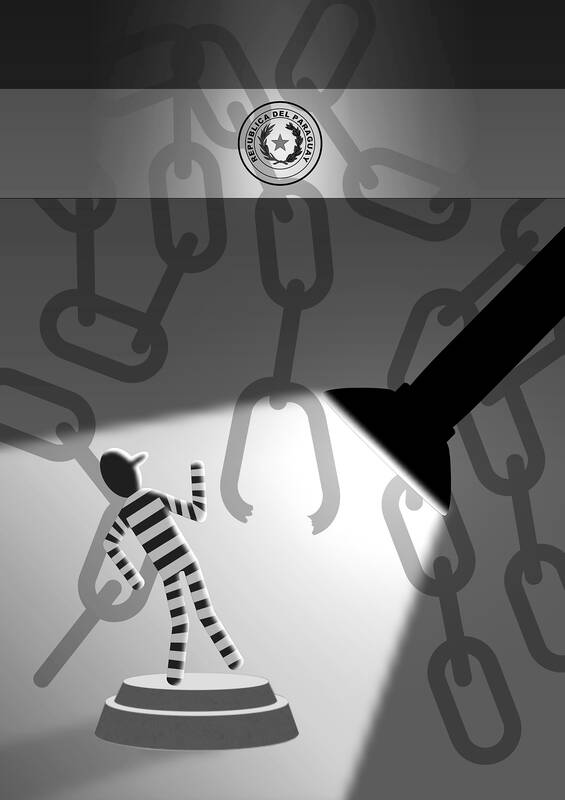
Illustration: Yusha
Although the country is about the size of California, Paraguay’s US$47 billion economy is about 1 percent of the US state’s. However, rapid growth and economic reform helped the country win investment-grade credit status from Moody’s Ratings in 2024 and from S&P Global last year.
“We used to be like the ugliest girl at the ball,” said Selene Rojas, director of the upscale Shopping del Sol mall in the capital’s financial district. “Today, everyone’s asking us to dance,” she added.
Pena, a 47-year-old economist-turned-politician, has traveled abroad more than 50 times since taking office in August 2023 to spread the word that Paraguay is open for business. He has openly backed Trump’s push to strengthen Washington’s influence in the region. This month, he was among the Latin American leaders the US president convened in Miami to coordinate on security.
“Paraguay has been a very good friend of ours,” US Deputy Secretary of State Christopher Landau said. Landau, citing the country’s voting record at the UN and continued recognition of Taiwan, added, “They’re not dancing to China’s tune.”
In a region dependent on Chinese trade and investment, Paraguay is the only South American nation that still has diplomatic ties with Taiwan. As a result, it cannot sell its beef and soy to China, while also missing out on the billions of dollars Beijing has poured into infrastructure. Paraguay recognized Taiwan in 1957 and has stood by its decision ever since.
Washington is not rushing in with investments of its own and there are still no direct flights to the US from Asuncion. However, the week after the Miami summit, Paraguayan lawmakers approved a defense agreement allowing US troops into the country.
Pena calls his MAGA-like vision for Paraguay “the rebirth of a giant.” It harks back to a period of mid-19th-century prosperity, when it was a regional leader with infrastructure such as an ironworks and a railroad, until a bloody war with its neighbors left it in ruins.
Last century, it was run as a dictatorship for 35 years until 1989, when a military coup launched it into a tumultuous transition to democracy. However, Paraguay’s embrace of sound fiscal and monetary policies after its 2003 financial crisis seems to be paying off, with single-digit inflation and annual growth averaging about 4 percent over the past two decades.
“Paraguay will keep growing more than the other countries in South America,” Pena said in an interview in Washington last month. “Very soon it will have the highest per capita income, above Uruguay and above Chile,” he added.
Investors are also taking notice, pouring money into factories and real estate. Many of them are foreign, with migration authorities receiving close to 50,000 residency applications last year. About half were Brazilians, although there were also large numbers of Argentines, Germans, Bolivians and Spaniards.
Felipe Bertolini, 24, from Sao Paulo, is one of them. He and his father, a port investor, spent three days in Asuncion in late February applying to live in Paraguay. The tax regime at home, where the state takes about 40 percent of the revenue from his factoring and securitization company, led Bertolini to consider moving next door.
“Brazil is pushing people toward Paraguay because its taxes make entrepreneurship unviable,” he said. “Companies shut down in Brazil and come here.”
Brazil is the largest player in Paraguay; its share of foreign direct investment climbed to about 15 percent at the end of 2024 from less than 12 percent four years prior, according to central bank data.
Factories that enjoy tax breaks under Paraguay’s manufacture-for-export, or maquila, rules are a magnet for investors. Maquila exports by companies such as Blue Design, headed by Argentine textile entrepreneur Jorge Bunchicoff, have more than quadrupled in the past decade to about US$1.2 billion last year.
Bunchicoff ships about 1 million premium denim products, including jeans and jackets, annually from his state-of-the-art factory on the outskirts of Asuncion to global markets, including the US, UK and Japan. The company supplies high-end brands such as Lacoste and Good American, while its own brand, Dala, can sell for more than US$300.
“I could never have done this in Argentina or Brazil because of high costs and toxic labor relations in both countries,” said Bunchicoff, who traded in Paraguay for 30 years. The secret to his success, he said, is a compelling blend of cheap energy and labor, low taxes and predictability.
New arrivals to Paraguay are also fueling consumption. About 120,000 people a week visit Shopping del Sol, up 30 percent over the past three years, thanks in part to immigration, said Rojas, the mall director, adding, “You can really see the arrival of foreigners. Hotels are full. Restaurants are full. The car fleet has grown tremendously. Our airport can’t keep up.”
Still, Paraguay’s economic miracle faces headwinds that could curb growth and social mobility if handled poorly. Only Venezuela outranks it as the most corrupt nation in South America, according to Transparency International’s latest index.
The Colorado Party retains a tight grip on power — it has lost presidential elections only once since the end of Alfredo Stroessner’s rule — owing to entrenched client politics and disorganized opposition.
In 2024, the party used its congressional majorities to impeach a prominent opposition senator and pass a bill increasing government oversight of civil society, which critics denounced as democratic backsliding. And this year, the US removed one of Pena’s predecessors from a financial blacklist.
More than 60 percent of the workforce toils in the informal economy, according to government data. While poverty has fallen sharply since the early 2000s, about a fifth of Paraguayans still live below the poverty line.
Nicolas Ozorio believes the economy’s strong performance is not reaching enough people. The 36-year-old builder wants the government to spread the gains more effectively through social programs. “That progress doesn’t reach the entire population,” he said. “That’s where we are falling short. It cannot benefit just a few.”
Low taxes — a key selling point for investors — leave the government with little revenue for education, healthcare and infrastructure. Public works in Asuncion are glaringly absent, with roads, sidewalks and drainage systems in disrepair, even in wealthy neighborhoods.
For Dionisio Borda, the former finance minister widely credited with engineering Paraguay’s post-default revival, the next government should consider raising more revenue. The state’s tax take as a share of the economy is too low to fund needed investment in people and infrastructure.
“The regional average is 25 percent. Ours is 11.3 percent today, and we have to get to at least 15 percent,” he said.
The push to make Paraguay more fiscally responsible seems to be paying off for some.
Finance Minister Carlos Fernandez said that during last month’s roadshow, investors were already so familiar with the country that they asked him to skip the opening presentation and go straight to questions. After pulling in about US$500 million in 2024 as part of its first global bond denominated in the local guarani currency, Paraguay issued a record US$1 billion in guarani debt last month.
“It is a big change from a decade ago,” Fernandez said, “when Paraguay’s first US$1 billion bond deal was in dollars. That gives you a sense of how the credibility of the Paraguayan economy has evolved.”
The finance minister added that the latest guarani issuance was “a graduation diploma.”
Paraguay’s dollar bonds have returned almost 10 percent in the last 12 months, compared to a 13 percent gain for Latin American sovereign debt, according to a Bloomberg index.
Despite that success, Fitch Ratings — the only major agency that keeps Paraguay in speculative territory at “BB+” with a positive outlook — is not in a rush to upgrade the country to investment grade.
Fitch has pointed to the need for large projects to advance, including the multibillion-dollar Paracel pulp mill. Paracel declined to comment. Paraguay addressed one of Fitch’s other concerns earlier this week by passing a pension reform for civil servants to help underpin growth and public finances.
Even as the country becomes better known outside Latin America, business leaders say Paraguay still undersells itself.
“Having two ratings agencies grant investment grade puts Paraguay more in the shop window,” said Hugo Pastore, executive director of grain and oilseed export group Capeco. “We do a lot right, but we do not market it enough. We have to tell the world more about how well we do things,” he added.
From the Iran war and nuclear weapons to tariffs and artificial intelligence, the agenda for this week’s Beijing summit between US President Donald Trump and Chinese President Xi Jinping (習近平) is packed. Xi would almost certainly bring up Taiwan, if only to demonstrate his inflexibility on the matter. However, no one needs to meet with Xi face-to-face to understand his stance. A visit to the National Museum of China in Beijing — in particular, the “Road to Rejuvenation” exhibition, which chronicles the rise and rule of the Chinese Communist Party — might be even more revealing. Xi took the members
The Chinese Nationalist Party (KMT) and the Taiwan People’s Party (TPP) on Friday used their legislative majority to push their version of a special defense budget bill to fund the purchase of US military equipment, with the combined spending capped at NT$780 billion (US$24.78 billion). The bill, which fell short of the Executive Yuan’s NT$1.25 trillion request, was passed by a 59-0 margin with 48 abstentions in the 113-seat legislature. KMT Chairwoman Cheng Li-wun (鄭麗文), who reportedly met with TPP Chairman Huang Kuo-chang (黃國昌) for a private meeting before holding a joint post-vote news conference, was said to have mobilized her
Before the Chinese Communist Party (CCP) and its People’s Liberation Army (PLA) can blockade, invade, and destroy the democracy on Taiwan, the CCP seeks to make the world an accomplice to Taiwan’s subjugation by harassing any government that confers any degree of marginal recognition, or defies the CCP’s “One China Principle” diktat that there is no free nation of Taiwan. For United States President Donald Trump’s upcoming May 14, 2026 visit to China, the CCP’s top wish has nothing to do with Trump’s ongoing dismantling of the CCP’s Axis of Evil. The CCP’s first demand is for Trump to cease US
As artificial intelligence (AI) becomes increasingly widespread in workplaces, some people stand to benefit from the technology while others face lower wages and fewer job opportunities. However, from a longer-term perspective, as AI is applied more extensively to business operations, the personnel issue is not just about changes in job opportunities, but also about a structural mismatch between skills and demand. This is precisely the most pressing issue in the current labor market. Tai Wei-chun (戴偉峻), director-general of the Institute of Artificial Intelligence Innovation at the Institute for Information Industry, said in a recent interview with the Chinese-language Liberty Times


 RSS
RSS