


Today marks the 30th anniversary of Taiwan’s first direct presidential election. This year also marks a broader democratic milestone, as the years Taiwan has spent as a free nation have now exceeded the years it endured under martial law. Taiwan’s democracy remains a living project, still growing stronger and deeper with time. That progress belongs to Taiwanese, and it gives this generation a clear duty to protect the peace and security that sustain it.
Taiwan’s democracy did not emerge fully formed; it was built through social struggle, political reform and the steady expansion of public participation. Direct presidential elections gave Taiwanese the power to choose their leader, while the end of the authoritarian era allowed democratic institutions to take root in everyday life. Today, these hard-won gains shape how Taiwan governs itself, how Taiwanese debate public affairs and how power is held accountable.
That democratic development carries a practical lesson — freedom requires protection. Democratic institutions need a secure environment in which to function. A society that values open elections, civil liberties and a constitutional government must also take national defense seriously. After all, Taiwan faces ongoing military pressure and “gray zone” coercion from China. Under these conditions, preserving peace depends on maintaining credible defense capacity. Stability does not come from wishful thinking; it rests on preparedness, resilience and the ability to deter aggression.
National defense is essential to Taiwan’s democratic survival. In his first term as chair of the Foreign Affairs and National Defense Committee, the first item Democratic Progressive Party (DPP) Legislator Chen Kuan-ting (陳冠廷) placed on the agenda was a review of the special defense bill. That choice sent a clear signal. As Taiwan’s democracy continues to deepen, strengthening defense readiness remains a serious political priority.
Moreover, that signal matters internationally. Taiwan’s partners watch closely for signs of political seriousness and strategic consistency. Beijing watches for signs of hesitation, division and drift. The legislature’s agenda therefore carries meaning beyond domestic politics. Safeguarding democracy requires investment, planning and resolve. Consequently, that message bolsters deterrence and reassures those who support Taiwan that its democratic system is capable of acting with purpose.
Legislative oversight is an essential part of democratic governance. Defense budgets should be reviewed seriously, with careful attention to strategic priorities, implementation timelines and the responsible use of public funds. However, oversight should not be turned into performative obstruction. What Taiwan needs is substantive scrutiny that strengthens national defense, not meaningless political blocking that delays urgent preparations and weakens the signal Taiwan sends to the outside world.
Looking back, 30 years after the first direct presidential election, Taiwan has every reason to take pride in how far it has come. It has built a democracy that is open, competitive and resilient. More broadly, it has entered a new stage in which the years of freedom now outweigh the years of authoritarian control. That achievement should inspire confidence, but also vigilance. A democracy that continues to grow must also continue to defend itself.
Taiwan’s democratic story is still being written. Protecting that story requires more than remembrance. It requires the will to preserve peace through strength, to defend democratic institutions through preparedness and to act with clarity when national security is on the line.
Gahon Chiang is a congressional staff member in the office of DPP Legislator Chen Kuan-ting, focusing on Taiwan’s national security policy.
Taiwanese pragmatism has long been praised when it comes to addressing Chinese attempts to erase Taiwan from the international stage. “Taipei” and the even more inaccurate and degrading “Chinese Taipei,” imposed titles required to participate in international events, are loathed by Taiwanese. That is why there was huge applause in Taiwan when Japanese public broadcaster NHK referred to the Taiwanese Olympic team as “Taiwan,” instead of “Chinese Taipei” during the opening ceremony of the Tokyo Olympics. What is standard protocol for most nations — calling a national team by the name their country is commonly known by — is impossible for
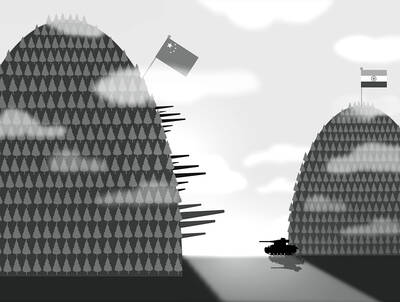
India is not China, and many of its residents fear it never will be. It is hard to imagine a future in which the subcontinent’s manufacturing dominates the world, its foreign investment shapes nations’ destinies, and the challenge of its economic system forces the West to reshape its own policies and principles. However, that is, apparently, what the US administration fears. Speaking in New Delhi last week, US Deputy Secretary of State Christopher Landau warned that “we will not make the same mistakes with India that we did with China 20 years ago.” Although he claimed the recently agreed framework
The Office of the US Trade Representative (USTR) on Wednesday last week announced it is launching investigations into 16 US trading partners, including Taiwan, under Section 301 of the Trade Act of 1974 to determine whether they have engaged in unfair trade practices, such as overproduction. A day later, the agency announced a separate Section 301 investigation into 60 economies based on the implementation of measures to prohibit the importation of goods produced with forced labor. Several of Taiwan’s main trading rivals — including China, Japan, South Korea and the EU — also made the US’ investigation list. The announcements come
Taiwan is not invited to the table. It never has been, but this year, with the Philippines holding the ASEAN chair, the question that matters is no longer who gets formally named, it is who becomes structurally indispensable. The “one China” formula continues to do its job. It sets the outer boundary of official diplomatic speech, and no one in the region has a serious interest in openly challenging it. However, beneath the surface, something is thickening. Trade corridors, digital infrastructure, artificial intelligence (AI) cooperation, supply chains, cross-border investment: The connective tissue between Taiwan and ASEAN is quietly and methodically growing


 RSS
RSS