


Jurgen Habermas, who died recently at 96, was a titan of postwar philosophy. His theory of the public sphere, which grounds political legitimacy in reasoned debate rather than electoral outcomes, was one of the most influential ideas in modern democratic thought. It was an idea for its time, and one that is increasingly being questioned in ours.
Born in Dusseldorf in 1929, Habermas’ life changed completely in 1945. The realization that he had grown up under a criminal regime — and his perpetual fear that Germany would experience a political relapse — shaped his life and work. However, he leaves behind a world that seems to be dismantling everything he defended, both as a scholar and as a politically engaged public intellectual.
Habermas is usually seen as the leader of the second generation of the Frankfurt School, an intellectual movement devoted to the critical analysis of society. Unlike his predecessors — including his mentor, Theodor W. Adorno, and luminaries such as Max Horkheimer and Herbert Marcuse — Habermas saw linguistic communication as the foundation of human social interaction. In his view, language is not just a series of rules that allows individuals to share information and coordinate with one another; rather, in engaging linguistically, we also recognize the other as an individual who understands what we are saying and has the capacity and freedom to respond to it.
Habermas developed the implications of this idea in a series of pathbreaking books, including The Structural Transformation of the Public Sphere (1962), The Theory of Communicative Action (1981) and Between Facts and Norms (1992).
For Habermas, the ills of modern society, he argued, can be ameliorated by ensuring that the operations of the economy and government are subordinated to informed, critical, public discourse, where “the unforced force of the better argument” can assert itself.
The American legal theorist Ronald Dworkin once remarked that even Habermas’ “fame is famous.” Despite being aware of his status, he was extremely generous, making time to discuss his work with young scholars like me. At guest seminars accompanying his frequent lecture tours, he would go around the room introducing himself by name to all the starstruck students.
Habermas was an active participant in the public sphere he had theorized, a relentless provocateur who shaped nearly every major postwar German debate. He had a unique ability to identify what was not being said but needed to be brought to light, which he combined with a constructive effort to advance whatever outcome he deemed not only desirable, but also possible.
His critics often disparaged his theory of politics and society as one based on the example of a graduate seminar. However, Habermas knew how the world really works. He knew that the public sphere is often wild and chaotic, and he displayed an astonishingly high tolerance for conflict and contestation when participating in it.
He did so frequently, speaking out on a wide array of issues, including the 1968 student movement (with which he later broke, owing to some leaders’ refusal to renounce revolutionary violence), violations of civil liberties, attempts to relativize the Holocaust, immigration policy, and German reunification. His capacity to provoke outrage never diminished. Most recently, his responses to Russia’s full-scale invasion of Ukraine and Israel’s military offensive in Gaza drew strident condemnations from his critics, who saw his pacifistic concerns about the return of war to Europe and his worries about rising anti-Semitism as out of step with the times. Yet both concerns were rooted in his recognition that the Holocaust remains central to German politics.
While Habermas indelibly shaped politics and culture in postwar Germany, he increasingly turned his attention outward following the Cold War. During this period of rapid globalization, he became increasingly concerned about the rise of international finance and global market forces. He responded by championing a revised, democratically empowered EU, which he saw as the only vehicle capable of subordinating transnational markets to democratic self-determination.
Habermas emphasized that public intellectuals’ success should not be measured in terms of outcomes, but in terms of their ability to improve the quality of public debate by ensuring that important but overlooked arguments and voices receive a fair hearing. Still, it must have been difficult for him to see how often his fellow participants in public debate rejected his positions. After long seeming unbothered, he recently admitted his despair at the fact that the postwar world he had worked so tirelessly to help construct was gradually being dismantled “step by step.”
He lived long enough to witness the rise of a new generation of political leaders who do not share his commitment to dialogue, multilateralism, international law and democracy.
As both a philosopher and public intellectual, Habermas was not the quietist, non-political thinker many of his critics make him out to be.
In keeping with the practical commitments of the Frankfurt School to which he belonged, he heeded the Marxist call for a philosophy that not only interprets the world but also seeks to change it.
It seems only fitting that he passed away on the morning of March 14, the anniversary of Karl Marx’s death. At a time when democracy is in decline, and the international order is increasingly defined by arbitrary strength rather than legitimate power, Habermas’ communicative approach will be missed.
Peter J. Verovsek is senior assistant professor of History and Theory of European Integration at the University of Groningen and the author of Jurgen Habermas: Public Intellectual and Engaged Critical Theorist (Columbia University Press, 2026).
Copyright: Project Syndicate
On March 22, 2023, at the close of their meeting in Moscow, media microphones were allowed to record Chinese Communist Party (CCP) dictator Xi Jinping (習近平) telling Russia’s dictator Vladimir Putin, “Right now there are changes — the likes of which we haven’t seen for 100 years — and we are the ones driving these changes together.” Widely read as Xi’s oath to create a China-Russia-dominated world order, it can be considered a high point for the China-Russia-Iran-North Korea (CRINK) informal alliance, which also included the dictatorships of Venezuela and Cuba. China enables and assists Russia’s war against Ukraine and North Korea’s
After thousands of Taiwanese fans poured into the Tokyo Dome to cheer for Taiwan’s national team in the World Baseball Classic’s (WBC) Pool C games, an image of food and drink waste left at the stadium said to have been left by Taiwanese fans began spreading on social media. The image sparked wide debate, only later to be revealed as an artificially generated image. The image caption claimed that “Taiwanese left trash everywhere after watching the game in Tokyo Dome,” and said that one of the “three bad habits” of Taiwanese is littering. However, a reporter from a Japanese media outlet
Taiwanese pragmatism has long been praised when it comes to addressing Chinese attempts to erase Taiwan from the international stage. “Taipei” and the even more inaccurate and degrading “Chinese Taipei,” imposed titles required to participate in international events, are loathed by Taiwanese. That is why there was huge applause in Taiwan when Japanese public broadcaster NHK referred to the Taiwanese Olympic team as “Taiwan,” instead of “Chinese Taipei” during the opening ceremony of the Tokyo Olympics. What is standard protocol for most nations — calling a national team by the name their country is commonly known by — is impossible for
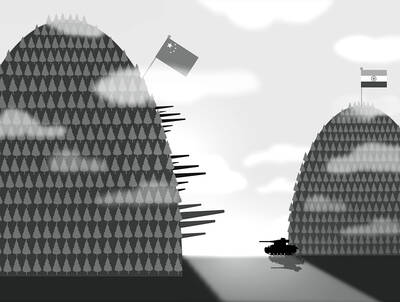
India is not China, and many of its residents fear it never will be. It is hard to imagine a future in which the subcontinent’s manufacturing dominates the world, its foreign investment shapes nations’ destinies, and the challenge of its economic system forces the West to reshape its own policies and principles. However, that is, apparently, what the US administration fears. Speaking in New Delhi last week, US Deputy Secretary of State Christopher Landau warned that “we will not make the same mistakes with India that we did with China 20 years ago.” Although he claimed the recently agreed framework


 RSS
RSS