


On March 7, Premier Cho Jung-tai (卓榮泰) stood among fans, cheering as the national team defeated Czechia 14-0 in the World Baseball Classic. Whether you call it “baseball diplomacy” or just a fan cheering for his favorite team, the image was simple and powerful: Taiwan refused to be invisible on the world stage. For one shining moment, politics took a backseat to national pride.
However, instead of applauding this moment, opposition lawmakers chose to echo Beijing’s outrage.
Chinese Nationalist Party (KMT) Legislator Hsu Chiao-hsin (徐巧芯) spent weeks hammering the trip as some sort of scandal. First, she accused Cho of abusing public money to fund the trip. When Cho provided evidence to show that the trip was paid for personally, she pivoted to a “heavy revelation” about internal Democratic Progressive Party (DPP) factions and broken promises to Japan.
Meanwhile, Beijing screamed provocation and labeled the trip as an effort toward Taiwan independence, warning Japan that it would “pay the price,” for allowing such behavior. The message from China was crystal clear — Taiwan’s leaders should stay home, stay small and never dare show their faces abroad.
Instead of pushing back against Beijing, elected representatives rushed to amplify the outrage and turned a moment of national joy into another partisan trench war.
When lawmakers turn a trip to cheer for a baseball team into a political weapon, they are not “holding the government accountable,” they are siding with the bully who wants to erase Taiwan from the international map.
Beijing does not care if the trip was self-funded, private or planned six months in advance. To them, any Taiwanese official breathing Japanese air is already a crime.
By reproducing that logic in the legislature and courts, the opposition tells the world: “We agree — Taiwan should stay quiet.”
This reveals how broken Taiwanese politics has become. A country that cannot even celebrate an official supporting its own athletes without turning it into a scandal is a country that has lost its way. Where is the basic pride that says “Taiwan first”?
Lawmakers are more interested in scoring points against the DPP than scoring points for Taiwan on the global stage.
This behavior rewards Beijing’s bullying. Every time the opposition piles on, they send a signal to China: “Some of us here can do your dirty work for you.”
They are not protecting taxpayers; they are protecting Beijing’s narrative that Taiwan has no right to exist as a normal country. Using the Vital Area Regulations (要塞堡壘地帶法) or corruption statutes to investigate a man who paid his own way to cheer for Taiwan is turning democracy into a tool for external intimidation.
Taiwanese have every right to be furious. They have built one of Asia’s most vibrant democracies precisely so that they can stand tall — not so elected representatives can act as Beijing’s echo chamber.
This issue is bigger than one trip or one premier. It is about whether we believe Taiwan has the right to normal international friendships, sports diplomacy and national pride.
If the opposition claims to love Taiwan, they must prove it. They must celebrate when Taiwan scores. Criticizing policy failures is important, but do not turn every moment of dignity into ammunition for the side that wants to control Taiwan.
Because if Taiwan cannot even celebrate its own team winning in Tokyo without causing conflict at home, then Beijing has already won without firing a single shot.
John Cheng is a retired businessman from Hong Kong now living in Taiwan.
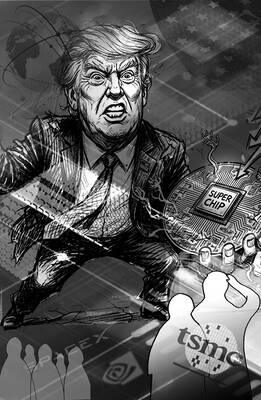
The White House’s decision to take a 9.9 percent stake in Intel Corp is looking like very shrewd business indeed. Since the government bought in at US$20.47 a share last August, the US chipmaker’s surging stock price has delivered the US a US$43 billion return. One of the reasons the investment has so far proved so sound is that the White House has made sure of it. According to The Wall Street Journal, Howard personally pushed deals on Intel’s behalf with some of the most lucrative clients imaginable. They include Nvidia Corp, the company at the heart of the AI
A single photograph can cut through a lot of noise, but it can also be used to misrepresent the truth. At the very least, it can concentrate the mind on something that requires further investigation. On Monday last week, Ma Ying-jeou Foundation CEO Tai Hsia-ling (戴遐齡) and former National Security Council secretary-general King Pu-tsung (金溥聰) held a news conference in which they showed a photograph of former foundation CEO Hsiao Hsu-tsen (蕭旭岑), now Chinese Nationalist Party (KMT) deputy chairman. In the image Hsiao is seated next to Xiamen Taiwan Businessmen Association chairman Han Ying-huan (韓螢煥). The two men were holding
I first met Professor Ray Jiing (井迎瑞) as a film and documentary student at Shih Hsin University’s (SHU) Department of Radio Television and Film in 1988. The following year, he went on to become the director of the Chinese Taipei Film Archive — forerunner of the Taiwan Film and Audiovisual Institute (TFAI). Over his eight-year tenure, Jiing rescued and restored over 200 classic Taiwanese films. In 1997, he established the Graduate Institute of Studies in Documentary and Film Archiving at Tainan National University of the Arts (TNNUA), and I joined the program in his third cohort of students. Beyond a
A recent report concerning a student who is suing his teacher posed the question in its headline: Does failing a student in two subjects constitute bullying? The college student in Chiayi County apparently sought NT$2 million (US$63,603) in state compensation, but a court dismissed the case. The first reaction of many might have been to ask: What has happened to students nowadays? Some say that teachers have lost their authority, while others say students are overindulged. Some even start reminiscing over the days when “whatever the teacher says goes.” However, the real issue might be overlooked if emotional reactions like that are the


 RSS
RSS