


South Korea is getting a rude awakening about what happens when US priorities shift: Even long-standing alliances can start to look like relationships of convenience.
Any erosion of US reliability in the Indo-Pacific weakens confidence in Washington. It also strengthens China’s narrative that the US is unwilling to stay the course when its interests move elsewhere.
The reported transfer of US air defense assets — including parts of the Terminal High Altitude Area Defense (THAAD) system — from the Korean Peninsula to the Middle East to support operations in the Iran war is causing all kinds of alarm. The US and South Korea agreed to install it in 2016 to help Seoul combat North Korea’s growing nuclear and missile threat.
US President Donald Trump has also asked countries like Japan, South Korea and China, along with NATO and other allies, to send warships to the Strait of Hormuz to help commercial vessels sail through it safely. He has threatened to delay his summit with Chinese President Xi Jinping (習近平) if Beijing does not agree to his demands.
Seoul has not made a decision on whether to help Trump and is wary of getting dragged into an ever-deepening crisis. South Korean President Lee Jae-myung struck a careful note when he addressed the THAAD issue in parliament last week, acknowledging that the government opposed the redeployment but conceding that nothing could be done to prevent it.
This is a difficult moment for South Koreans. It is a reminder that the guarantees offered by their most important ally cannot be trusted. The country has already been bruised by the White House’s tariffs. To contain the damage, Trump and his team need to offer Seoul reassurance — not chaotic messaging and difficult requests.
Pyongyang has already seized the moment. It fired more than 10 ballistic missiles toward the waters off its eastern coast on Saturday, days after testing cruise missiles from a new warship. This is worrying for Lee, who said that even if the US military moves air defense assets out of South Korea, it would not seriously affect Seoul’s ability to defend itself against its nuclear-armed neighbor.
North Korea’s supreme leader, Kim Jong-un, is in his strongest position in years, as I have written recently. The conflict in Iran will only reinforce his perception that Washington’s attention is divided.
None of this means the US-South Korea alliance is collapsing. Washington stations roughly 28,500 troops there under a mutual defense treaty codified in 1953. For decades, that alliance has anchored deterrence on a peninsula that remains technically at war.
Seoul has been a willing partner, boosting defense spending in response to Trump’s calls for greater burden-sharing. It has also pushed through a special bill to invest US$350 billion in the US in an attempt to placate the president over his arbitrary tariff program.
This plays neatly into China’s narrative. Beijing objected vehemently to the installation of THAAD around a decade ago, notes Edward Howell, a lecturer in international relations at the University of Oxford and author of the upcoming book A New Axis of Upheaval: North Korea, Russia, China, Iran. Chinese officials have long argued the US-made system could be used to track its own missiles in a Taiwan conflict, weakening Beijing’s nuclear deterrence, he told me. If parts of it are now redeployed elsewhere, “it will raise broader questions about how reliable US alliances are in the Indo-Pacific,” Howell said.
Seoul spent years dealing with economic and political fallout from China for hosting THAAD. The costs ran into the billions, as relations with its largest trading partner sank to historic lows. However, it absorbed that backlash and argued the system was essential to counter North Korea’s evolving missile threat. Washington has left Seoul wondering whether those sacrifices were made in vain.
This harsh lesson is being absorbed in real time by South Koreans, who could start pushing their government to rely less on the US for protection and strengthen their own defenses by expanding domestic weapons programs and even considering the idea of a homegrown nuclear arsenal. Public opinion polls have consistently shown widespread support for developing an independent deterrent. If doubts about US reliability deepen, that pressure will grow.
This could trigger a regional arms race, undermining the nonproliferation framework America has spent decades trying to uphold. Lee has also been making overtures to Beijing, which could open up more space for China to expand its influence.
How the US balances its priorities will reinforce longer-term concerns about its security guarantees. Japan, which hosts the largest concentration of US forces in Asia, will be particularly sensitive to any signs that these commitments are becoming conditional. Its defense minister said Monday there were no plans to send warships to the Strait of Hormuz.
In the absence of a clear response, Washington could simply clarify whether the reported THAAD redeployment is temporary. Outlining other measures to protect Seoul and preserve deterrence on the peninsula would go a long way to calm nerves. Providing details about additional surveillance, rotational deployments, and expanded exercises might also help reassure anxious citizens. A joint US-South Korea statement should outline that treaty obligations remain ironclad.
Without that clarity, doubt will fill the vacuum.
Karishma Vaswani is a Bloomberg Opinion columnist covering Asia politics with a special focus on China. Previously, she was the BBC’s lead Asia presenter and worked for the BBC across Asia and South Asia for two decades. This column reflects the personal views of the author and does not necessarily reflect the opinion of the editorial board or Bloomberg LP and its
On March 22, 2023, at the close of their meeting in Moscow, media microphones were allowed to record Chinese Communist Party (CCP) dictator Xi Jinping (習近平) telling Russia’s dictator Vladimir Putin, “Right now there are changes — the likes of which we haven’t seen for 100 years — and we are the ones driving these changes together.” Widely read as Xi’s oath to create a China-Russia-dominated world order, it can be considered a high point for the China-Russia-Iran-North Korea (CRINK) informal alliance, which also included the dictatorships of Venezuela and Cuba. China enables and assists Russia’s war against Ukraine and North Korea’s
After thousands of Taiwanese fans poured into the Tokyo Dome to cheer for Taiwan’s national team in the World Baseball Classic’s (WBC) Pool C games, an image of food and drink waste left at the stadium said to have been left by Taiwanese fans began spreading on social media. The image sparked wide debate, only later to be revealed as an artificially generated image. The image caption claimed that “Taiwanese left trash everywhere after watching the game in Tokyo Dome,” and said that one of the “three bad habits” of Taiwanese is littering. However, a reporter from a Japanese media outlet
Taiwanese pragmatism has long been praised when it comes to addressing Chinese attempts to erase Taiwan from the international stage. “Taipei” and the even more inaccurate and degrading “Chinese Taipei,” imposed titles required to participate in international events, are loathed by Taiwanese. That is why there was huge applause in Taiwan when Japanese public broadcaster NHK referred to the Taiwanese Olympic team as “Taiwan,” instead of “Chinese Taipei” during the opening ceremony of the Tokyo Olympics. What is standard protocol for most nations — calling a national team by the name their country is commonly known by — is impossible for
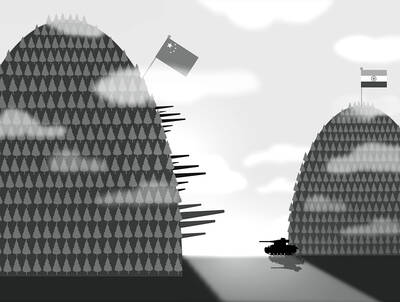
India is not China, and many of its residents fear it never will be. It is hard to imagine a future in which the subcontinent’s manufacturing dominates the world, its foreign investment shapes nations’ destinies, and the challenge of its economic system forces the West to reshape its own policies and principles. However, that is, apparently, what the US administration fears. Speaking in New Delhi last week, US Deputy Secretary of State Christopher Landau warned that “we will not make the same mistakes with India that we did with China 20 years ago.” Although he claimed the recently agreed framework


 RSS
RSS