


An escalating Pakistani campaign of airstrikes against targets in Afghanistan is aimed at forcing the Taliban authorities to abandon their support for Pakistani militants, officials and experts said.
The strategy is to impose such a steep cost on the Taliban administration that it acts to prevent attacks emanating from Afghanistan. Yet, it carries the risk of spiraling violence.
Afghan authorities on Tuesday said an overnight airstrike in Kabul had hit a drug rehabilitation center, killing 400 people.
Islamabad described that claim as propaganda, saying that the targets were “military and terrorist infrastructure.”
Since the 2021 Taliban takeover, waves of terrorist attacks have pummeled Pakistan, launched from what Islamabad considers to be sanctuaries in Afghanistan.
Pakistan said that its patience has snapped, naming an operation launched at the end of last month “Ghazab lil-Haq,” or “Righteous Fury.”
A senior Pakistani security official said that, as Pakistan was facing a rise in bloodshed, Afghanistan should also suffer, adding: “Why should they live in peace?”
The Taliban has denounced the airstrikes as a violation of sovereignty and vowed to retaliate. It has hinted at unleashing suicide bombers.
“They should not think that they can martyr people in Kabul, destroy the city and disturb its security, while remaining safe in Islamabad,” said Taliban Minister of Defense Mohammad Yaqoob, son of the movement’s founder, Mullah Omar.
Taliban Minister of Foreign Affairs Amir Khan Muttaqi compared the airstrike to Israel’s actions in Gaza, “repeated with full cruelty by a Muslim neighbor.”
Some of the airstrikes are rumored to have targeted Taliban leaders. Pakistan might eventually look for even more radical options.
In past decades, Islamabad backed armed opposition in Afghanistan, including the Taliban. However, no obvious group now exists to stage an uprising, while experts in Pakistan have said that this strategy backfired repeatedly. Islamabad has called for a more “inclusive” government in Kabul.
In recent months, Pakistan also imposed other measures, such as closing the border for trade to landlocked Afghanistan and expelling hundreds of thousands of Afghan refugees.
Mosharraf Zaidi, a spokesperson for Pakistani Prime Minister Shehbaz Sharif, said Pakistan had no quarrel with Afghans.
The airstrikes were based on intelligence and as accurate as counterterrorism operations anywhere, he added.
“There’s one objective: protect the people of Pakistan from further terrorist attacks,” Zaidi said. “Under this [Taliban] regime, there is a clear and sustained protection, nurturing and support for terrorist groups that has to end.”
Former Pakistani foreign secretary Aizaz Ahmad Chaudhry said Islamabad had tried to negotiate with the Taliban, bilaterally and with the involvement of other countries as mediators, including China and Middle Eastern nations, without results.
“The Taliban are running the state as a militia, rather than a government that cares for its people,” Chaudhry said. “Pakistan’s actions are defensive, not offensive.”
Former Pakistani ambassador to Afghanistan Asif Durrani said the West had washed its hands of Afghanistan with the 2021 withdrawal of foreign forces, leaving Pakistan to deal with the fallout.
“Pakistan has borne the pain,” Durrani said. “This is payback time.”
Durrani predicted that the Taliban government would not last, with tribal factions or other opponents emerging at some point in the future.
US-led international forces, present in Afghanistan for 20 years after the Sept. 11, 2001, terror attacks, had accused Pakistan of harboring the Taliban.
Islamabad said that Pakistani militants are now based in Afghanistan and that Afghans have also joined them.
Some analysts warned that just as those international and Afghan soldiers had failed to defeat the Taliban, a military onslaught from Pakistan would not work and had no clear off-ramp.
Pakistan has always tried to avoid being sandwiched between a hostile Afghanistan to the west and the threat from its foe India to the east, a scenario it now confronts. The US-Israeli war on Iran adds further instability along another of Pakistan’s borders.
Sanober Institute executive director Qamar Cheema said that Pakistan’s military leadership — led by Field Marshal Asim Munir — was different.
Munir has been described by US President Donald Trump as his “favorite field marshal.”
“The military leadership at the moment has a view that we need to act hard, we need to act strong, we need to be bold and we need to deal with the threat wherever it is,” Cheema said. “Nothing is off the table.”
On March 22, 2023, at the close of their meeting in Moscow, media microphones were allowed to record Chinese Communist Party (CCP) dictator Xi Jinping (習近平) telling Russia’s dictator Vladimir Putin, “Right now there are changes — the likes of which we haven’t seen for 100 years — and we are the ones driving these changes together.” Widely read as Xi’s oath to create a China-Russia-dominated world order, it can be considered a high point for the China-Russia-Iran-North Korea (CRINK) informal alliance, which also included the dictatorships of Venezuela and Cuba. China enables and assists Russia’s war against Ukraine and North Korea’s
After thousands of Taiwanese fans poured into the Tokyo Dome to cheer for Taiwan’s national team in the World Baseball Classic’s (WBC) Pool C games, an image of food and drink waste left at the stadium said to have been left by Taiwanese fans began spreading on social media. The image sparked wide debate, only later to be revealed as an artificially generated image. The image caption claimed that “Taiwanese left trash everywhere after watching the game in Tokyo Dome,” and said that one of the “three bad habits” of Taiwanese is littering. However, a reporter from a Japanese media outlet
Taiwanese pragmatism has long been praised when it comes to addressing Chinese attempts to erase Taiwan from the international stage. “Taipei” and the even more inaccurate and degrading “Chinese Taipei,” imposed titles required to participate in international events, are loathed by Taiwanese. That is why there was huge applause in Taiwan when Japanese public broadcaster NHK referred to the Taiwanese Olympic team as “Taiwan,” instead of “Chinese Taipei” during the opening ceremony of the Tokyo Olympics. What is standard protocol for most nations — calling a national team by the name their country is commonly known by — is impossible for
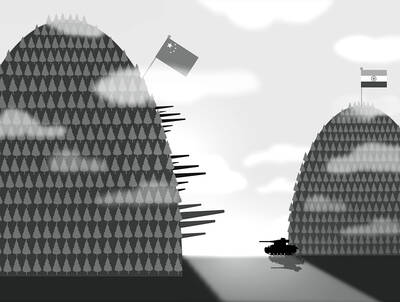
India is not China, and many of its residents fear it never will be. It is hard to imagine a future in which the subcontinent’s manufacturing dominates the world, its foreign investment shapes nations’ destinies, and the challenge of its economic system forces the West to reshape its own policies and principles. However, that is, apparently, what the US administration fears. Speaking in New Delhi last week, US Deputy Secretary of State Christopher Landau warned that “we will not make the same mistakes with India that we did with China 20 years ago.” Although he claimed the recently agreed framework


 RSS
RSS