


Napoleon famously derided his foreign minister, Prince Talleyrand, as “de la merde dans un bas de soie” (shit in a silk stocking). That quip came to mind watching US President Donald Trump’s foreign minister, US Secretary of State Marco Rubio, address this year’s Munich Security Conference.
Last year, US Vice President J.D. Vance flew to Munich, Germany, to berate Europe’s leaders to their faces, attacking the EU’s immigration policies, hate speech regulations and efforts to keep the far right out of power. Rubio is Vance in a silk stocking. He delivered much the same message, this time swaddled in diplomatic gauze.
In 2016, Rubio called Trump “a con artist” who could not be trusted with the nuclear codes. Now, he serves as Trump’s chief diplomat — and he just presided, without protest, over the lapse of the last remaining agreement limiting Russian and US nuclear arms.
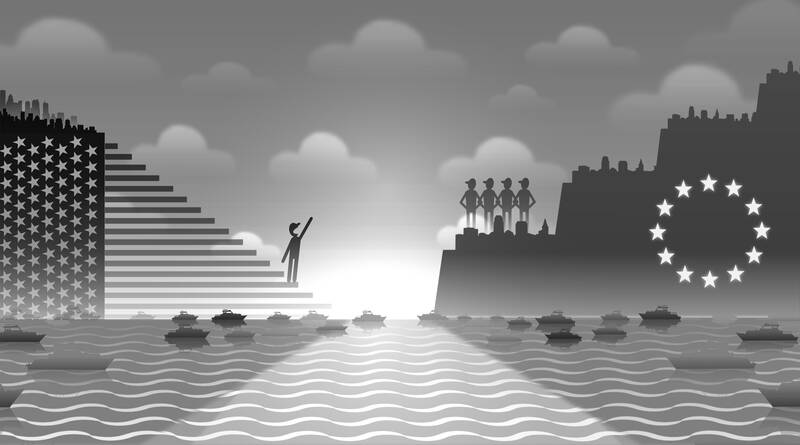
Illustration: Yusha
Rubio’s self-betrayal has been so thorough that it amounts to a job qualification. In Trump’s Washington, having once possessed principles and publicly discarded them is a more reliable proof of servility than never having had principles at all.
In Munich, Rubio saturated his speech with performative reassurance. The US and Europe “belong together.” Their destinies are “intertwined.” The US wants a “reinvigorated alliance” and a “strong Europe.” However, what holds the West together, in his telling, is not shared institutions, not a common commitment to the rule of law, not the post-World War II architecture of treaties and not multilateral cooperation. It is “shared history, Christian faith, culture, heritage, language, ancestry and the sacrifices our forefathers made together.”
The key words here are “Christian faith” and “ancestry.” Rubio defined the transatlantic bond not as a political alliance, but as a civilizational bloodline — a kinship rooted in religion and consanguinity.
“We will always be a child of Europe,” he said, a formulation that casts the relationship not as a contract among sovereign equals, but as a family tie — inherited, not chosen, with loyalty following from biology, not from shared principles and goals.
This is not the language of NATO. It is the language of the late academic Samuel Huntington’s “clash of civilizations” — the idea that the West is defined not by what it believes, but by who it is; not by its principles, but by its bloodlines and its faith. It is a formula that builds an imaginary wall around Christian Europe and its diaspora, and leaves outside Europe’s Muslim citizens, the secular traditions of the French Republic and the multi-confessional realities of modern European life.
Rubio’s promise of a future “as proud, as sovereign, and as vital as our civilization’s past” gives the game away. The future he describes is not a vision of something to be built. It is the past projected forward — nostalgia packaged as a goal.
So, what lay beneath the silk was the same litany Vance delivered last year, now stated with somewhat better manners: Europe has outsourced its sovereignty to multilateral institutions. Europe is captive to a “climate cult” that impoverishes its citizens. Mass immigration threatens “civilizational erasure.”
Of course, “civilizational erasure” is not a neutral description of demographic change. It is the vocabulary of the European far right, obsessed with the “great replacement” of white people. In Munich, Rubio conferred the legitimacy of the world’s most powerful government on a narrative that frames immigration not as a policy challenge to be managed, but as an existential threat to Western civilization’s survival — a framing that places it beyond the reach of compromise or democratic restraint.
Rubio’s polish made the phrase more dangerous, not less: Couched in the language of shared concern for Europe’s future, it sounded almost solicitous, as if the Trump administration were merely trying to save its friends from a peril that they were too polite to name. However, the effect is to narrow the space for pragmatic cooperation on asylum, labor mobility and integration — the actual work European governments need to do — while handing Europe’s nationalist parties an endorsement that they could scarcely have imagined before Trump.
Rubio’s casual use of the derogatory phrase “climate cult” also deserves attention — not for what it says about climate policy, but for what it reveals about the hollowness of Rubio’s references to the glorious future his boss claims to be building. Climate policy is, by definition, an investment in the future — perhaps the most consequential one any generation could make. Calling it a cult, dismissing climate mitigation efforts as religious delusion, is a spectacular way of saying that the future habitability of the planet is not worth investing in.
Moreover, Rubio’s schedule told a different story than his rhetoric. On Feb. 13, the day before his conference speech, he skipped the Berlin Format meeting on Ukraine — a gathering that included Ukrainian President Volodymyr Zelenskiy, French President Emmanuel Macron, German Chancellor Friedrich Merz, and the heads of the European Commission, the European Council and NATO. After his speech, he flew to Bratislava and Budapest to visit Slovakian Prime Minister Robert Fico and Hungarian Prime Minister Viktor Orban — the EU’s two most Russia-friendly leaders, who Trump has courted as ideological allies and recently hosted at Mar-a-Lago.
So, while Rubio told his Munich audience that the US wants a “strong Europe,” he is publicly backing leaders who have made careers of attacking European institutions from within, vetoing collective action and cultivating ties with Russian President Vladimir Putin.
Pressed on Ukraine in the post-speech interview, Rubio let slip a revealing formulation: The US wants a deal that Ukraine could “live with” and that Russia could “accept.” The asymmetry is the point. Ukraine is expected to endure; Russia is expected to be satisfied.
Rubio did not fly from Munich to Bratislava and Budapest to deepen the transatlantic alliance. He went to show which Europe the US prefers: not a Europe of collective defense and shared sovereignty, but a Europe of governments that defy the EU, court the Kremlin and call it sovereignty.
Russia and China were absent from Rubio’s speech. The enemies he identified were not authoritarian great powers, but immigration, climate policy and the multilateralism that has governed the Western alliance since 1945.
Chinese Minister of Foreign Affairs Wang Yi (王毅) happily exploited this opening, saying that “certain countries” undermining multilateral cooperation and reviving a Cold War mentality bear primary responsibility for today’s global dysfunction — a rebuke that would have been harder to deliver had Rubio not just dismissed the post-World War II institutional order from the same stage.
Rubio is no Talleyrand. Whereas Talleyrand served France’s interests while reshaping Europe’s balance of power, Rubio serves a president who mistakes demolition for strength and nostalgia for renewal. The silk stocking softened the tone and flattered the audience. However, beneath it lays the same message Vance delivered bare-knuckled last year — that Europe is useful only if it submits, Western civilization is defined by exclusion and a common future is available only on conditions that guarantee there would never be one.
Stephen Holmes, professor of law at New York University School of Law and Richard Holbrooke fellow at the American Academy in Berlin, is the coauthor of The Light that Failed: A Reckoning.
Copyright: Project Syndicate
When Chinese President Xi Jinping (習近平) sits down with US President Donald Trump in Beijing on Thursday next week, Xi is unlikely to demand a dramatic public betrayal of Taiwan. He does not need to. Beijing’s preferred victory is smaller, quieter and in some ways far more dangerous: a subtle shift in American wording that appears technical, but carries major strategic meaning. The ask is simple: replace the longstanding US formulation that Washington “does not support Taiwan independence” with a harder one — that Washington “opposes” Taiwan independence. One word changes; a deterrence structure built over decades begins to shift.
The cancelation this week of President William Lai’s (賴清德) state visit to Eswatini, after the Seychelles, Madagascar and Mauritius revoked overflight permits under Chinese pressure, is one more measure of Taiwan’s shrinking executive diplomatic space. Another channel that deserves attention keeps growing while the first contracts. For several years now, Taipei has been one of Europe’s busiest legislative destinations. Where presidents and foreign ministers cannot land, parliamentarians do — and they do it in rising numbers. The Italian parliament opened the year with its largest bipartisan delegation to Taiwan to date: six Italian deputies and one senator, drawn from six
Recently, Taipei’s streets have been plagued by the bizarre sight of rats running rampant and the city government’s countermeasures have devolved into an anti-intellectual farce. The Taipei Parks and Street Lights Office has attempted to eradicate rats by filling their burrows with polyurethane foam, seeming to believe that rats could not simply dig another path out. Meanwhile, as the nation’s capital slowly deteriorates into a rat hive, the Taipei Department of Environmental Protection has proudly pointed to the increase in the number of poisoned rats reported in February and March as a sign of success. When confronted with public concerns over young
Taipei is facing a severe rat infestation, and the city government is reportedly considering large-scale use of rodenticides as its primary control measure. However, this move could trigger an ecological disaster, including mass deaths of birds of prey. In the past, black kites, relatives of eagles, took more than three decades to return to the skies above the Taipei Basin. Taiwan’s black kite population was nearly wiped out by the combined effects of habitat destruction, pesticides and rodenticides. By 1992, fewer than 200 black kites remained on the island. Fortunately, thanks to more than 30 years of collective effort to preserve their remaining


 RSS
RSS