


India is getting richer every year, but its cities do not seem to be getting any more livable. Not because the country is too poor, or because leaders lack ambition, but because urban citizens are starved of funds and deprived of representation — and the government is in no hurry to fix it, even though people are dying as a result.
Mumbai’s skyline is dotted with opulent glass towers, and it calls itself India’s commercial capital. The civic body, the Brihanmumbai Municipal Corp, is the country’s richest. Yet, residents have lived for years with no say in how their city was being run. When it finally held local polls last month, it was after a gap of nearly a decade.
The equivalent city authority in Bengaluru, home to world-beating tech companies, has not allowed people to vote for its leadership since 2015. It could hopefully happen later this year — only because the Indian Supreme Court last month put its foot down.

Illustration: Yusha
This carelessness about local polls is a widespread problem: Last year, Janaagraha estimated that 61 percent of urban governments in 17 of 28 states had their elections delayed.
Residents suffer when it happens, but powerful state-level politicians do not care. That is because they then get to handpick their favorite bureaucrats as stand-in administrators. When the local administration is unelected, it is also unaccountable and unresponsive. It could focus on wringing revenue out of cities without having to do much to provide decent conditions to taxpayers.
Technically, cities should get a share of the national pool of taxes. In fact, the commission in charge of dividing revenue up between New Delhi, various states and local bodies reported that it was tripling the amount that urban local bodies are supposed to get. However, what is the point if there is nobody there to receive this largesse?
If a town does not hold elections, the rules say it misses out on these grants. Mumbai lost almost half a billion dollars because of this; other towns lost less, but they had far fewer resources to begin with and it hurt them even more.
It is not as if the federal government or state administrations are making up the shortfall. Last week’s budget made a song and dance about new grants supposedly targeting smaller towns, but the reality is that vital lines of urban finance have been cut. Funding for affordable housing shrank by 6 percent, for urban rejuvenation by 20 percent and for transportation by 60 percent.
New Delhi’s promises of cash are not worth the paper they are written on. Last year, the amount it spent on urban programs was 40 percent less than what was announced.
One funding cut was particularly distressing: The government’s flagship initiative for urban sanitation had its budget halved, just weeks after dozens died in Indore after drinking water that had been contaminated by raw sewage. This is a town that the government has ranked as the cleanest in the country every single year for the past eight years.
Even closeness to the centers of power does not protect locals from poor governance. Indian Prime Minister Narendra Modi’s long-time home of Gandhinagar, now represented in parliament by his trusted deputy, dealt with a typhoid outbreak last month after the water pipelines developed “several leaks” and let in sewage. At least 5,500 people in 26 cities across the country fell ill last year because of water contaminated by sewage due to faulty, decades-old pipelines — and that is just the cases that have been recorded and reported.
India has failed to give city residents the basics: uncontaminated water, breathable air and a government they could vote out if it fails them. Until it takes democratic accountability seriously, and gives elected urban leaders the power to tax and the authority to act, citizens would be forced to endure life in some of the world’s most hellish urban environments.
India is not short of ideas, expertise or funds. The cities are struggling, because they are treated as outposts of an empire: Administered by unaccountable viceroys and dangerous to the people forced to live in them.
Mihir Sharma is a Bloomberg Opinion columnist. A senior fellow at the Observer Research Foundation in New Delhi, he is author of Restart: The Last Chance for the Indian Economy. This column reflects the personal views of the author and does not necessarily reflect the opinion of the editorial board or Bloomberg LP and its owners.
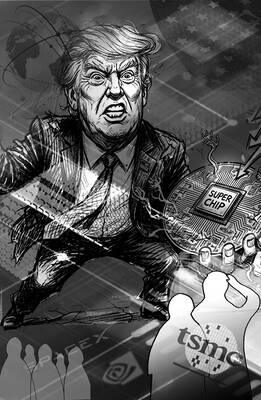
The White House’s decision to take a 9.9 percent stake in Intel Corp is looking like very shrewd business indeed. Since the government bought in at US$20.47 a share last August, the US chipmaker’s surging stock price has delivered the US a US$43 billion return. One of the reasons the investment has so far proved so sound is that the White House has made sure of it. According to The Wall Street Journal, Howard personally pushed deals on Intel’s behalf with some of the most lucrative clients imaginable. They include Nvidia Corp, the company at the heart of the AI
A single photograph can cut through a lot of noise, but it can also be used to misrepresent the truth. At the very least, it can concentrate the mind on something that requires further investigation. On Monday last week, Ma Ying-jeou Foundation CEO Tai Hsia-ling (戴遐齡) and former National Security Council secretary-general King Pu-tsung (金溥聰) held a news conference in which they showed a photograph of former foundation CEO Hsiao Hsu-tsen (蕭旭岑), now Chinese Nationalist Party (KMT) deputy chairman. In the image Hsiao is seated next to Xiamen Taiwan Businessmen Association chairman Han Ying-huan (韓螢煥). The two men were holding
I first met Professor Ray Jiing (井迎瑞) as a film and documentary student at Shih Hsin University’s (SHU) Department of Radio Television and Film in 1988. The following year, he went on to become the director of the Chinese Taipei Film Archive — forerunner of the Taiwan Film and Audiovisual Institute (TFAI). Over his eight-year tenure, Jiing rescued and restored over 200 classic Taiwanese films. In 1997, he established the Graduate Institute of Studies in Documentary and Film Archiving at Tainan National University of the Arts (TNNUA), and I joined the program in his third cohort of students. Beyond a
President William Lai Ching-te’s (賴清德) May 20 second-anniversary address was not just a routine policy review; it was damage control. US President Donald Trump’s remarks — that he did not want to see anyone move toward independence and that the delivery of a major Taiwan arms package could depend on the progress of US-China relations — unsettled Taiwan’s public and created an opening for opposition parties to question whether Taiwan was being treated as a bargaining chip in Washington’s dealings with Beijing. Lai’s speech was designed to close that opening. The address covered the expected ground: sovereignty, cross-strait relations, defense spending,


 RSS
RSS