


The US’ highest court on Friday struck down a number of the White House’s tariffs in a revision of the extent and form of power wielded by US President Donald Trump’s administration over foreign trade and economic relations. As soon as he returned to office last year, Trump made sweeping use of executive authority to exert pressure on trading partners, rolling out “reciprocal” tariffs under the International Emergency Economic Powers Act (IEEPA). It was a coercive and rapidly enforced policy, altering the US’ relationship with each and every one of its trading partners virtually overnight.
Critically, the ruling against the use of IEEPA to unilaterally impose broad tariffs means that similar programs would need a clear and alternative legal basis involving congressional approval. It does not mean that the tariffs would disappear altogether, or that Trump is out of other options. For example, specific sectors could be targeted under Section 232 of the Trade Expansion Act, and individual countries could face punitive tariffs under Section 301 of the Trade Act.
For Taiwanese companies, the biggest change is the reduced risk of being caught off guard by unanticipated and immediately implemented tariff measures; such levies would be subject to clearer, more institutionalized procedures. Taiwan must also be prepared to respond to possible changes to the outcomes of its negotiations with the US. The agreement signed last month has seen tariffs reduced for certain products and, despite leaving some benefits left to be desired, nevertheless afforded Taiwanese companies a level of stability and reduced psychological stress for predicting risks and managing investments.
The Trump administration has already made clear its intentions to maintain broad trading pressure through alternative legal mechanisms. However, losing the flexibility of the IEEPA is still a blow to the White House, creating stricter executive procedural requirements and judicial scrutiny.
Trade structures that emerge in the wake of Trump’s barrage of tariffs are unlikely to return to their previous arrangement. Traditional manufacturing sectors have long since begun diversifying their supply chains, with some outfits relocating their production lines out of China to Southeast Asia or other regions. Buyers have similarly grown accustomed to more diversified procurement habits. Even if tariffs are lifted, “de-concentrated” supply chain structures are unlikely to disappear.
Within the US and China’s relationship as strategic competitors, thinking on technology and supply chains has not changed, particularly on semiconductors. The US continues to influence economic decisionmaking through export controls, investment reviews and subsidy conditions. Even if Trump’s tariff tools are limited, technological competition would continue to pressure Taiwanese firms.
For the chip industry, represented by the Taiwan Semiconductor Manufacturing Co, the challenge is not simply tariff rates, but the combined impact of national security frameworks, export controls and subsidy policies. Technology transfers and establishing fabs in the US are aimed more at long-term strategic positioning than merely responding to tariffs.
Although the US Supreme Court ruling certainly eases a level of external uncertainty, for companies that have already decided to invest more heavily in the US, marginal adjustments might be made based on revised risk assessments, but a wholesale withdrawal is unlikely.
As for retail and service industries, as tariff negotiations begin to yield results and the latest court ruling reduces risks, companies could expect boosts to profitability and potentially stock prices. Benefits might also be seen for high-end consumer goods, department stores and the hospitality industry.
Great power rivalry is a long-term phenomenon, and one that is here to stay. For Taiwanese corporations, right now is a moment for adjustment after the stress test of Trump’s tariff war. Competitiveness would not be decided by hopes of dodging tariffs and seeing competitors getting slapped with even higher duties, but by successful industrial upgrading. Meanwhile, whether Trump will resort to more forceful measures to achieve his aims remains to be seen.
Wang Fu Kai is the president of the Chinese Integrated Marketing Communications Association.
Translated by Gilda Knox Streader
During the long Lunar New Year’s holiday, Taiwan has shown several positive developments in different aspects of society, hinting at a hopeful outlook for the Year of the Horse, but there are also significant challenges that the country must cautiously navigate with strength, wisdom and resilience. Before the holiday break, Taiwan’s stock market closed at a record 10,080.3 points and the TAIEX wrapped up at a record-high 33,605.71 points, while Taipei and Washington formally signed the Taiwan-US Agreement on Reciprocal Trade that caps US tariffs on Taiwanese goods at 15 percent and secures Taiwan preferential tariff treatment. President William Lai (賴清德) in
As red lanterns adorn street corners and social media feeds teem with zodiac divinations, the Year of the Horse has arrived. In our hyper-accelerated age, the horse is almost exclusively synonymous with the idiom ma dao cheng gong (馬到成功) — “instant success upon arrival.” It is a linguistic shot of adrenaline, fueling the thrilling illusion that once the bell tolls, our lives would screech off into a cloud of dust, leaving all troubles behind. Yet, when examining the millennia-long partnership between humans and this magnificent “biological machine,” a different truth emerges. The true essence of the horse is not merely speed;
Chinese Nationalist Party (KMT) Deputy Chairman Hsiao Hsu-tsen (蕭旭岑) earlier this month led a delegation to Beijing to attend a think tank forum between the KMT and Chinese Communist Party (CCP). After returning to Taiwan, Hsiao spoke at length about “accumulating mutual trust” and letting matters “fall into place,” portraying the forum as a series of discussions focused on cooperation in tourism, renewable energy, disaster prevention, emerging industries, health and medicine, and artificial intelligence (AI). However, when the entire dialogue presupposes the so-called “1992 consensus — the idea that there is only “one China,” with each side of the Taiwan
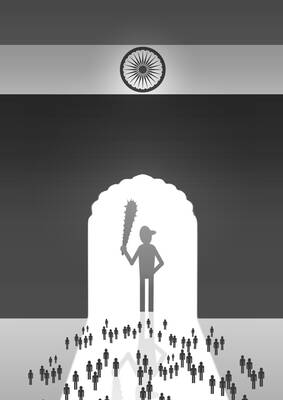
India is getting richer every year, but its cities do not seem to be getting any more livable. Not because the country is too poor, or because leaders lack ambition, but because urban citizens are starved of funds and deprived of representation — and the government is in no hurry to fix it, even though people are dying as a result. Mumbai’s skyline is dotted with opulent glass towers, and it calls itself India’s commercial capital. The civic body, the Brihanmumbai Municipal Corp, is the country’s richest. Yet, residents have lived for years with no say in how their city was


 RSS
RSS