


Ongoing efforts to derail multilateral tax cooperation lie at the heart of a global program to replace democratic governance with coercive rule by the extremely wealthy — or what we call 21st-century Caesarism. Any strategy to counter this program therefore must recognize that taxing extreme wealth is essential to saving democracy.
Fortunately, there has been some progress here. The African Union continues to champion the UN Framework Convention on International Tax Cooperation; Colombia, Brazil, Spain and Tunisia have implemented progressive tax reforms; the French public has signaled strong support for a 2 percent tax on the ultra-wealthy; and a proposed California ballot initiative would enact a one-time 5 percent tax on billionaires’ net worth.
However, tax justice remains hotly contested. At the Organisation for Economic Co-operation and Development (OECD)/G20 Inclusive Framework negotiations early last month, more than 145 countries agreed to give big US multinationals a free pass. Having been compromised by power imbalances from the outset, the OECD/G20 process was easy for US President Donald Trump to hijack. Following intensive lobbying by Washington, large US energy, technology and pharmaceutical firms secured sweeping exemptions from the 15 percent global minimum tax that had been agreed in 2021 after a decade of painstaking negotiations.
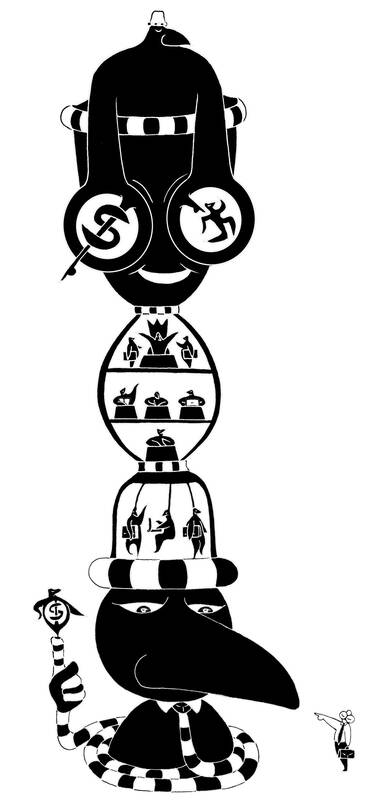
Illustration: Mountain People
Of course, the OECD/G20 Inclusive Framework could not state its surrender openly. Instead, it suddenly “discovered” that the existing US tax regime is equivalent to Pillar Two of the original agreement, implying that other countries are barred from imposing additional taxes on multinationals headquartered in the US.
However, the two are not the same: The global minimum tax applies a country-by-country computation to determine the amount, whereas US rules apply to US-based multinationals’ total foreign profits. The latter allows companies to offset high taxes paid in some countries against zero taxes paid in others, thus restoring the advantages of zero-tax jurisdictions.
Not only does this new agreement fundamentally undermine the principle that multinationals should pay a minimum coordinated tax rate wherever they operate. It also grants US-headquartered multinationals a competitive advantage over other multinationals, all of which are still subject to the 15 percent global minimum tax.
The mechanism for this capitulation was revealing. Under threat of retaliation from the US, G7 leaders prenegotiated the new terms in June last year, and Inclusive Framework members rubber-stamped them last month to avoid picking another fight with Trump.
As Oswald Spengler warned a century ago about the collapse of democracy and the rise of Caesarism, “the forces of dictatorial money-economics” are dismantling the regulatory state and multilateralism. Trump’s aggressive neo-mercantilist strategy — unilaterally declaring punitive tariffs, threatening and imposing blockades, kidnapping national leaders, wielding aircraft carriers like privateer ships, and proposing “boards of peace” designed to re-establish colonial control — bypasses existing international institutions wherever it can. The goal is to appropriate resources and prevent perceived rivals such as China from accessing them.
No country should relinquish its sovereign right to tax multinationals and the super-rich. To surrender this prerogative is not only morally bankrupt and strategically misguided; it is also economically foolish.
To see this, consider Brazil’s economic recovery under President Luiz Ignacio Lula da Silva, Spain’s robust growth under Prime Minister Pedro Sanchez, or Colombia’s growth since the introduction of progressive tax reforms by former Colombian minister of finance and public credit Jose Antonio Ocampo. These governments stood up to Trump and are leading a global democratic counterreactionary coalition. Their success provides powerful empirical evidence that progressive fiscal policies and enhanced state capacity correlate with positive economic indicators and greater social cohesion.
Many in Europe are coming to this realization, too. In France, the “Zucman Tax” — Gabriel Zucman’s proposed minimum 2 percent tax on the wealth of the ultra-rich — commands almost 90 percent public support and is dominating the national conversation. Although initially rejected by the French National Assembly, it is up for renewed debate this year.
Similarly, in December last year, Tunisia approved a new 0.5 to 1 percent levy on the worldwide assets (including real estate, stocks, bonds and cryptocurrencies) of residents with holdings worth more than US$1 million. In California, voters this year are to decide whether to impose a one-time 5 percent levy on billionaires’ wealth to fund healthcare, food assistance and education. Notably, this initiative is gaining support even from some billionaires. In New York, negotiations toward the Framework Convention on International Tax Cooperation are to resume at the UN, a forum less vulnerable to corporate capture.
True, one of the Trump administration’s first acts was to withdraw from these talks, but the rest of the world decided to continue. The goal is to deliver a framework convention and two early protocols — one on the taxation of cross-border services and one on disputes — for approval by the UN General Assembly next year. The crucial question is how rights to tax the profits of multinationals should be allocated; also up for negotiation are new taxes on cross-border services (including digital ones), new commitments for countries to tax the super-rich, and better information exchanges between countries on beneficial asset ownership.
The current tax rules for multinationals, devised in the 1920s, are no longer fit for today’s digital economy. Negotiators in New York must seize this unique opportunity. They should abandon the fiction that a multinational enterprise is just a collection of independent entities — a conceit that big corporations use to shift profits to low-tax jurisdictions, thus abusing OECD guidelines. A unitary taxation approach is long overdue. The architecture starves governments of at least US$240 billion annually, forces local firms to compete on an uneven playing field, and leads to higher taxes on workers (whose income is less mobile), as countries try to offset lost revenues.
Multinationals’ global income should be apportioned to different jurisdictions on the basis of verifiable factors such as sales and employees, rather than on the outdated principle of “arm’s-length” transactions. The text of the tax convention should reflect this. Failing that, the deeply flawed rules would become entrenched, and the pursuit of “compatibility” with existing frameworks developed at the OECD would compromise both the ambition and the objectives of the UN Tax Convention.
The result would be another fruitless tweak to a failing system. If democracy is to prevail over Caesarism, we must tax extreme wealth — and we must do it fast.
Joseph E. Stiglitz, a Nobel laureate in economics, is a former chief economist of the World Bank, a former chair of the US President’s Council of Economic Advisers, university professor at Columbia University, and the author, most recently, of The Road to Freedom: Economics and the Good Society. Jayati Ghosh, professor of economics at the University of Massachusetts Amherst, is a member of the Club of Rome’s Transformational Economics Commission and cochair of the Independent Commission for the Reform of International Corporate Taxation.
Copyright: Project Syndicate
Taiwan’s higher education system is facing an existential crisis. As the demographic drop-off continues to empty classrooms, universities across the island are locked in a desperate battle for survival, international student recruitment and crucial Ministry of Education funding. To win this battle, institutions have turned to what seems like an objective measure of quality: global university rankings. Unfortunately, this chase is a costly illusion, and taxpayers are footing the bill. In the past few years, the goalposts have shifted from pure research output to “sustainability” and “societal impact,” largely driven by commercial metrics such as the UK-based Times Higher Education (THE) Impact
History might remember 2026, not 2022, as the year artificial intelligence (AI) truly changed everything. ChatGPT’s launch was a product moment. What is happening now is an anthropological moment: AI is no longer merely answering questions. It is now taking initiative and learning from others to get things done, behaving less like software and more like a colleague. The economic consequence is the rise of the one-person company — a structure anticipated in the 2024 book The Choices Amid Great Changes, which I coauthored. The real target of AI is not labor. It is hierarchy. When AI sharply reduces the cost
I wrote this before US President Donald Trump embarked on his uneventful state visit to China on Thursday. So, I shall confine my observations to the joint US-Philippine military exercise of April 20 through May 8, known collectively as “Balikatan 2026.” This year’s Balikatan was notable for its “firsts.” First, it was conducted primarily with Taiwan in mind, not the Philippines or even the South China Sea. It also showed that in the Pacific, America’s alliance network is still robust. Allies are enthusiastic about America’s renewed leadership in the region. Nine decades ago, in 1936, America had neither military strength
The Chinese Nationalist Party (KMT) is often accused of getting close to, and even conspiring with, the Chinese Communist Party (CCP). There are certainly good reasons behind these accusations, yet the confounding truth is that it makes neither historical nor logical sense for it to do so. Whether one believes that the Chinese civil war fought between the KMT and CCP in the previous century has ended or has yet to be resolved, the KMT’s retreat to Taiwan in 1949 resulted in the CCP governing China and the KMT taking root in Taiwan. For years, the KMT refused to even


 RSS
RSS