


US President Donald Trump last week stole the spotlight during the World Economic Forum in Davos, Switzerland, before artificial intelligence (AI) took center stage. Trump’s threats to impose tariffs on European allies over his ambitions to take Greenland triggered a sell-off in global equities. It was only after walking back the trade threats and ambitions to take Greenland by force that markets returned to calm and AI took over, with debate about the good and the bad the technology could unleash.
IMF managing director Kristalina Georgieva at a panel on the global economic outlook said an “AI tsunami” was hitting the labor market, and it would wipe out many entry-level jobs, mostly affecting young people.
As the technology becomes increasingly widespread, the demand for skills would undergo a significant transformation, she said, citing IMF data.
AI is likely to affect about 60 percent of jobs in advanced economies and 40 percent globally, Georgieva said, adding that some people stand to benefit from the technology, but others face lower wages and fewer job opportunities.
Georgieva urged employers to discuss the role of AI tools with employees before adopting their use in the workplace, especially as the technology rapidly advances.
Still, no one knows how to make it safe and inclusive, she said, adding that her biggest worry is the potential harm that unregulated, market-driven deployment of AI would create.
Dario Amodei — CEO of Anthropic, one of the world’s most powerful AI creators — also expressed concern about high unemployment and underemployment brought on by widespread AI use.
Nevertheless, he said he believes the good from the technology would outweigh the bad, Bloomberg News reported.
Amodei has long warned about AI’s effects on the job market. During an interview last year, he said the emerging technology could wipe out 50 percent of entry-level jobs across technology, finance, law, consulting and other clerical positions, leading to a “white-collar bloodbath.”
Yet, not every business executive speaking at Davos agreed that AI is destined to wreak havoc on the labor market. Nvidia Corp CEO Jensen Huang (黃仁勳) made a case for realistic optimism, based on the history of technological advancements.
The massive build-out of AI infrastructure would create swaths of blue-collar jobs, Huang said, adding that he expected great demand for skilled vocational workers such as electricians, plumbers and construction workers, along with a substantial income.
“You don’t need to have a PhD in computer science to do so,” Bloomberg News quoted him as saying.
Just as people’s responses to any developing technology in the past, there are mixed views on the impact of AI on the labor market. The emergence of new technologies generally has three effects on labor demand: displacement, productivity and reinstatement, academic studies have shown.
The displacement effect means that the emergence of new technologies would replace the existing workforce, reducing labor demand. According to the productivity effect, new technologies would increase manufacturers’ productivity and profit, prompting them to further expand their operations and thus increasing labor demand. Meanwhile, the reinstatement effect states that new technologies create new types of jobs and demands, and in those jobs, labor would have a comparative advantage over machines, which would boost labor demand.
For pessimists, the displacement effect of AI would be significant, while optimists believe that the productivity and reinstatement effects of the technology would be sufficient to offset the displacement effect.
AI could be viewed as a form of creative destruction, which transforms jobs, rather than eliminating them. Regardless, as the technology is evolving rapidly, its long-term effects on economic growth and employment remain to be seen.
Most importantly, policymakers and officials should start looking into the workforce changes AI could create, develop policies to address the issues, and inform and educate the public on how AI might change their lives, positively and negatively.
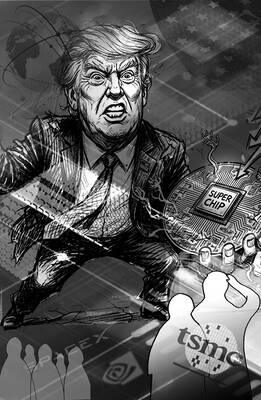
The White House’s decision to take a 9.9 percent stake in Intel Corp is looking like very shrewd business indeed. Since the government bought in at US$20.47 a share last August, the US chipmaker’s surging stock price has delivered the US a US$43 billion return. One of the reasons the investment has so far proved so sound is that the White House has made sure of it. According to The Wall Street Journal, Howard personally pushed deals on Intel’s behalf with some of the most lucrative clients imaginable. They include Nvidia Corp, the company at the heart of the AI
The Ministry of the Interior, working with the navy and coast guard, is organizing Taiwan’s first joint exercise simulating escort tankers carrying liquefied natural gas (LNG) and oil through a Chinese blockade. The drills simulate fuel transport along three maritime corridors leading toward Japan, the Philippines and the US. Deputy Minister of the Interior Sawyer Mars (馬士元) said that a blockade of the Taiwan Strait would amount to “almost a 100 percent blockade of the regional energy supply.” Minister of National Defense Wellington Koo said planning to counter a blockade is standard practice in Taipei. While the exercise is limited in
A single photograph can cut through a lot of noise, but it can also be used to misrepresent the truth. At the very least, it can concentrate the mind on something that requires further investigation. On Monday last week, Ma Ying-jeou Foundation CEO Tai Hsia-ling (戴遐齡) and former National Security Council secretary-general King Pu-tsung (金溥聰) held a news conference in which they showed a photograph of former foundation CEO Hsiao Hsu-tsen (蕭旭岑), now Chinese Nationalist Party (KMT) deputy chairman. In the image Hsiao is seated next to Xiamen Taiwan Businessmen Association chairman Han Ying-huan (韓螢煥). The two men were holding
I first met Professor Ray Jiing (井迎瑞) as a film and documentary student at Shih Hsin University’s (SHU) Department of Radio Television and Film in 1988. The following year, he went on to become the director of the Chinese Taipei Film Archive — forerunner of the Taiwan Film and Audiovisual Institute (TFAI). Over his eight-year tenure, Jiing rescued and restored over 200 classic Taiwanese films. In 1997, he established the Graduate Institute of Studies in Documentary and Film Archiving at Tainan National University of the Arts (TNNUA), and I joined the program in his third cohort of students. Beyond a


 RSS
RSS