


It is not too dramatic to say that Japan has only 12 years left to secure its future. By 2038, Chinese President Xi Jinping (習近平) will be 85 years old. As long as he remains healthy, it is difficult to imagine that he would abandon the ambition of fully absorbing Taiwan into China, meaning that Japan has a dozen years, at most, to prevent moves in this direction.
Whether it succeeds or fails will decisively shape its own fate.
Japan can no longer assume that time is on its side. Twelve years pass quickly. In 2014, Japan had already secured its role as host of the 2020 Olympic Games. That still feels recent, yet the world has changed profoundly since then. Geopolitical time now moves far faster than public awareness.
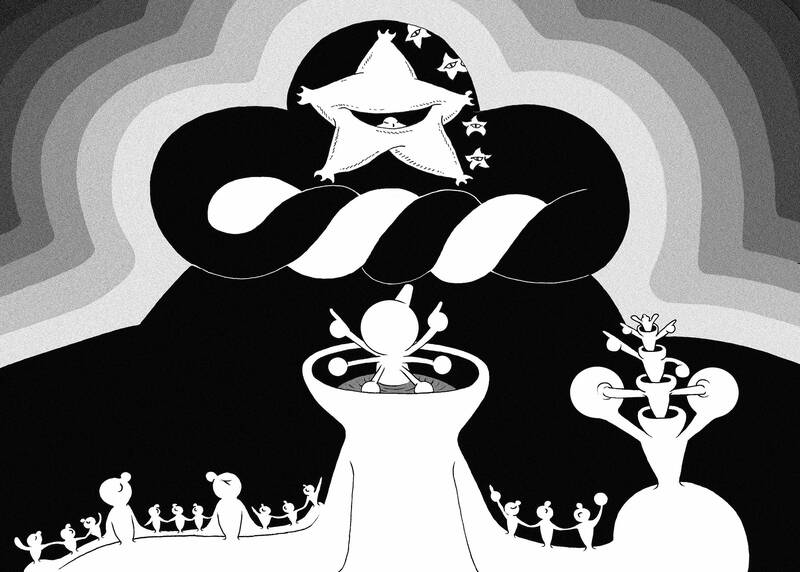
Illustration: Mountain People
If Japan wishes to preserve its strategic autonomy, it must be able to explain convincingly why it cannot and should not fall under China’s influence. A crucial first step is to recognize that Japan’s post-World War II strategic framework has become obsolete. Such an acknowledgment has implications for politics, economics, alliance management and even constitutional arrangements.
For decades, Japan defined itself as a pacifist state. It upheld its pledge not to acquire nuclear weapons, refrained from exporting arms and behaved impeccably at the UN. It sought to be liked by all countries, China included.
During China’s “reform and opening up,” Japan channeled massive amounts of investment into the country.
That posture served its purpose. It reassured regional neighbors and positioned Japan favorably during an era of expanding globalization.
However, that era has ended.
While the principles Japan upheld throughout the post-war period were not inherently mistaken, restraint now carries growing strategic costs. Reliance on multilateral legitimacy — particularly through the UN — is becoming a source of weakness as multilateral institutions fragment. The pursuit of universal friendship is giving way to selective alignment and the formation of hostile blocs.
Behind these shifts lies a transformational change. The US, Japan’s strategic guarantor since the end of the war, is no longer the country it once was. Eight decades after the Allied victory, lessons about how previous wars began and what it cost to win them no longer shape US strategic instincts. World War II, the Korean War and the Vietnam War have become distant memories for the current leaders of the US.
The US commitment to defend Japan, South Korea and Taiwan emerged from a victory achieved 80 years ago. Washington maintained its security guarantees not only because of their strategic value, but also because of the immense cost incurred in securing them.
However, that logic has lost much of its hold on policymakers today, and therein lies the central irony confronting Japan. For decades, its security rested on being obviously indispensable — to US strategy in Asia, to the global economy and to the open trading system.
However, today US leaders increasingly question Japan’s indispensability and expect the country to prove its worth through crude cost-benefit calculations.
These global shifts collide sharply with Japan’s domestic realities. Strategic competition rewards speed, yet Japan is an aging society. It faces a stark trade-off between missiles and hospital beds. To double defense spending over a decade would require sustained annual growth of roughly 7 percent, an extraordinarily difficult feat.
Even if such a doubling were achieved, it would still be far from sufficient to counter a rapidly expanding Chinese military.
Meanwhile, confusion surrounding Japan’s non-nuclear principles persists. The three principles — not possessing, not producing and not permitting the introduction of nuclear weapons — remain deeply embedded in national identity, as does the moral inheritance of Hiroshima and Nagasaki. What has changed is not a loss of trust in US extended deterrence, but a growing recognition that deterrence must be credible not only in theory, but also in practice. As the regional security environment deteriorates, many are questioning whether the US’ faraway nuclear capabilities are still compatible with effective deterrence in Japan’s immediate vicinity.
Each time Japan attempts to break out of its strategic shell, the international discourse constrains it. Efforts to increase defense spending are met with accusations of remilitarization (charges that China is eager to amplify). Any consideration of constitutional revisions along the lines advocated by the late Japanese prime minister Abe Shinzo are labeled extremism. When Japanese leaders visit Yasukuni Shrine, international opinion tends to ascribe malign intent without nuance.
Even encouraging respect for the national flag and anthem invites the worst suspicions.
These reactions do not come only from China or South Korea. Much of the Western media respond the same way. The result has been a narrowing of debate over Japan’s strategic choices, delaying necessary decisions.
At the same time, assets once taken for granted have depreciated: US backing feels less assured, being a “good global citizen” at the UN yields diminishing returns and Japan’s technological edge is increasingly contested.
Japan’s greatest vulnerability lies not only in policy failures, but in its collective psychology. There are risks in pursuing reforms that lack broad social acceptance and in investing in an international order that might not endure. If political disengagement from the US were to become acceptable, long-suppressed grievances could quickly resurface.
Even today, Japan harbors a latent fear of strategic enclosure. Situated off the northeastern edge of Eurasia, the country has always depended on distant sea lanes. While fears of reduced autonomy and shrinking options are rarely stated explicitly, they are ever-present, subtly shaping national behavior.
What, then, must Japan’s leaders do? Two imperatives are clear:
First, Japan must act now to expand its strategic room for maneuver. Postponing major decisions can no longer be portrayed as preserving options; it now has the opposite effect.
Second, Japanese leaders must communicate more effectively, domestically and internationally. They must explain clearly, without moralizing, why adaptation and change are necessary to preserve autonomy and security. Change should not be framed as a rupture with the post-World War II order, but as the means by which its principles can be sustained under new conditions.
Without action, Japan will drift. Without effective communication, it will fracture. The next 12 years will not forgive dithering or confusion.
Taniguchi Tomohiko, a former special adviser to late Japanese prime minister Shinzo Abe, is chairman of Nippon Kaigi (Japan Conference), a lobbying organization.
Copyright: Project Syndicate
When Chinese President Xi Jinping (習近平) sits down with US President Donald Trump in Beijing on Thursday next week, Xi is unlikely to demand a dramatic public betrayal of Taiwan. He does not need to. Beijing’s preferred victory is smaller, quieter and in some ways far more dangerous: a subtle shift in American wording that appears technical, but carries major strategic meaning. The ask is simple: replace the longstanding US formulation that Washington “does not support Taiwan independence” with a harder one — that Washington “opposes” Taiwan independence. One word changes; a deterrence structure built over decades begins to shift.
The cancelation this week of President William Lai’s (賴清德) state visit to Eswatini, after the Seychelles, Madagascar and Mauritius revoked overflight permits under Chinese pressure, is one more measure of Taiwan’s shrinking executive diplomatic space. Another channel that deserves attention keeps growing while the first contracts. For several years now, Taipei has been one of Europe’s busiest legislative destinations. Where presidents and foreign ministers cannot land, parliamentarians do — and they do it in rising numbers. The Italian parliament opened the year with its largest bipartisan delegation to Taiwan to date: six Italian deputies and one senator, drawn from six
Recently, Taipei’s streets have been plagued by the bizarre sight of rats running rampant and the city government’s countermeasures have devolved into an anti-intellectual farce. The Taipei Parks and Street Lights Office has attempted to eradicate rats by filling their burrows with polyurethane foam, seeming to believe that rats could not simply dig another path out. Meanwhile, as the nation’s capital slowly deteriorates into a rat hive, the Taipei Department of Environmental Protection has proudly pointed to the increase in the number of poisoned rats reported in February and March as a sign of success. When confronted with public concerns over young
Taipei is facing a severe rat infestation, and the city government is reportedly considering large-scale use of rodenticides as its primary control measure. However, this move could trigger an ecological disaster, including mass deaths of birds of prey. In the past, black kites, relatives of eagles, took more than three decades to return to the skies above the Taipei Basin. Taiwan’s black kite population was nearly wiped out by the combined effects of habitat destruction, pesticides and rodenticides. By 1992, fewer than 200 black kites remained on the island. Fortunately, thanks to more than 30 years of collective effort to preserve their remaining


 RSS
RSS