


During the Sunflower movement, Huang Kuo-chang (黃國昌), who is now chairman of the Taiwan People’s Party (TPP), gave voice to a generation’s anger toward opaque power, procedural abuse and backroom deals. He spoke plainly, argued fiercely and wielded constitutional language with rare fluency. For many young Taiwanese, he showed that law could restrain power and that institutions could be defended, not hijacked.
Huang still speaks the language of accountability, invokes constitutional purity and escalates conflict in a show of moral seriousness. However, the tactics once used to defend democracy are now being used to exhaust it.
The shift became unmistakable in 2024, when the Chinese Nationalist Party (KMT) and the TPP pushed through controversial legislative reform bills. What began as a legitimate debate over legislative oversight turned into an exercise in escalation: procedural brinkmanship pushed without safeguards, while constitutional consequences were brushed aside and governability treated as collateral damage. It was at that moment that many veterans of the Sunflower movement publicly broke with Huang — not because they opposed reform, but because that goal had been replaced by attrition.
Today, Huang is charging ahead with impeachment threats untethered from constitutional reality, censure of the premier and referendums designed for mobilization, not feasibility. Each maneuver, taken alone, can be defended as “tough opposition.” Together, they form a strategy of permanent procedural escalation.
The Sunflower movement did not seek to paralyze government; it sought to restore limits on it. It treated unchecked power as dangerous — not authority itself.
A civil lawsuit against President William Lai (賴清德) over political rhetoric makes that inversion plain, especially coming from a party that routinely labels a democratically elected president a “dictator.” That is not a principled position to uphold standards; it is selective legalism.
Voters should ask themselves: Does this resemble preparation to govern or a commitment to permanent confrontation?
It matters not only for Huang, but for the future of Taiwan’s so-called third force. A viable third party offers voters an alternative vision of governance — credible, stabilizing and capable of responsibility. Politics built on obstruction without destination does the opposite. It neither challenges the two-party system nor restrains it, and it does nothing to strengthen checks and balances.
Some TPP supporters like Huang precisely because he “breaks” a system they see as corrupt, but burning it all down is strategic self-harm.
Taiwan faces sustained coercion from a stronger authoritarian neighbor. In that context, politics that treat governability as suspect weakens the nation. Beijing does not need Taiwanese politicians to praise the Chinese Communist Party (CCP). What it benefits from is a Taiwan internally fractured, exhausted and unable to act decisively when pressured.
There is no evidence that Huang is a CCP agent, but his rhetoric, nevertheless, redirects anger inward amid external threats, blurs responsibility and normalizes institutional paralysis, which serves Beijing’s interests. That is why so many former supporters feel disoriented. The voice and techniques sound familiar, but the goal is unrecognizable.
Those who supported Huang because they believed democracy required restraint, responsibility and institutional repair, should be the first to question rhetoric that feeds on dysfunction. The Sunflower movement taught Taiwan that democracy is worth defending even when it is slow, frustrating and imperfect. What Huang offers now is a strategy that profits from exhaustion and mistakes endless escalation for justice.
John Cheng is a retired businessman from Hong Kong now living in Taiwan.
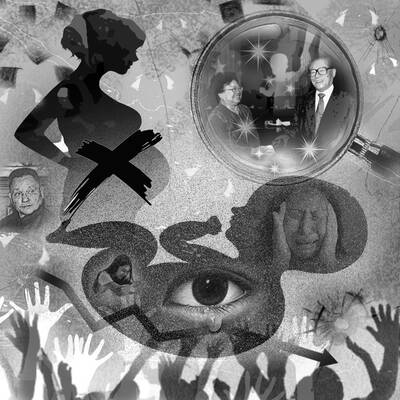
Jan. 1 marks a decade since China repealed its one-child policy. Just 10 days before, Peng Peiyun (彭珮雲), who long oversaw the often-brutal enforcement of China’s family-planning rules, died at the age of 96, having never been held accountable for her actions. Obituaries praised Peng for being “reform-minded,” even though, in practice, she only perpetuated an utterly inhumane policy, whose consequences have barely begun to materialize. It was Vice Premier Chen Muhua (陳慕華) who first proposed the one-child policy in 1979, with the endorsement of China’s then-top leaders, Chen Yun (陳雲) and Deng Xiaoping (鄧小平), as a means of avoiding the

The last foreign delegation Nicolas Maduro met before he went to bed Friday night (January 2) was led by China’s top Latin America diplomat. “I had a pleasant meeting with Qiu Xiaoqi (邱小琪), Special Envoy of President Xi Jinping (習近平),” Venezuela’s soon-to-be ex-president tweeted on Telegram, “and we reaffirmed our commitment to the strategic relationship that is progressing and strengthening in various areas for building a multipolar world of development and peace.” Judging by how minutely the Central Intelligence Agency was monitoring Maduro’s every move on Friday, President Trump himself was certainly aware of Maduro’s felicitations to his Chinese guest. Just
A recent piece of international news has drawn surprisingly little attention, yet it deserves far closer scrutiny. German industrial heavyweight Siemens Mobility has reportedly outmaneuvered long-entrenched Chinese competitors in Southeast Asian infrastructure to secure a strategic partnership with Vietnam’s largest private conglomerate, Vingroup. The agreement positions Siemens to participate in the construction of a high-speed rail link between Hanoi and Ha Long Bay. German media were blunt in their assessment: This was not merely a commercial win, but has symbolic significance in “reshaping geopolitical influence.” At first glance, this might look like a routine outcome of corporate bidding. However, placed in
China often describes itself as the natural leader of the global south: a power that respects sovereignty, rejects coercion and offers developing countries an alternative to Western pressure. For years, Venezuela was held up — implicitly and sometimes explicitly — as proof that this model worked. Today, Venezuela is exposing the limits of that claim. Beijing’s response to the latest crisis in Venezuela has been striking not only for its content, but for its tone. Chinese officials have abandoned their usual restrained diplomatic phrasing and adopted language that is unusually direct by Beijing’s standards. The Chinese Ministry of Foreign Affairs described the


 RSS
RSS