


Taiwan’s energy debate is too often framed as merely a technical issue of emissions targets or electricity prices. In reality, it is a question of national security. As Taiwan’s economy becomes increasingly dependent on energy-intensive industries — from advanced semiconductors to artificial intelligence — the resilience of its power system has emerged as a strategic policy issue. Energy security is a crucial pillar of national security, and it must be treated as such.
This challenge is becoming more acute. Taiwan’s electricity demand is projected to rise steadily over the coming decade, driven primarily by industrial expansion and digitalization. At the same time, the phaseout of nuclear power has removed a stable source of clean baseload electricity, while reliance on imported liquefied natural gas (LNG) continues to grow. With limited LNG storage capacity and heavy dependence on maritime supply routes, Taiwan’s energy system remains exposed to geopolitical disruption, price volatility and crisis scenarios.
To its credit, Taiwan has made real progress in renewable energy. Solar capacity has expanded rapidly — despite not meeting last year’s power generation target of 20 gigawatts — and offshore wind is becoming a visible part of the energy mix. These achievements matter for decarbonization and for reducing reliance on imported fossil fuels. Yet intermittent renewable technologies alone cannot solve Taiwan’s energy security challenge. The output of solar and wind farms depends on weather conditions and the time of day, rather than on demand. Moreover, their integration places increasing stress on a grid that has already shown vulnerabilities through repeated blackouts in the past few years. Taiwan’s problem is no longer simply how much electricity it can generate, but how reliably it can deliver power under all conditions.
This is where geothermal energy enters the conversation — and why it deserves far greater political and strategic attention. Unlike solar or wind, geothermal power provides constant, round-the-clock baseload electricity. It is domestically sourced, immune to fuel supply disruptions and well-suited to complement variable renewables. For an island economy facing climate and security pressures, geothermal is not an exotic alternative; it is a stabilizing force.
Located on the Pacific Ring of Fire, Taiwan possesses significant geothermal potential that remains largely untapped. Estimates vary, but even conservative assessments suggest that geothermal could supply a meaningful share of Taiwan’s electricity needs. Yet the installed capacity remains marginal. The limiting factors are not geological, but institutional: high upfront exploration costs, regulatory complexity, land-use disputes and a lack of mechanisms to share early-stage risk.
Overcoming these barriers requires international cooperation. Geothermal development is capital and knowledge-intensive, particularly in its early phases. Successful projects depend on advanced drilling expertise, robust regulatory frameworks and long-term financing structures. Taiwan does not need to reinvent these systems from scratch. It can and should work with partners that have already developed them.
Europe is one direction for Taiwan to consider. Several European countries have accumulated decades of experience in geothermal energy, including newer technologies that enable access to geothermal resources beyond traditional hotspots. European cooperation offers Taiwan not only technical expertise, but also access to de-risking instruments, standards alignment and integration into broader green industrial strategies. In an era of climate-linked trade measures and supply-chain scrutiny, this alignment is increasingly valuable.
However, Taiwan’s international energy partnerships should not be limited to Europe. Under the New Southbound Policy Plus, Taiwan could deepen cooperation with partners that offer practical, applied experience. New Zealand is a global leader in geothermal development, with decades of operational knowledge spanning engineering, regulation, environmental management and engagement with indigenous communities. Importantly, cooperation between Taiwan and New Zealand on geothermal energy is already under way.
Private-sector engagement and academic collaboration have created a foundation that Taiwan should build upon. New Zealand firms have identified geothermal opportunities in Taiwan, while academic exchanges and research cooperation are helping develop the human capital needed for long-term deployment. This is precisely the kind of outcome the New Southbound Policy Plus was meant to achieve: cooperation that strengthens industrial capacity and strategic resilience through people-first projects, rather than merely expanding trade statistics.
Geothermal energy is not a plug-and-play technology. It requires a skilled domestic workforce capable of managing exploration, drilling, plant operation and environmental safeguards over decades. Partnerships with experienced countries would allow Taiwan to develop this expertise at home, reducing dependence on external contractors and ensuring that geothermal becomes a permanent component of the national energy system.
The security implications are clear: A more diversified energy mix anchored by geothermal power would reduce Taiwan’s exposure to imported fuels and maritime chokepoints. It would strengthen grid resilience during crises and provide stable electricity to critical infrastructure and strategic industries. For a country that produces the vast majority of the world’s most advanced semiconductors, this is not merely a domestic concern. It is a matter of global economic stability.
Energy diversification also carries a deterrent logic. Systems that are decentralized, domestically sourced and difficult to disrupt are inherently more resilient to coercion. Just as Taiwan seeks redundancy in its supply chains and defense planning, it must pursue redundancy in its energy sector. Geothermal energy, developed through a network of trusted international partnerships, fits squarely within this logic.
First, Taiwan should explicitly integrate geothermal energy into its national security and energy planning frameworks, recognizing it as strategic infrastructure rather than a niche renewable energy source.
Second, it should expand and formalize international partnerships — with Europe, New Zealand and other experienced players — focused on technology transfer, risk-sharing and standards alignment.
Third, it should establish targeted financing and regulatory mechanisms to de-risk early-stage projects, including designated geothermal development zones and streamlined permitting.
Finally, it should continue investing in academic and workforce development, including with international partners, to ensure that geothermal capacity is not only built, but sustained.
Taiwan has the geological conditions, the technological partners and the strategic imperative to act. What remains is the political will to treat geothermal energy for what it truly is: not just a tool for decarbonization, but an investment in national security. In a world where energy disruptions are increasingly weaponized, building resilient, domestic sources of power is a strategic necessity.
Marcin Jerzewski is head of the Taiwan office of the European Values Center for Security Policy and a fellow at Visegrad Insight.
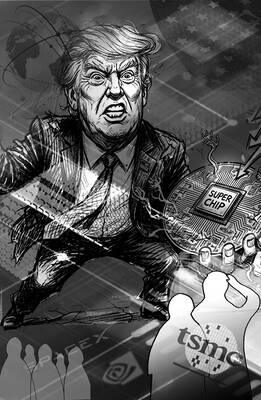
The White House’s decision to take a 9.9 percent stake in Intel Corp is looking like very shrewd business indeed. Since the government bought in at US$20.47 a share last August, the US chipmaker’s surging stock price has delivered the US a US$43 billion return. One of the reasons the investment has so far proved so sound is that the White House has made sure of it. According to The Wall Street Journal, Howard personally pushed deals on Intel’s behalf with some of the most lucrative clients imaginable. They include Nvidia Corp, the company at the heart of the AI
The Ministry of the Interior, working with the navy and coast guard, is organizing Taiwan’s first joint exercise simulating escort tankers carrying liquefied natural gas (LNG) and oil through a Chinese blockade. The drills simulate fuel transport along three maritime corridors leading toward Japan, the Philippines and the US. Deputy Minister of the Interior Sawyer Mars (馬士元) said that a blockade of the Taiwan Strait would amount to “almost a 100 percent blockade of the regional energy supply.” Minister of National Defense Wellington Koo said planning to counter a blockade is standard practice in Taipei. While the exercise is limited in
A single photograph can cut through a lot of noise, but it can also be used to misrepresent the truth. At the very least, it can concentrate the mind on something that requires further investigation. On Monday last week, Ma Ying-jeou Foundation CEO Tai Hsia-ling (戴遐齡) and former National Security Council secretary-general King Pu-tsung (金溥聰) held a news conference in which they showed a photograph of former foundation CEO Hsiao Hsu-tsen (蕭旭岑), now Chinese Nationalist Party (KMT) deputy chairman. In the image Hsiao is seated next to Xiamen Taiwan Businessmen Association chairman Han Ying-huan (韓螢煥). The two men were holding
I first met Professor Ray Jiing (井迎瑞) as a film and documentary student at Shih Hsin University’s (SHU) Department of Radio Television and Film in 1988. The following year, he went on to become the director of the Chinese Taipei Film Archive — forerunner of the Taiwan Film and Audiovisual Institute (TFAI). Over his eight-year tenure, Jiing rescued and restored over 200 classic Taiwanese films. In 1997, he established the Graduate Institute of Studies in Documentary and Film Archiving at Tainan National University of the Arts (TNNUA), and I joined the program in his third cohort of students. Beyond a


 RSS
RSS