


Amelia Miller has an unusual business card. When I saw the title of “Human-AI [artificial intelligence] Relationship Coach” at a tech event, I presumed she was capitalizing on the rise of chatbot romances to make those strange bonds stronger. It turned out the opposite was true. AI tools were subtly manipulating people and displacing their need to ask others for advice. That was having a detrimental impact on real relationships with humans.
Miller’s work started early last year when she was interviewing people for a project with the Oxford Internet Institute, and speaking to a woman who had been in a relationship with ChatGPT for more than 18 months. The woman shared her screen on Zoom to show ChatGPT, which she had given a male name, and in what felt like a surreal moment, Miller asked them if they ever fought. They did, sort of. Chatbots were notoriously sycophantic and supportive, but the female interviewee sometimes got frustrated with her digital partner’s memory constraints and generic statements.
Why did she not just stop using ChatGPT? The woman answered that she had come too far and could not delete him. “It’s too late,” she said.
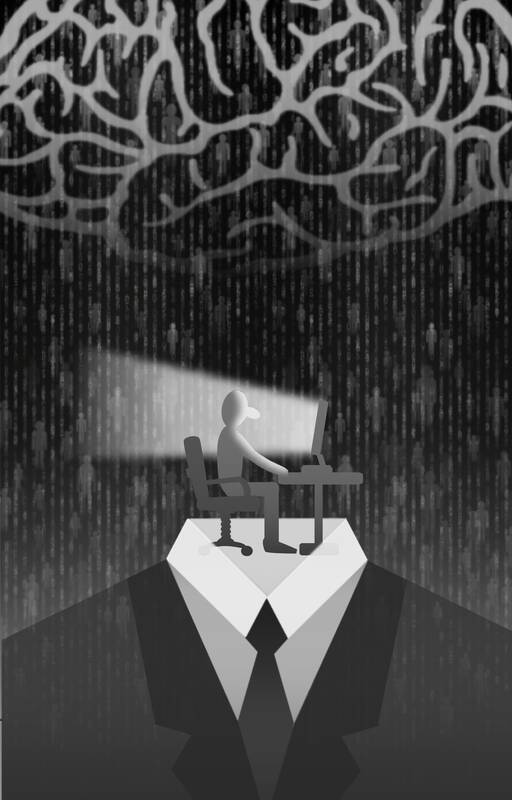
Illustration: Yusha
That sense of helplessness was striking. As Miller spoke to more people it became clear that many were not aware of the tactics AI systems used to create a false sense of intimacy, from frequent flattery to anthropomorphic cues that made them sound alive.
This was different from smartphones or TV screens. Chatbots, in use by more than a billion people across the globe, are imbued with character and humanlike prose. They excel at mimicking empathy and, like social media platforms, are designed to keep us coming back for more with features like memory and personalization. While the rest of the world offers friction, AI-based personas are easy, representing the next phase of “parasocial relationships,” where people form attachments to social media influencers and podcast hosts.
Like it or not, anyone who uses a chatbot for work or their personal life has entered a relationship of sorts with AI, for which they ought to take better control.
Miller’s concerns echo warnings from academics and lawyers looking at human-AI attachment, but with the addition of concrete advice. First, define what you want to use AI for. Miller calls this process the writing of your “Personal AI Constitution,” which sounds like consultancy jargon but contains a tangible step: changing how ChatGPT talks to you. She recommends entering the settings of a chatbot and altering the system prompt to reshape future interactions.
For all our fears of AI, the most popular new tools are more customizable than social media ever was. You cannot tell TikTok to show you fewer videos of political rallies or obnoxious pranks, but you can go into the “custom instructions” feature of ChatGPT to tell it exactly how you want it to respond.
Succinct, professional language that cuts out the bootlicking is a good start. Make your intentions for AI clearer and you are less likely to be lured into feedback loops of validation that lead you to think your mediocre ideas are fantastic, or worse.
The second part does not involve AI at all but rather making a greater effort to connect with real-life humans, building your “social muscles” as if going to a gym. One of Miller’s clients had a long commute, which he would spend talking to ChatGPT on voice mode. When she suggested making a list of people in his life that he could call instead, he did not think anyone would want to hear from him.
“If they called you, how would you feel?” she asked. “I would feel good,” he admitted.
Even the innocuous reasons people turn to chatbots can weaken those muscles, particularly asking AI for advice, one of the top use cases for ChatGPT. The act of seeking advice is not just an information exchange but a relationship builder too, requiring vulnerability on the part of the initiator.
Doing that with technology means that over time, people resist the basic social exchanges that are needed to make deeper connections. “You can’t just pop into a sensitive conversation with a partner or family member if you do not practice being vulnerable [with them] in more low-stakes ways,” Miller says.
As chatbots become a confidante for millions, people should take advantage of their ability to take greater control. Configure ChatGPT to be direct and seek advice from real people rather than an AI model that validates all ideas. The future looks far more bland otherwise.
Parmy Olson is a Bloomberg Opinion columnist covering technology. A former reporter for the Wall Street Journal and Forbes, she is author of Supremacy: AI, ChatGPT and the Race That Will Change the World. This column reflects the personal views of the author and does not necessarily reflect the opinion of the editorial board or Bloomberg LP and its owners.

The White House’s decision to take a 9.9 percent stake in Intel Corp is looking like very shrewd business indeed. Since the government bought in at US$20.47 a share last August, the US chipmaker’s surging stock price has delivered the US a US$43 billion return. One of the reasons the investment has so far proved so sound is that the White House has made sure of it. According to The Wall Street Journal, Howard personally pushed deals on Intel’s behalf with some of the most lucrative clients imaginable. They include Nvidia Corp, the company at the heart of the AI
A single photograph can cut through a lot of noise, but it can also be used to misrepresent the truth. At the very least, it can concentrate the mind on something that requires further investigation. On Monday last week, Ma Ying-jeou Foundation CEO Tai Hsia-ling (戴遐齡) and former National Security Council secretary-general King Pu-tsung (金溥聰) held a news conference in which they showed a photograph of former foundation CEO Hsiao Hsu-tsen (蕭旭岑), now Chinese Nationalist Party (KMT) deputy chairman. In the image Hsiao is seated next to Xiamen Taiwan Businessmen Association chairman Han Ying-huan (韓螢煥). The two men were holding
I first met Professor Ray Jiing (井迎瑞) as a film and documentary student at Shih Hsin University’s (SHU) Department of Radio Television and Film in 1988. The following year, he went on to become the director of the Chinese Taipei Film Archive — forerunner of the Taiwan Film and Audiovisual Institute (TFAI). Over his eight-year tenure, Jiing rescued and restored over 200 classic Taiwanese films. In 1997, he established the Graduate Institute of Studies in Documentary and Film Archiving at Tainan National University of the Arts (TNNUA), and I joined the program in his third cohort of students. Beyond a
A recent report concerning a student who is suing his teacher posed the question in its headline: Does failing a student in two subjects constitute bullying? The college student in Chiayi County apparently sought NT$2 million (US$63,603) in state compensation, but a court dismissed the case. The first reaction of many might have been to ask: What has happened to students nowadays? Some say that teachers have lost their authority, while others say students are overindulged. Some even start reminiscing over the days when “whatever the teacher says goes.” However, the real issue might be overlooked if emotional reactions like that are the


 RSS
RSS