


It might have seemed that every piece of bad news for the global climate and energy transition this year had some sort of connection to US President Donald Trump. If only it were so simple.
In fact, there are plenty of negative factors well away from the White House that have damaged our chances of tackling global warming and many might have been ignored amid the drumbeat of more high-profile news.
For the past few years, I have been trying to highlight some of these neglected issues that we should be worrying more about.
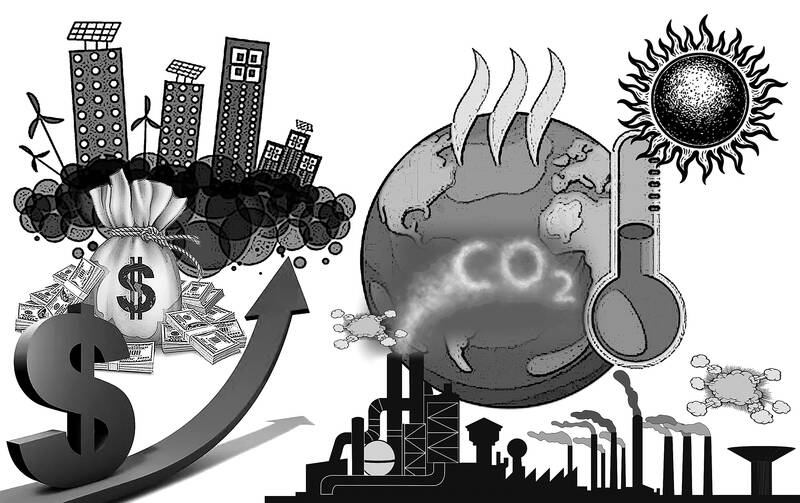
Illustration: Constance Chou
Here is my summary of three troubling developments that flew below the radar:
POLLUTION WAS HELPING
One huge success for the environment in recent years has been the reduction in emissions of particulates in many parts of the world — in China, from shipping, and in urban areas of developed countries.
Right?
Well, kinda.
While the fall in sulfur dioxides, nitrogen oxides and ozone has been an unquestioned benefit for human health, more evidence has emerged over the past year pointing to how it has accelerated the pace of global warming and contributed to more volatile rainfall.
Such particulates help to reflect sunlight back into space and affect the formation of water droplets in clouds. With fewer of them about, more sunlight reaches the ground to warm the planet and storms can become more violent.
Changes in cloud brightness driven by fewer particulates over the past two decades might have contributed about half as much to the world’s climate imbalance as carbon dioxide emissions, according to one study published last month.
That means that we might be underestimating how much the planet will warm in response to carbon pollution.
GREEN HYDROGEN
There have been signs for a year or so that green hydrogen has been struggling to achieve its early promise. It is produced by using clean power to split water molecules, and touted as a way to zero out emissions from industries such as steel production, cement, shipping, fertilizers, plastics, trucking and aviation. Too many projects remained at the proposal stage, and evidence that costs would decline as rapidly as for solar, wind and lithium-ion batteries has been thin on the ground.
Halfway through a decade that Deloitte has suggested could be as decisive for hydrogen as the 2010s were for renewables, progress is stalling. Of a still-growing 100 million tonnes per year hydrogen market, green H2 projects operating or under construction account for only about 3 million tonnes.
The International Energy Agency in September downgraded its estimate for potential 2030 green hydrogen capacity by about one-quarter to 37 million tonnes.
RENEWABLES
Financing is a critical and little-noticed factor in the cost of renewable power. Clean energy and the grid networks require minimal long-term expenditure, but substantial up-front costs. Higher interest rates make them less competitive against fossil energy, which tends to be cheaper to build, but more expensive to run because of ongoing expenditure on fuel. Central bank rates have been trending down as Trump’s words and actions push the US Federal Reserve toward a more accommodative stance — but the long-term interest rates on government bonds have been more sticky.
That means lower rates are not helping as in the late 2010s, when they were accompanied by a flat yield curve that made long-term investments such as renewables more attractive.
The steeper curve might prove as consequential a deterrent for clean power as a library of Trump executive orders.
Predictions are only worth something if you check back later on how they performed — so how did last year’s overlooked stories compare with what happened this year? You can read the original article to decide, but here is my assessment:
‧ Hydro Runs Dry: Roughly one-third of all clean energy is produced by hydroelectric dams — but a run of dry years in major generating regions has left the sector badly underperforming.
It is probably too soon to confirm whether there is an ongoing trend at work and strong generation in India helped slash consumption of coal this year.
Still, hydro power in the EU fell 13 percent in the first eight months relative to last year and Norway’s reservoirs ran low, while China’s dams continued to underperform.
There is no sign that things are improving on this front.
‧ Palm Pilot: Indonesia’s plan to use homegrown biofuels to reduce dependency on imported crude is one of the most under-appreciated climate disasters out there — because clearing of tropical forest land to grow fuel crops is a major driver of emissions in its own right.
We warned about the impact of a plan to increase palm oil blending in diesel to 50 percent, which could convert an additional 5.3 million hectares of forest land to plantations by 2042.
Worse was to come just a few days after we published: The Indonesian government proposed converting 20 million hectares of forest for food and ethanol to blend into gasoline. The electrification of Indonesia’s road fleet cannot come soon enough.
‧ Indian Coal Is Back: After years in the doldrums, India’s coal power sector looked to be in much more rude health. We predicted that capacity and generation might start climbing again, dashing hopes of an early emissions peak. That has not been the case this year: Thanks to a cool, wet summer, and strong generation from hydro, solar and wind, fossil generation is expected to fall 5 percent, its worst performance in well over a decade.
Do not celebrate too soon: The Indian government is planning to increase its coal generation fleet by nearly 50 percent by 2035. The renewables boom will need to prove those fossil plants superfluous, and quickly, if we want to stop them getting built.
That might seem a gloomy way to conclude the year, but there has been underappreciated good news as well.
From the Iran war and nuclear weapons to tariffs and artificial intelligence, the agenda for this week’s Beijing summit between US President Donald Trump and Chinese President Xi Jinping (習近平) is packed. Xi would almost certainly bring up Taiwan, if only to demonstrate his inflexibility on the matter. However, no one needs to meet with Xi face-to-face to understand his stance. A visit to the National Museum of China in Beijing — in particular, the “Road to Rejuvenation” exhibition, which chronicles the rise and rule of the Chinese Communist Party — might be even more revealing. Xi took the members
The Chinese Nationalist Party (KMT) and the Taiwan People’s Party (TPP) on Friday used their legislative majority to push their version of a special defense budget bill to fund the purchase of US military equipment, with the combined spending capped at NT$780 billion (US$24.78 billion). The bill, which fell short of the Executive Yuan’s NT$1.25 trillion request, was passed by a 59-0 margin with 48 abstentions in the 113-seat legislature. KMT Chairwoman Cheng Li-wun (鄭麗文), who reportedly met with TPP Chairman Huang Kuo-chang (黃國昌) for a private meeting before holding a joint post-vote news conference, was said to have mobilized her
Before the Chinese Communist Party (CCP) and its People’s Liberation Army (PLA) can blockade, invade, and destroy the democracy on Taiwan, the CCP seeks to make the world an accomplice to Taiwan’s subjugation by harassing any government that confers any degree of marginal recognition, or defies the CCP’s “One China Principle” diktat that there is no free nation of Taiwan. For United States President Donald Trump’s upcoming May 14, 2026 visit to China, the CCP’s top wish has nothing to do with Trump’s ongoing dismantling of the CCP’s Axis of Evil. The CCP’s first demand is for Trump to cease US
As artificial intelligence (AI) becomes increasingly widespread in workplaces, some people stand to benefit from the technology while others face lower wages and fewer job opportunities. However, from a longer-term perspective, as AI is applied more extensively to business operations, the personnel issue is not just about changes in job opportunities, but also about a structural mismatch between skills and demand. This is precisely the most pressing issue in the current labor market. Tai Wei-chun (戴偉峻), director-general of the Institute of Artificial Intelligence Innovation at the Institute for Information Industry, said in a recent interview with the Chinese-language Liberty Times


 RSS
RSS