


Former Hong Kong chief executive Leung Chun-ying (梁振英) has chosen a curious moment to speak candidly. Days after the Hong Kong court delivered its 855-page verdict against pro-democracy media mogul Jimmy Lai (黎智英), Leung wrote a lengthy post on Facebook explaining — without embarrassment and with a hint of pride — how he spent years privately summoning major corporations to squeeze the advertising lifeblood out of the Apple Daily until it was “compressed to near zero.”
When he was still in office, Leung denied doing this, but with Lai convicted and the newspaper dead, he called it reflection.
It is an extraordinary confession because it confirms what Hong Kong officials spent a decade dismissing as paranoia: The territory’s most outspoken newspaper was not defeated by the market, readers, nor law alone, but by deliberate political pressure from the very top.
Leung framed the action as necessary — even admirable. Lai, in his view, was simply too influential, too dangerous and too effective to be left to the market. Therefore, his punishment should be understood not in narrow legal terms, but in the grander logic of political impact. In other words, guilt was measured not by statute, but by usefulness to the cause.
What makes the confession remarkable is not its cruelty, but its timing. Leung waited until the defendant was already convicted, long imprisoned, old and sick. Only then did he feel safe enough to explain how power really worked. Only then could he say aloud that law was never the main instrument — that economic strangulation, intimidation of advertisers and “early struggle” were preferable to courts, and that relying on legislation alone was never enough.
It is not the language of a former leader reflecting on mistakes, it is the language of someone reassuring the system that it had been right all along.
The irony is inescapable. For years, the territory was told that its decline began in 2020, with the implementation of Hong Kong’s National Security Law. Before that, some thought there was still rule of law, press freedom and a functioning version of “one country, two systems.” Leung’s post blew up that comforting fiction.
He described actions taken years earlier, when the Basic Law was supposedly intact, courts were still trusted and the system was still being sold to the world — and to Taiwan — as proof that freedom and authoritarianism could coexist.
Leung’s confession reveals that even at the height of Hong Kong’s supposed autonomy, its leader saw nothing wrong with using executive influence to punish a newspaper for its stance, or in redefining patriotism as loyalty not to the country, but to the ruling party.
He now urges society to learn the “lesson” of Lai: Next time, do not wait for trials; crush dissent earlier, more decisively and more creatively. Law, in this telling, is not a shield, but a finishing touch.
This shows Taiwan what the “successful” version of “one country, two systems” looked like, even before its formal burial: a territory where media could be suffocated without a single court order, where a chief executive could deny such conduct while in office and boast of it afterward and where a publisher’s crime was not what he did, but how much influence he had.
Leung has done something rare. In trying to justify the destruction of Lai and Apple Daily, he has stripped away the last illusion. Hong Kong did not lose its freedoms suddenly in 2020. It lost them gradually, methodically and with the quiet approval of leaders who believed that law existed to serve power, not restrain it.
If this is the system some still urge Taiwan to trust, then Leung’s “confession” should be required reading, not as history, but as warning.
John Cheng is a retired businessman from Hong Kong now living in Taiwan.

KMT Chairwoman Cheng Li-wun’s (鄭麗文) recent visit to Beijing and her upcoming visit to Washington will serve as a high-level test of her diplomatic mettle. In Beijing, Cheng was received with symbolic gestures, a warm reception, and high-level access. In Washington, she will receive far less pomp and far sharper questions about the KMT’s vision for the future of Taiwan. Her challenge will be to persuade Washington that the KMT’s engagement with China can coexist with strong deterrence. Cheng’s April 7-12 visit to mainland China coincided with an intense period of conflict in Iran. Despite the strategic significance of Cheng’s trip,

The closure of the Strait of Hormuz has sent the vast Asian chemicals industry into a tailspin. Deprived of the likes of Qatari natural gas and Saudi Arabian oil, the region’s fertilizer and plastics plants are slowing production or even shutting down. Everywhere except China, that is. In petrochemicals, China is unique. As well as a traditional industry that uses oil and gas as feedstock, it has parallel output that relies on its abundant domestic coal. Unsurprisingly, India and other regional powers want to copy and paste the Chinese method. This would not be easy — or climate friendly. The
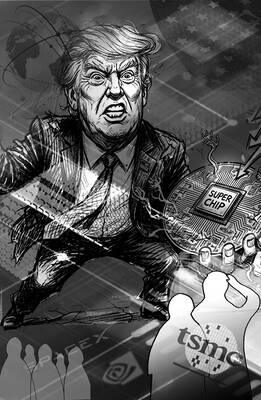
The White House’s decision to take a 9.9 percent stake in Intel Corp is looking like very shrewd business indeed. Since the government bought in at US$20.47 a share last August, the US chipmaker’s surging stock price has delivered the US a US$43 billion return. One of the reasons the investment has so far proved so sound is that the White House has made sure of it. According to The Wall Street Journal, Howard personally pushed deals on Intel’s behalf with some of the most lucrative clients imaginable. They include Nvidia Corp, the company at the heart of the AI
Indonesian President Prabowo Subianto says he knows how to fix the problems facing Indonesia. Yet his economic mismanagement and authoritarian tendencies are steering the nation toward a familiar mix of currency instability and political chaos. The world’s fourth-most populous nation risks reversing the hard-won democratic and business reforms that came after the Asian Financial Crisis in 1997. At that time, the rupiah collapsed and the political upheaval that followed forced former president Haji Mohamed Suharto from power. Prabowo’s administration is ignoring similar warning signs. That disconnect was apparent in a national address on Wednesday, when Prabowo projected the swagger that has


 RSS
RSS