


Moore Threads Technology Co’s 425 percent first-day pop this month — China’s most successful initial public offering (IPO) since 2019 — capped a year in which investors have grown increasingly excited about the prospects for the country’s artificial intelligence (AI) chip advancement. That is despite basic technological hurdles that might hinder the industry’s longer-term prospects.
From Moore Threads to Cambricon Technologies Corp and MetaX, the market is celebrating a coterie of once-unknown names that now harbor bold ambitions to take on Nvidia Corp — at least at home.
Major players such as Alibaba Group Holding Ltd and Baidu Inc are making headway into the semiconductors that underpin AI development — one of Beijing’s top priorities.
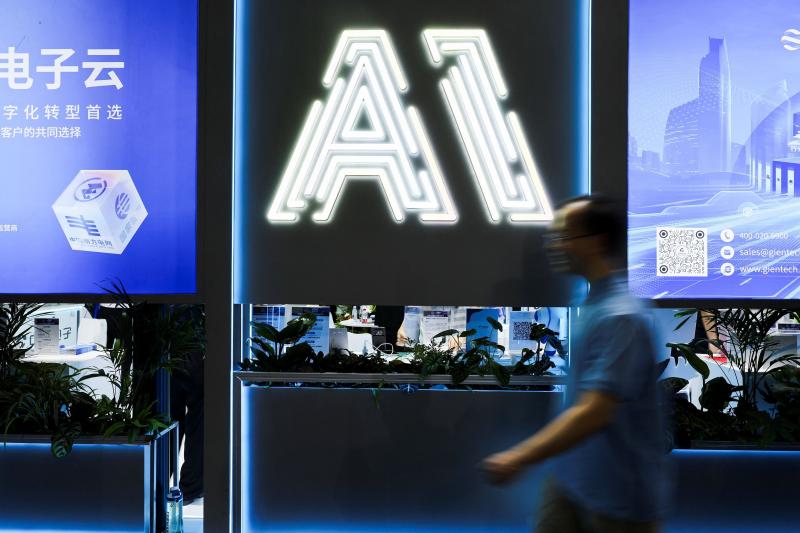
Photo: Go Nakamua, Reuters
Recently, Canadian research firm TechInsights took apart a Huawei Technologies Co smartphone and revealed a processor made using more advanced technologies than Chinese chipmakers were thought capable of.
China is even now preparing a package of as much as US$70 billion to bankroll and support the sector, people familiar with the matter said.
The reality though is that China’s chipmaking sector is struggling with technological bottlenecks that capital alone might not easily resolve — including in manufacturing.
To advance to the cutting edge, many like Huawei are relying on Semiconductor Manufacturing International Corp (SMIC) — a US-blacklisted firm that cannot procure the requisite equipment to efficiently crank out advanced chips.
In its report, TechInsights cautioned that SMIC’s achievements came with “tradeoffs” in cost.
Cambricon is making its best processors at about a 20 percent yield — meaning four out of five silicon dies that roll off the assembly line are discarded as unusable.
Late last month, Moore Threads warned that investors might be getting overexuberant, triggering a 19 percent plunge in its shares.
“The key challenge remains access to advanced-node wafer capacity,” said Karl Li, investment manager of China equities at Aberdeen Investments. “There remains a considerable supply deficit. We expect China to emphasize the expansion of advanced-node capacity to resolve this constraint, but we still anticipate a technological gap to the US to be maintained over the next couple of years.”
In just a week, Moore Threads — a loss-making firm with a fraction of Huawei’s output — more than quintupled to become one of China’s most valuable pure hardware companies.
At a market value of about US$54 billion, the company’s shares are worth about 870 times its revenue for last year — well above the sector average, according to data compiled by Bloomberg.
Cambricon is in the same neighborhood, at several hundred times last year’s sales. Nvidia is at about 30.
AI accelerator designer MetaX Integrated Circuits Shanghai Co drew thousands of times more bids for shares than it was offering in its IPO.
The mania reflects a bet that Beijing would pull out all the stops to prop up homegrown chipmakers in the age of AI, seeking to blunt US dominance in a field that could determine the destinies of nations. That necessarily involves developing Nvidia substitutes in the US.
US President Donald Trump’s offer earlier this month to allow Nvidia to sell the relatively powerful H200 to China has so far met with silence on Beijing’s part.
“Access to H200s could temporarily ease performance constraints, reducing urgency for some firms,” Forrester Research analyst Charlie Dai (戴鯤) said. “However, China’s strategic commitment to semiconductor independence remains unwavering. The effect will be substantial in the near term, but limited over time as policy, funding and talent continue driving domestic innovation.”
In the longer run, Beijing is focused on self-reliance in technology. The emergence of DeepSeek — which just this month released a highly capable model despite its lack of unfettered access to advanced Nvidia accelerators — underscores how Huawei and its rivals are climbing the technology ladder with semiconductors optimized for training smaller, open-sourced platforms.
Hardware constraints might actually help drive innovation on the AI applications front.
“China has the best open-source models in the world, despite not having the best silicon,” said Felix Wang, tech sector head at Hedgeye Risk Management. “China chipmakers and AI players may have an advantage over the US, since they’re more adept at finding optimizations in those models.”
National resolve or not, the chokepoints facing China’s chip companies remain firmly in place.
Chinese AI chip designers cannot utilize the most cutting-edge fabrication processes at Taiwan Semiconductor Manufacturing Co (TSMC) due to US curbs, putting them at an disadvantage against Nvidia and Advanced Micro Devices Inc.
Memory is another major issue. Chinese companies have to rely on smuggled and previously stockpiled foreign parts, particularly high-end memory chips, for making AI accelerators. That is because China has not established a comprehensive ecosystem to provide all the critical parts it needs for emerging technologies. National champion Huawei’s latest AI chip was found to contain an older generation of high-bandwidth memory chips from South Korean powerhouses SK Hynix Inc and Samsung Electronics Co, while using dies from TSMC.
Washington and its allies including Japan and the Netherlands are not supplying China with the equipment required to make the most sophisticated AI chips. Dutch firm ASML Holding NV so far has not sold a single extreme ultraviolet lithography system to the country. That large, multimillion-dollar machine is seen as essential for manufacturing the fastest and most capable AI accelerators.
Huawei is planning to make about 600,000 of its marquee 910C Ascend chips next year, while Cambricon is preparing to deliver about 500,000 AI accelerators next year. Both are regarded as major achievements within China.
However, for context, Nvidia alone was estimated to have sold 1 million H20 chips last year, a product it customized for China to meet export control requirements.
“Replicating the chip-plus-software ecosystem takes more than 10 years, as one has to deal with user inertia, lack of cutting-edge chip fabrication technologies and equipment import restrictions, among other issues,” said Phelix Lee (李旭暘), an analyst at Morningstar.
An elderly mother and her daughter were found dead in Kaohsiung after having not been seen for several days, discovered only when a foul odor began to spread and drew neighbors’ attention. There have been many similar cases, but it is particularly troubling that some of the victims were excluded from the social welfare safety net because they did not meet eligibility criteria. According to media reports, the middle-aged daughter had sought help from the local borough warden. Although the warden did step in, many services were unavailable without out-of-pocket payments due to issues with eligibility, leaving the warden’s hands

When former president Tsai Ing-wen (蔡英文) first took office in 2016, she set ambitious goals for remaking the energy mix in Taiwan. At the core of this effort was a significant expansion of the percentage of renewable energy generated to keep pace with growing domestic and global demands to reduce emissions. This effort met with broad bipartisan support as all three major parties placed expanding renewable energy at the center of their energy platforms. However, over the past several years partisanship has become a major headwind in realizing a set of energy goals that all three parties profess to want. Tsai
Japanese Prime Minister Sanae Takaichi on Monday announced that she would dissolve parliament on Friday. Although the snap election on Feb. 8 might appear to be a domestic affair, it would have real implications for Taiwan and regional security. Whether the Takaichi-led coalition can advance a stronger security policy lies in not just gaining enough seats in parliament to pass legislation, but also in a public mandate to push forward reforms to upgrade the Japanese military. As one of Taiwan’s closest neighbors, a boost in Japan’s defense capabilities would serve as a strong deterrent to China in acting unilaterally in the
Indian Ministry of External Affairs spokesman Randhir Jaiswal told a news conference on Jan. 9, in response to China’s latest round of live-fire exercises in the Taiwan Strait: “India has an abiding interest in peace and stability in the region, in view of our trade, economic, people-to-people and maritime interests. We urge all parties to exercise restraint, avoid unilateral actions and resolve issues peacefully without threat or use of force.” The statement set a firm tone at the beginning of the year for India-Taiwan relations, and reflects New Delhi’s recognition of shared interests and the strategic importance of regional stability. While India


 RSS
RSS