


As geopolitical tensions rise, competition for the cutting-edge science and talent that underpins advanced technology has heated up. The US, China and other major powers now regard leadership in areas such as artificial intelligence (AI), semiconductors, quantum technologies and biotechnology as central to military capability, economic security and ideological influence.
Little wonder, then, that governments are pouring money into strategic technologies, tightening export controls and investment screening, and subjecting international scientific collaboration to new security requirements. Research institutions are increasingly treated as frontline national-security assets. The logic of great-power rivalry is reshaping, and often constraining, cross-border academic relationships and the mobility of scientists.
Some have called the current tech race a new “cold war,” drawing parallels to the Cold War-era space race between the US and the Soviet Union, which began when the latter launched Sputnik in 1957. While there are indeed parallels, the irony is that the US is not following its successful Cold War strategy — China is.
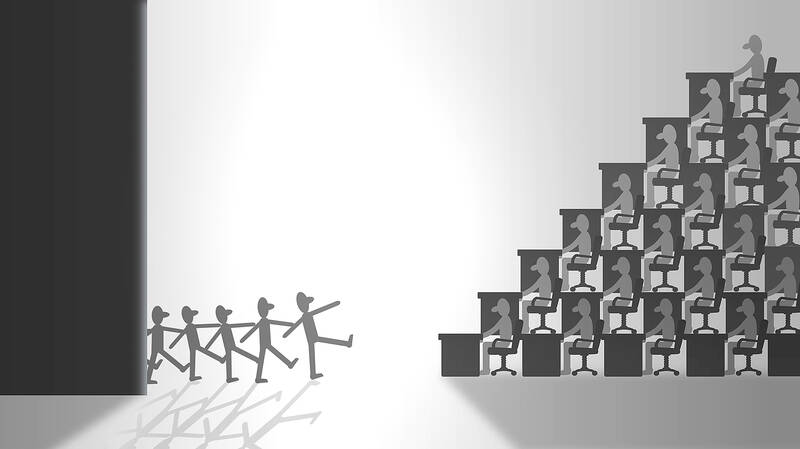
Illustration: Yusha
To be sure, the US used export controls and alliance coordination during the Cold War to keep advanced weapons, nuclear materials and dual-use technologies out of the Soviet bloc. However, its overarching approach to science from the 1960s to the 1980s was forward-looking and proactive, rather than defensive.
The US government invested heavily in basic scientific research, which policymakers believed was the key to outperforming the Soviet Union over the long term. That meant massively expanding support for university research through agencies such as the National Science Foundation and the National Institutes of Health, creating new national laboratories and establishing the Advanced Research Projects Agency (later renamed the Defense Advanced Research Projects Agency) to back high-risk, high-reward projects in computing, materials science and communications.
While the space race supercharged funding for physics, engineering and mathematics, programs such as the GI Bill (enacted during World War II to pay college tuition for US veterans) and increased federal student aid greatly boosted the supply of scientists and engineers.
The US also actively sought foreign talent during the Cold War. It paired generous research opportunities with relatively open — and often strategically targeted — immigration policies. The US’ well-funded universities, national labs and government agencies attracted scientists from all over the world. Some, such as those willing to leave communist regimes in Eastern Europe, were deliberately recruited and sometimes given accelerated security clearances. Over time, student visas, Fulbright scholarships and immigration preferences for highly skilled professionals broadened and routinized the inflow.
The message was clear: If you were a talented scientist, the best place to build your career and raise your family was the US. But this is no longer a given. The proactive Cold War strategy of increasing support for science and welcoming foreign talent contrasts sharply with the efforts of US President Donald Trump’s administration to slash federal spending and isolate the US from the global research community.
The second Trump administration’s move to reduce government research grants accelerates the slowdown in federal funding for basic science that began in the 1980s. Overall investment in research and development since the end of the Cold War has increasingly been funded by profit-seeking corporations.
At the same time, recent visa crackdowns and anti-immigrant rhetoric have made the US feel less welcoming to many international students and foreign-born professionals, who account for roughly one-fifth of the nation’s STEM (science, technology, engineering and math) workforce and more than 40 percent of doctoral-level scientists and engineers. Slashing investment in basic science and discouraging foreign talent risk eroding the underpinnings of US scientific leadership.
Meanwhile, China is increasingly following a playbook similar to the one the US used in the Cold War. Yes, the Chinese government has restricted the outflow of critical technology and data. However, it has also significantly increased investment in basic science, and implemented a host of measures to attract foreign researchers and overseas Chinese talent in key sectors such as AI, semiconductors and biotechnology. Most notably, China recently introduced a new K visa targeted at young STEM and tech workers who want to study or do business in the country, marketing it as a rough equivalent to the H-1B visa in the US.
China’s boldness stands in stark opposition to the US’ insecurity. Over the past decade, US policy has centered overwhelmingly on defending the country from China, Russia and other rivals through economic sanctions, export controls and tighter immigration restrictions.
However, a far more effective long-term strategy would be to expand investment in scientific research, welcome foreign STEM talent and strengthen efforts to retain it.
This approach is sound under any circumstances. If fears of a second Cold War prove accurate, then the US’ best chance of success is to return to the strategy that helped it win the first one: advancing the scientific frontier at home. And if those fears turn out to be exaggerated, investments in basic research — especially in universities and nonprofit institutions — would still yield technologies that benefit everyone.
The first Cold War made the case convincingly. Transformative breakthroughs such as the Internet, personal computers, modern climate and weather monitoring systems, magnetic resonance imaging machines and radiation-based cancer therapies were all products of sustained scientific investment.
Trying to wall off the US is ultimately self-defeating when its competitors are actively recruiting the world’s brightest minds. The US can still lead in science, but only if it remains an open global hub, rather than withdrawing into a moated fortress.
Nancy Qian, professor of economics at Northwestern University, is codirector of the university’s Poverty Research Lab, founding Director of the China Econ La, and a visiting professor at the Einaudi Institute for Economics and Finance.
Copyright: Project Syndicate
The Chinese Communist Party (CCP) has long been expansionist and contemptuous of international law. Under Chinese President Xi Jinping (習近平), the CCP regime has become more despotic, coercive and punitive. As part of its strategy to annex Taiwan, Beijing has sought to erase the island democracy’s international identity by bribing countries to sever diplomatic ties with Taipei. One by one, China has peeled away Taiwan’s remaining diplomatic partners, leaving just 12 countries (mostly small developing states) and the Vatican recognizing Taiwan as a sovereign nation. Taiwan’s formal international space has shrunk dramatically. Yet even as Beijing has scored diplomatic successes, its overreach
After more than a year of review, the National Security Bureau on Monday said it has completed a sweeping declassification of political archives from the Martial Law period, transferring the full collection to the National Archives Administration under the National Development Council. The move marks another significant step in Taiwan’s long journey toward transitional justice. The newly opened files span the architecture of authoritarian control: internal security and loyalty investigations, intelligence and counterintelligence operations, exit and entry controls, overseas surveillance of Taiwan independence activists, and case materials related to sedition and rebellion charges. For academics of Taiwan’s White Terror era —
After 37 US lawmakers wrote to express concern over legislators’ stalling of critical budgets, Legislative Speaker Han Kuo-yu (韓國瑜) pledged to make the Executive Yuan’s proposed NT$1.25 trillion (US$39.7 billion) special defense budget a top priority for legislative review. On Tuesday, it was finally listed on the legislator’s plenary agenda for Friday next week. The special defense budget was proposed by President William Lai’s (賴清德) administration in November last year to enhance the nation’s defense capabilities against external threats from China. However, the legislature, dominated by the opposition Chinese Nationalist Party (KMT) and Taiwan People’s Party (TPP), repeatedly blocked its review. The
In her article in Foreign Affairs, “A Perfect Storm for Taiwan in 2026?,” Yun Sun (孫韻), director of the China program at the Stimson Center in Washington, said that the US has grown indifferent to Taiwan, contending that, since it has long been the fear of US intervention — and the Chinese People’s Liberation Army’s (PLA) inability to prevail against US forces — that has deterred China from using force against Taiwan, this perceived indifference from the US could lead China to conclude that a window of opportunity for a Taiwan invasion has opened this year. Most notably, she observes that


 RSS
RSS