


For a glimpse of what our artificial intelligence (AI)-driven future could be, consider what is happening in the music business. It was through music that the market for non-rare products and services began, where remuneration for the works of the mind was first imagined. Johann Sebastian Bach had to hold coffeehouse concerts to support his vast family, but with the Industrial Revolution, mass production and the extreme division of labor that it brought, much larger markets became available.
The digital economy took this further. Musicians who once relied on the lords who commissioned them, then on the bourgeois consumers who bought concert tickets and finally on the record companies that paid them royalties, today are remunerated by streaming services and other online platforms.
Now, AI is turning the industry on its head. Generative AI tools can produce music without human composers, using the immense catalog of existing works to train themselves. The virtual band The Velvet Sundown passed the 1 million mark in streams on Spotify in a matter of weeks, and Heart on My Sleeve, posted to TikTok by an anonymous user who “used AI to make a drake song ft. the weeknd,” has racked up millions of views.
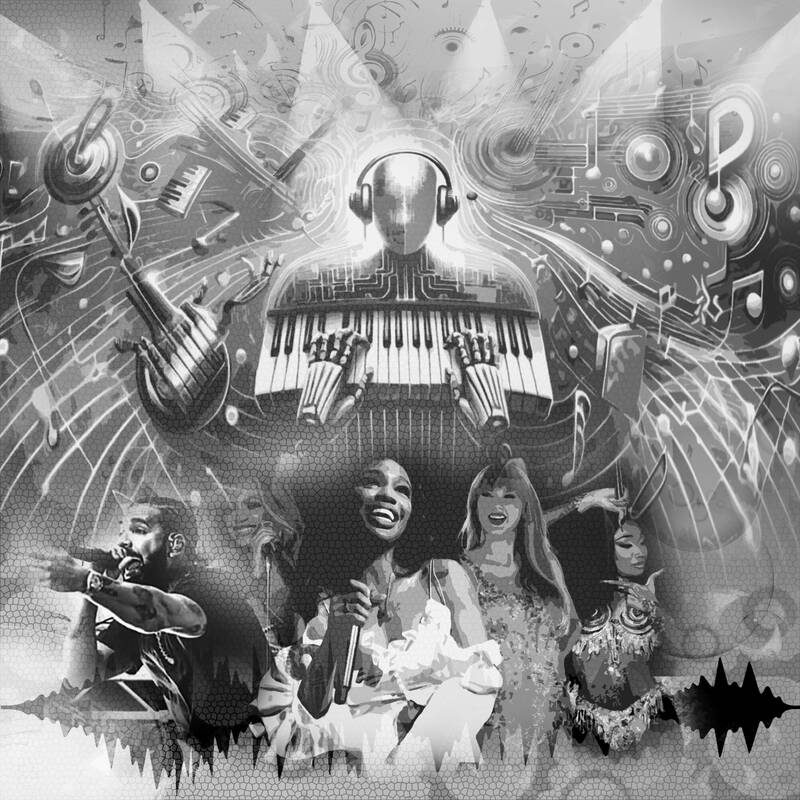
Illustration: Kevin Sheu
One can also find artificial DJs capable of hosting a party like a human, complete with speeches and playlists, as well as AI-generated film soundtracks and voiceovers that imitate artists’ voices and styles. In each case, pretty much anyone can generate low-cost music and audio for use across a broad range of applications.
The evolution is dizzying.
The International Confederation of Societies of Authors and Composers (CISAC) said it expects the market for music and audiovisual content created by generative AI to skyrocket, from about 3 billion euros (US$3.5 billion) currently to 64 billion euros by 2028, with generative AI music possibly accounting for about 20 percent of streaming platforms’ revenues.
Creators’ revenues are also at risk; for music, the total could fall by about 24 percent by 2028, the CISAC said.
To protect artists’ copyrighted material, policymakers in some jurisdictions are beginning to take legislative action. The European AI Act requires those who publish and distribute AI-generated material to be transparent about its sources. There are also several European projects exploring watermarking and blockchain-based solutions to identify source material and automatically pay out micro-royalties. However, such protections would likely prove illusory. The artists of tomorrow would have to be remunerated in other ways. The arrival of a new kind of economy means everything must change.
After all, anyone with a computer or mobile phone can create, arrange, mix, master and produce a music video, or adapt their own works for video games, interactive advertising, marketing campaigns and other uses. One possibility, then, is that generative AI would further enable some artists to forego arrangements with record companies and other traditional intermediaries. In doing so, they might try to maintain a personalized dialogue with their fans, whom they can offer customized experiences.
Sensing the changes that are coming, music distribution platforms are trying to get ahead of the game by allying themselves with legacy record companies, which are themselves in grave danger of extinction. For example, Spotify has signed an agreement with three major record companies promising to use AI with and for human artists, thus guaranteeing them transparency, consent, remuneration and protections against cloned voices. However, these legacy players would be unable to keep their promise, because the remuneration mechanisms provided for in these agreements would be largely illusory: too small and without real control.
Thus, if artists are not careful, the upheaval introduced by AI would amount to a change of master: after the feudal lord, the bourgeois and the all-powerful record company would come the triumph of the algorithm. Copyright protections would evaporate, and musicians would become mere employees of the algorithm, if not its slaves. The only way that artists can escape this fate is by becoming entrepreneurs of their own creations, harnessing AI’s formidable potential themselves and capitalizing on the irreplaceability, already visible and lasting, of the in-person concert performance.
Meanwhile, consumers, who could become passive subjects of algorithmic control, could assert themselves. They could become cocomposers, determining the form to be given to the work they listen to (by choosing the music style, the instruments and the singers) and, like the artist, privileging the actual, direct, living, irreplaceable exchange of the concert performance.
The only true freedom, in music as elsewhere, is to create and control the fruit of one’s creation. AI could amplify this freedom if we act now by focusing on the development of creativity at school and elsewhere. However, as matters stand, it seems well on its way to doing the opposite.
Jacques Attali, founding president of the European Bank for Reconstruction and Development, is a former special adviser to French President Francois Mitterrand and the author of 86 books.
Copyright: Project Syndicate
The saga of Sarah Dzafce, the disgraced former Miss Finland, is far more significant than a mere beauty pageant controversy. It serves as a potent and painful contemporary lesson in global cultural ethics and the absolute necessity of racial respect. Her public career was instantly pulverized not by a lapse in judgement, but by a deliberate act of racial hostility, the flames of which swiftly encircled the globe. The offensive action was simple, yet profoundly provocative: a 15-second video in which Dzafce performed the infamous “slanted eyes” gesture — a crude, historically loaded caricature of East Asian features used in Western
Is a new foreign partner for Taiwan emerging in the Middle East? Last week, Taiwanese media reported that Deputy Minister of Foreign Affairs Francois Wu (吳志中) secretly visited Israel, a country with whom Taiwan has long shared unofficial relations but which has approached those relations cautiously. In the wake of China’s implicit but clear support for Hamas and Iran in the wake of the October 2023 assault on Israel, Jerusalem’s calculus may be changing. Both small countries facing literal existential threats, Israel and Taiwan have much to gain from closer ties. In his recent op-ed for the Washington Post, President William
A stabbing attack inside and near two busy Taipei MRT stations on Friday evening shocked the nation and made headlines in many foreign and local news media, as such indiscriminate attacks are rare in Taiwan. Four people died, including the 27-year-old suspect, and 11 people sustained injuries. At Taipei Main Station, the suspect threw smoke grenades near two exits and fatally stabbed one person who tried to stop him. He later made his way to Eslite Spectrum Nanxi department store near Zhongshan MRT Station, where he threw more smoke grenades and fatally stabbed a person on a scooter by the roadside.
Taiwan-India relations appear to have been put on the back burner this year, including on Taiwan’s side. Geopolitical pressures have compelled both countries to recalibrate their priorities, even as their core security challenges remain unchanged. However, what is striking is the visible decline in the attention India once received from Taiwan. The absence of the annual Diwali celebrations for the Indian community and the lack of a commemoration marking the 30-year anniversary of the representative offices, the India Taipei Association and the Taipei Economic and Cultural Center, speak volumes and raise serious questions about whether Taiwan still has a coherent India


 RSS
RSS