


More than two decades ago, the US railed against the “axis of evil.” Now, after international climate talks spluttered to a meager conclusion, the US finds itself grouped with unflattering company — an “axis of obstruction” that has stymied progress on the climate crisis.
US President Donald Trump’s administration opted to not send anyone to the UN climate summit in Brazil that culminated over the weekend — a first for the US in 30 years of these annual gatherings and another representation of Trump’s disdain for the climate crisis, which he has called a “hoax” and a “con job.”
But even without the administration saying “drill, baby, drill” at the conference center in Belem, near the mouth of the Amazon River, 194 other countries were unable to bring down the curtain on the era of coal, oil and gas. The term “fossil fuel” was not mentioned in the agreement text after fierce opposition led by Saudi Arabia, which has been cajoled by the US to take a more moderate line at past climate talks.
Michael Jacobs, of the think tank ODI Global and the University of Sheffield, said that the COP30 summit revealed “an increasingly bitter conflict at the heart of global climate politics: between those who accept the scientific fact that to deal with climate change the world must wean itself off fossil fuels over the coming decades; and those who are resisting this in pursuit of their short-term energy interests.”
The US can be considered part of the latter group, along with Saudi Arabia, the United Arab Emirates and Russia, Jacobs said.
“I think today we have witnessed what the three countries have agreed,” he said of Trump’s separate dealings with Saudi Arabia and Russia over the past week.
“Geopolitically, this is the creation of a new axis of obstruction — actively promoting fossil fuels and opposed to climate action,” Jacobs said.
The US finds itself ranged against a loose coalition of about 90 countries, including much of Europe, that demanded a roadmap to phase out fossil fuels — the root cause of the worsening climate crisis — in Belem.
This group is convening in a separate summit in Colombia in April to push this goal, amid impatience with the ponderous, consensus-driven UN framework on the climate crisis that barely held in place at COP30.
“Even without the Trump administration there to bully and cajole, petrostates again shut down meaningful progress on a roadmap to phase out fossil fuels with necessary funding for poorer countries,” said Jean Su, energy justice director at the Center for Biological Diversity.
If a world of petrostates and “electrostates” is forming, the Trump administration is adamant the US remain in the first group. Over the course of COP30, the administration busied itself with stark counterprogramming in the US — stripping protections from streams and wetlands, making it harder to prevent species from becoming extinct and ushering oil and gas drilling into more than 1 billion acres of US waters.
This last measure includes new drilling in pristine areas of the Arctic and, in a sort of trollish move timed for the visit of California Governor Gavin Newsom to COP30, the prospect of oil rigs off the coast of California. Newsom has said that would happen “over my dead body.”
“President Trump has been clear: He will not jeopardize our country’s economic and national security to pursue vague climate goals that are killing other countries,” said Taylor Rogers, a White House spokeswoman. “President Trump serves the American people, not radical climate activists who have fallen victim to the biggest scam of the century.”
But while COP30 ended in frustration, there was recognition from observers that the world is still moving away from the age of fossil fuels, with double the amount globally invested in renewables such as wind and solar than traditional energy sources last year.
And while China did not fully step into the leadership vacuum in Belem, it is certainly leading as a clean energy superpower, even outstripping its competitor — China is making more money from exporting green technology than the US earns from exporting fossil fuels.
Even in the US, there is little appetite for Trump’s climate revanchism. Two-thirds of American voters oppose the president’s decision to withdraw the US from the Paris climate agreement, while clear majorities want action to slash planet-heating emissions and are worried about the heatwaves, floods, storms and other climate-driven calamities that are pushing up insurance rates and harming Americans’ health.
If there is an axis of obstruction, it might be able to slow the transition down but is unlikely to halt it altogether.
“The rest of the world is fed up with delay and denial,” as former US vice president Al Gore put it in the wake of the COP30 outcome.
“Ultimately, petrostates, the fossil-fuel industry, and their allies are losing power. Just as we have passed Peak Trump, I believe we have also passed Peak Petrostate,” Gore said. “They may be able to veto diplomatic language, but they can’t veto real-world action.”

A gap appears to be emerging between Washington’s foreign policy elites and the broader American public on how the United States should respond to China’s rise. From my vantage working at a think tank in Washington, DC, and through regular travel around the United States, I increasingly experience two distinct discussions. This divergence — between America’s elite hawkishness and public caution — may become one of the least appreciated and most consequential external factors influencing Taiwan’s security environment in the years ahead. Within the American policy community, the dominant view of China has grown unmistakably tough. Many members of Congress, as
The Hong Kong government on Monday gazetted sweeping amendments to the implementation rules of Article 43 of its National Security Law. There was no legislative debate, no public consultation and no transition period. By the time the ink dried on the gazette, the new powers were already in force. This move effectively bypassed Hong Kong’s Legislative Council. The rules were enacted by the Hong Kong chief executive, in conjunction with the Committee for Safeguarding National Security — a body shielded from judicial review and accountable only to Beijing. What is presented as “procedural refinement” is, in substance, a shift away from
The shifting geopolitical tectonic plates of this year have placed Beijing in a profound strategic dilemma. As Chinese President Xi Jinping (習近平) prepares for a high-stakes summit with US President Donald Trump, the traditional power dynamics of the China-Japan-US triangle have been destabilized by the diplomatic success of Japanese Prime Minister Sanae Takaichi in Washington. For the Chinese leadership, the anxiety is two-fold: There is a visceral fear of being encircled by a hardened security alliance, and a secondary risk of being left in a vulnerable position by a transactional deal between Washington and Tokyo that might inadvertently empower Japan
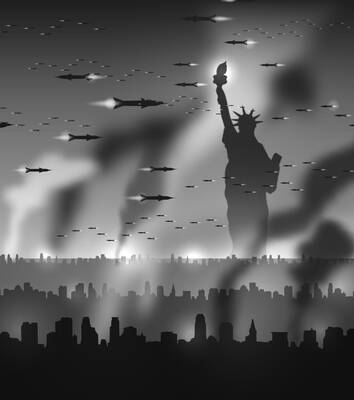
After declaring Iran’s military “gone,” US President Donald Trump appealed to the UK, France, Japan and South Korea — as well as China, Iran’s strategic partner — to send minesweepers and naval forces to reopen the Strait of Hormuz. When allies balked, the request turned into a warning: NATO would face “a very bad” future if it refused. The prevailing wisdom is that Trump faces a credibility problem: having spent years insulting allies, he finds they would not rally when he needs them. That is true, but superficial, as though a structural collapse could be caused by wounded feelings. Something


 RSS
RSS