


There are two big worries when it comes to the rapid advances in artificial intelligence (AI). The first is that it would lead to robot overlords that would eradicate humanity. The second is that AI would eliminate many jobs. The more likely scenario is that it creates a labor shortage, or at least a dearth of skilled workers who can make the most of the new technology.
I recently spoke to the head of the informatics program at a large university and asked her about training undergraduates for this future. The biggest obstacle is that many students do not have the necessary math skills for a world where AI would dominate our lives, especially those who do not plan to specialize in the field, she said.
What about those who do plan a career in AI? Technology has always made labor more valuable because it allows workers to become more productive. The concern now is people would use AI to do their thinking for them, thereby making themselves redundant. That would probably be the case for some, but using AI in a productive manner involves employing the technology to develop novel ideas, and that requires at least some human input.
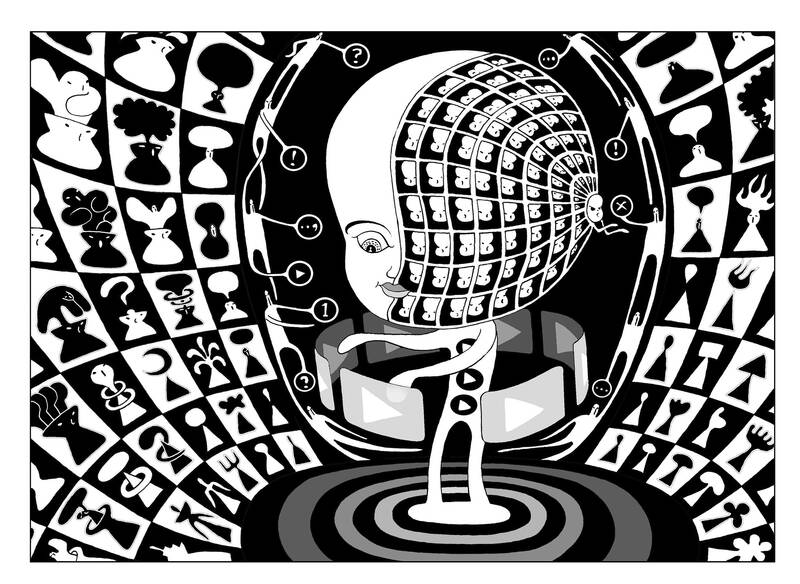
Illustration: Mountain People
For example, large language models work by taking lots of data to not only answer a question, but finding the answer that is most common, or average. Sometimes that is adequate, but what distinguishes people in a work situation is often coming up with an exceptional answer. AI could help you get there, but is rarely sufficient on its own; it also takes an ability to assess the output and push further. Often, the answer from AI is inadequate because it lacks the context that makes a certain situation unique.
Suppose you attempt to get a simple statistic from a large trove of data. It is not enough to get a statistic thrown back at you; you need to understand the limitations of the data your model is working with, where it comes from, when it is from, if it is relevant to your problem, and what specification the technology used to provide the statistic. Making sense of the results takes both decent statistical and analytic skills.
In the meantime, we are witnessing a collapse of standards and some students’ ability to do even basic math in some of the US’ best universities and secondary schools. Perhaps only a fraction of students at Harvard University need remedial math. However, the fact that this is even a population at such a school suggests standards across the board are weakening, not only for math, but reading as well. Even exceptional students are getting less rigorous training in how to think critically during this crucial time in their lives and brain development.
I have heard many academics say they are still unsure how to teach students the skills they need to thrive in an AI world that eliminates many entry-level jobs. Amid a major economic transition, it is impossible to know what the future of work would look like. One likely solution might be as simple as teaching the basics well, enforcing consistent standards and giving real grades.
Doing anything else risks a vicious cycle where new graduates cannot offer much improvement on AI because they lack the skills they need to work with the technology and so are not worth hiring. In such a scenario we end up in the worst of all worlds — unemployable graduates and employers unable to find enough workers who can use the new technology effectively.
When it comes to the US, there is an added risk tied to immigration. Many foreign students have better quantitative skills than their American peers, but the US’ legal and skilled migration system is broken. Even the president, long an immigration skeptic, admits the country needs more skilled workers who can create and use technology, and many of them would need to come from abroad. However, lasting immigration reform cannot come from an executive order; it requires the US Congress and bipartisan consensus on immigration priorities. Unfortunately, this is not looking likely at this time.
The result is that the US is potentially left dealing with a major mismatch in skills and the lack of analytical thinkers with strong math abilities who can use and adapt to however technology evolves. Neither the education nor immigration system is producing enough of these people. The outcome might be both many unemployable graduates and a massive labor shortage.
Allison Schrager is a Bloomberg Opinion columnist covering economics. A senior fellow at the Manhattan Institute, she is author of An Economist Walks Into a Brothel: And Other Unexpected Places to Understand Risk. This column reflects the personal views of the author and does not necessarily reflect the opinion of the editorial board or Bloomberg LP and its owners.
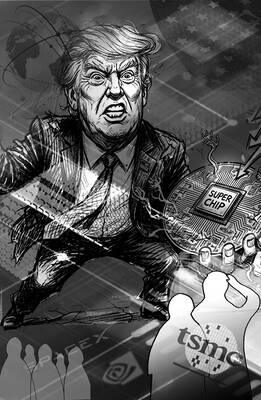
The White House’s decision to take a 9.9 percent stake in Intel Corp is looking like very shrewd business indeed. Since the government bought in at US$20.47 a share last August, the US chipmaker’s surging stock price has delivered the US a US$43 billion return. One of the reasons the investment has so far proved so sound is that the White House has made sure of it. According to The Wall Street Journal, Howard personally pushed deals on Intel’s behalf with some of the most lucrative clients imaginable. They include Nvidia Corp, the company at the heart of the AI
A single photograph can cut through a lot of noise, but it can also be used to misrepresent the truth. At the very least, it can concentrate the mind on something that requires further investigation. On Monday last week, Ma Ying-jeou Foundation CEO Tai Hsia-ling (戴遐齡) and former National Security Council secretary-general King Pu-tsung (金溥聰) held a news conference in which they showed a photograph of former foundation CEO Hsiao Hsu-tsen (蕭旭岑), now Chinese Nationalist Party (KMT) deputy chairman. In the image Hsiao is seated next to Xiamen Taiwan Businessmen Association chairman Han Ying-huan (韓螢煥). The two men were holding
I first met Professor Ray Jiing (井迎瑞) as a film and documentary student at Shih Hsin University’s (SHU) Department of Radio Television and Film in 1988. The following year, he went on to become the director of the Chinese Taipei Film Archive — forerunner of the Taiwan Film and Audiovisual Institute (TFAI). Over his eight-year tenure, Jiing rescued and restored over 200 classic Taiwanese films. In 1997, he established the Graduate Institute of Studies in Documentary and Film Archiving at Tainan National University of the Arts (TNNUA), and I joined the program in his third cohort of students. Beyond a
A recent report concerning a student who is suing his teacher posed the question in its headline: Does failing a student in two subjects constitute bullying? The college student in Chiayi County apparently sought NT$2 million (US$63,603) in state compensation, but a court dismissed the case. The first reaction of many might have been to ask: What has happened to students nowadays? Some say that teachers have lost their authority, while others say students are overindulged. Some even start reminiscing over the days when “whatever the teacher says goes.” However, the real issue might be overlooked if emotional reactions like that are the


 RSS
RSS