


Such is the gravitational pull cast by US President Donald Trump and the US economy that the politics of the other 192 countries that make up the UN are rapidly being reduced to one long discussion about how to relate to, and challenge this ever darker and weirder presidency.
Before Trump’s extraordinary 58-minute speech on the supposed threats posed by open borders, Shariah law, the UN’s failings and the “climate hoax,” the supporters of the UN’s values already knew they faced a challenge. Now they realize the degree to which the world’s superpower seems bent on the destruction of everything they believe.
Immediately after the shocked, and even embarrassed, UN delegates had recovered from Trump’s performance, the general assembly was addressed by leaders of two large Muslim states, Indonesian President Prabowo Subianto and Turkish President Recep Tayyip Erdogan.
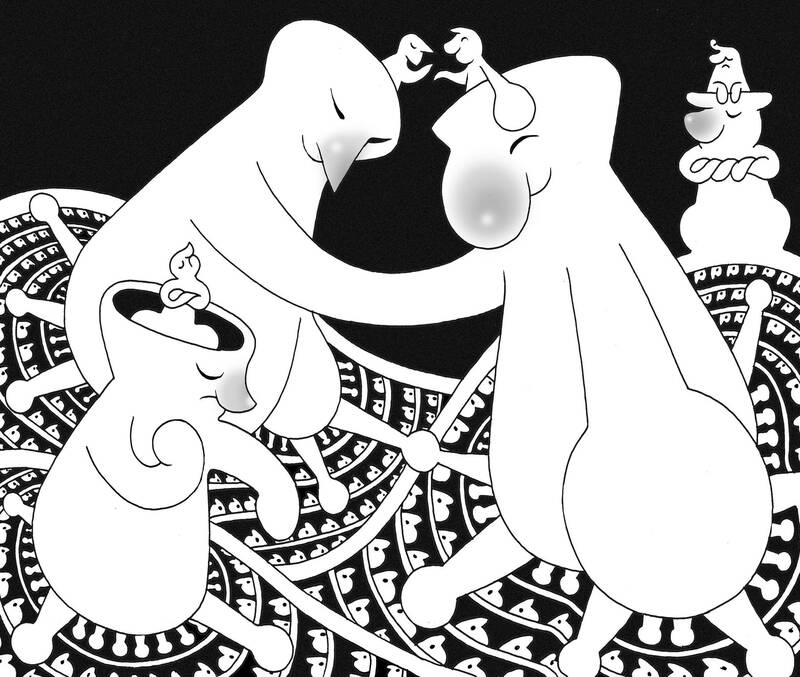
Illustration: Mountain People
Subianto was strongly applauded when he said: “Might cannot be right; right must be right. No one country can bully the whole of the human family. We may be weak individually, but the sense of oppression and injustice will unite us into a strong force that will overcome this injustice.”
Erdogan insisted that Israeli Prime Minister Benjamin Netanyahu was completely out of control, and those that were silent in the face of his barbarity were complicit.
And immediately prior to Trump’s address, Brazilian President Luiz Inacio Lula da Silva, without mentioning the US, had given a sophisticated warning about the threat posed by the new authoritarians.
“Today the ideals that inspired the UN’s founders in San Francisco are under threat as never before in their history. Multilateralism is at a new crossroads. This organization’s authority is in check. We are witnessing the constellation of an international order marked by repeated concessions to power play. Attacks on sovereignty, arbitrary sanctions and unilateral interventions are becoming the rule,” Lula said.
“There is a clear parallel between multilateralism’s crisis and the weakening of democracy. Authoritarianism is strengthened when we fail to act in the face of arbitrary acts when international society falters in defending peace and sovereignty. Anti-democratic forces are trying to subjugate institutions and stifle freedoms. They worship finance. They praise ignorance, and act as physical and digital militias and restrict the press,” Lula said.
Others such as South Korean President Lee Jae-myung said that the climate crisis was far from being a hoax, it represents a threat to global humanity.
Yet the Trump speech also made even more stark and urgent the unavoidable question of how the world can operate in the absence of reliable US leadership.
This is not just a question for the global south, but also for Europe as it confronts Russia, for Asia as it wrestles with Chinese power and for the Gulf as it grapples with Israel’s military dominance. One response is the alliance of autocrats on display in Beijing at the beginning of the month led by Chinese President Xi Jinping (習近平) and Russian President Vladimir Putin.
Another is the still forming anti-Trump alliance led by democratic leaders. This is operating apart from the UN, because the reality is that UN institutions, gridlocked by the veto of competing power blocs, and abandoned financially by the US, are being bypassed.
Trump’s claim to have ended seven “unendable wars,” all without any help from the UN, is absurd, but it is true that the UN Security Council is no longer capable of bringing conflicts to an end.
As Lula said: “The tyranny of the veto sabotages the very reason for the UN’s existence.”
In his speech, UN Secretary-General Antonio Guterres made a pitch for the UN’s continued relevance, but he acknowledged the pillars of peace and prosperity were buckling, and multilateralism was suffering.
“Multipolarity without effective multilateral institutions courts chaos, as Europe learned the hard way, resulting in World War I,” Guterres said.
At end of his speech, Guterres urged: “We must never give up.”
Efforts to develop a strong anti-Trump alliance bringing together the global south and Europe have been weakened by issues of double standards — the belief that Europe’s outrage with Russia’s invasion of Ukraine is not matched by similar outrage at Israel’s destruction of Gaza.
Spanish Prime Minister Pedro Sanchez, in a speech to 500 Columbia University students on Monday, repeatedly warned his fellow Europeans to realize how much damage the double standards charge had caused to their image.
Indeed, Sanchez is rapidly becoming the European leader most willing to stand in Trump’s way. At Columbia, he drew applause defending the positive virtues of migration, saying: “Open societies are the best antidote to fanaticism,” remarks that had a special relevance given Trump’s attempts to silence the Columbia campus protests.
“When the voice of a society is silenced, it ends up dying. Open societies thrive on words. Freedom of expression, of belief, the right to participate in public life empowers citizens. Losing the freedom to dissent is opening the door to tyranny,” he said.
Sanchez is also one of the front-rank politicians trying to build alliances to stand up to Trump, convening on Wednesday with Lula and Chilean President Gabriel Boric an alliance entitled “In Defense of Democracy,” focusing on issues such as reinforcing multilateralism, the rule of law and cooperation against extremism, and the algorithms that weaken social cohesion.
However, these global alliances are still in their infancy and ill-coordinated.
The greater danger is that each nation-state, driven by internal politics and assessments of their economic strength, would make their own decisions on how to combat, or bow to US power.
In making that decision, each country could experience Trump’s shakedown diplomacy. By mixing trade, security or immigration into one negotiation, Trump maximizes his leverage — and however much he is reviled, it is a brave country that resists.

Weeks into the craze, nobody quite knows what to make of the OpenClaw mania sweeping China, marked by viral photos of retirees lining up for installation events and users gathering in red claw hats. The queues and cosplay inspired by the “raising a lobster” trend make for irresistible China clickbait. However, the West is fixating on the least important part of the story. As a consumer craze, OpenClaw — the AI agent designed to do tasks on a user’s behalf — would likely burn out. Without some developer background, it is too glitchy and technically awkward for true mainstream adoption,
A delegation of Chinese Nationalist Party (KMT) officials led by Chairwoman Cheng Li-wun (鄭麗文) is to travel to China tomorrow for a six-day visit to Jiangsu, Shanghai and Beijing, which might end with a meeting between Cheng and Chinese President Xi Jinping (習近平). The trip was announced by Xinhua news agency on Monday last week, which cited China’s Taiwan Affairs Office (TAO) Director Song Tao (宋濤) as saying that Cheng has repeatedly expressed willingness to visit China, and that the Chinese Communist Party (CCP) Central Committee and Xi have extended an invitation. Although some people have been speculating about a potential Xi-Cheng
Chinese Nationalist Party (KMT) Chairwoman Cheng Li-wun (鄭麗文) is leading a delegation to China through Sunday. She is expected to meet with Chinese President Xi Jinping (習近平) in Beijing tomorrow. That date coincides with the anniversary of the signing of the Taiwan Relations Act (TRA), which marked a cornerstone of Taiwan-US relations. Staging their meeting on this date makes it clear that the Chinese Communist Party (CCP) intends to challenge the US and demonstrate its “authority” over Taiwan. Since the US severed official diplomatic relations with Taiwan in 1979, it has relied on the TRA as a legal basis for all
On Monday, the day before Chinese Nationalist Party (KMT) Chairwoman Cheng Li-wun (鄭麗文) departed on her visit to China, the party released a promotional video titled “Only with peace can we ‘lie flat’” to highlight its desire to have peace across the Taiwan Strait. However, its use of the expression “lie flat” (tang ping, 躺平) drew sarcastic comments, with critics saying it sounded as if the party was “bowing down” to the Chinese Communist Party (CCP). Amid the controversy over the opposition parties blocking proposed defense budgets, Cheng departed for China after receiving an invitation from the CCP, with a meeting with


 RSS
RSS