


As China steps up a campaign to diplomatically isolate and squeeze Taiwan, it has become more imperative than ever that Taipei play a greater role internationally with the support of the democratic world.
To help safeguard its autonomous status, Taiwan needs to go beyond bolstering its defenses with weapons like anti-ship and anti-aircraft missiles. With the help of its international backers, it must also expand its diplomatic footprint globally.
But are Taiwan’s foreign friends willing to translate their rhetoric into action by helping Taipei carve out more international space for itself? Beating back China’s effort to turn Taiwan into an international pariah demands sustained external support for Taipei.
The recent Quad summit of America, Australia, India and Japan, which was hosted by US President Joe Biden is his Delaware hometown of Wilmington, made no mention of Taiwan or the Taiwan Strait issue while identifying in its joint statement the challenges in the Indo-Pacific region.
Of late, though, several Western countries have criticized China for deliberately misinterpreting United Nations Resolution 2758 to claim that it enshrined Beijing’s “one China principle.” Beijing has used that 1971 resolution to exclude Taiwan from most international organizations.
By falsely conflating the 1971 resolution with its one China principle and speciously claiming that it reflects an international consensus in favor of that principle, Beijing has been vetoing Taipei’s participation even in international forums where Taiwan was present earlier, such as the World Health Organization’s decision-making World Health Assembly.
The fact is that the UN General Assembly adopted Resolution 2758 with a vote of 76 yes to 35 no, with 17 abstentions, “recognizing that the representatives of the Government of the People’s Republic of China are the only lawful representatives of China to the United Nations and that the People’s Republic of China is one of the five permanent members of the Security Council.” While disposing of the question of who had China’s seat in the UN, the resolution made no mention of Taiwan or China’s territorial or population scope.
Simply put, the resolution does not preclude Taiwan’s meaningful participation in the UN system and other multilateral forums.
Yet, for decades, the West did not credibly push back against Beijing’s deliberate misconstruction of the 1971 resolution or its blocking of Taiwan’s participation in international organizations, thereby inadvertently strengthening China’s diplomatic hand against Taipei. Even today, China continues to misuse that resolution in an effort to chip away at Taiwan’s autonomous status.
Take the Biden administration, which says that America’s one-China policy differs from Beijing’s one-China principle. US Secretary of State Antony Blinken has contended that US support for Taiwan’s meaningful participation in international forums aligns with the US reading of the 1971 resolution, as well as with America’s Taiwan Relations Act and bilateral communiques with China.
Still, Biden excluded Taiwan from his Indo-Pacific Economic Framework, a US-led multilateral partnership that covers everything from infrastructure to the digital economy.
The White House offered no explanation for omitting Taiwan, a technological powerhouse with the world’s 22nd-largest economy by gross domestic product that is a hub of global semiconductor production.
Biden’s geopolitical imperative to ensure that China did not undermine the unprecedented, US-led sanctions against Russia may have prompted Taiwan’s exclusion from the Indo-Pacific Economic Framework. Biden’s more conciliatory approach to Beijing, however, has yielded few positive results, with China quietly providing significant support to Russia’s military-industrial complex and effectively becoming Moscow’s banker.
Taiwan, a vibrant democracy, has all the attributes of a robust independent state, and most Taiwanese want it to stay that way.
What Taiwan needs from its international friends is tangible support against the designs of the Chinese Communist Party (CCP), which is totalitarian, expansionist and contemptuous of international law. In fact, under Xi Jinping (習近平), the CCP has become more despotic, coercive and punitive.
As part of a strategy to annex Taiwan, the CCP is working methodically to wipe out that island democracy’s international identity by persuading countries to break off diplomatic ties with Taipei. With its “tribute nation” approach to vulnerable states, Beijing has sought to influence their foreign policy through inducements, extending from loans to bribery.
China has already poached a number of Taiwan’s diplomatic allies, including in Central America where Taipei had strong relationships. From 2016 to 2024, Beijing poached 10 of Taiwan’s 22 allies across the world, with Nauru being the latest. This has left only 11 nations and the Vatican still recognizing Taiwan as a sovereign nation.
In one positive development, the small nation of Lithuania defied Chinese threats and allowed Taiwan in 2021 to open “The Taiwanese Representative Office” in Vilnius, the Lithuanian capital. This was followed by the opening of the Lithuanian Trade Representative Office in Taipei.
A “Taiwanese” representative office stands out in comparison to “Chinese Taipei” (used by a number of nations and the International Olympic Committee) or “Taipei Economic and Cultural Office” (as in Canada and the US, for example). A number of nations, from Britain to Singapore, host a “Taipei Representative Office.”
More broadly, most countries support keeping the status quo in the Taiwan Strait. So, radical ideas are unlikely to gain traction, including former US Secretary of State Mike Pompeo’s proposal that America recognize Taiwan as an independent nation, separate from communist China.
If Taiwan gains greater presence on the international stage, it will be able to shore up its status as a de facto nation, making it more difficult for China to seize the self-governing island in the way it occupied Tibet soon after coming under communist rule in 1949.
The then-independent Tibet should have applied for United Nations membership shortly after that international body came into existence in 1945, but it never did.
If Taiwan is not to go Tibet’s way, major democracies must strengthen and broaden their ties with Taipei and assist it in enlarging its diplomatic footprint. Major democracies must act before it becomes too late.
Brahma Chellaney, professor of strategic studies at the independent Center for Policy Research in New Delhi, is the author of nine books, including the award-winning Water: Asia’s New Battleground (Georgetown University Press).
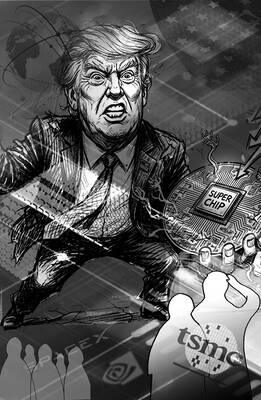
The White House’s decision to take a 9.9 percent stake in Intel Corp is looking like very shrewd business indeed. Since the government bought in at US$20.47 a share last August, the US chipmaker’s surging stock price has delivered the US a US$43 billion return. One of the reasons the investment has so far proved so sound is that the White House has made sure of it. According to The Wall Street Journal, Howard personally pushed deals on Intel’s behalf with some of the most lucrative clients imaginable. They include Nvidia Corp, the company at the heart of the AI
In a Taiwanese university classroom, a lecturer asks in English: “Can anyone give me an example from Taiwan?” Students look down. No one answers. After class, one student writes on the course platform in Mandarin: “I understood the concept, but I didn’t know how to answer in English.” That moment highlights a key issue in Taiwan’s English-medium instruction (EMI) reform: It is not just about more English-taught courses, but whether students can learn, participate and belong. EMI expansion is part of the Bilingual 2030 policy and the Ministry of Education’s BEST Program, aiming to improve English ability, support EMI teaching
A single photograph can cut through a lot of noise, but it can also be used to misrepresent the truth. At the very least, it can concentrate the mind on something that requires further investigation. On Monday last week, Ma Ying-jeou Foundation CEO Tai Hsia-ling (戴遐齡) and former National Security Council secretary-general King Pu-tsung (金溥聰) held a news conference in which they showed a photograph of former foundation CEO Hsiao Hsu-tsen (蕭旭岑), now Chinese Nationalist Party (KMT) deputy chairman. In the image Hsiao is seated next to Xiamen Taiwan Businessmen Association chairman Han Ying-huan (韓螢煥). The two men were holding
The Ministry of the Interior, working with the navy and coast guard, is organizing Taiwan’s first joint exercise simulating escort tankers carrying liquefied natural gas (LNG) and oil through a Chinese blockade. The drills simulate fuel transport along three maritime corridors leading toward Japan, the Philippines and the US. Deputy Minister of the Interior Sawyer Mars (馬士元) said that a blockade of the Taiwan Strait would amount to “almost a 100 percent blockade of the regional energy supply.” Minister of National Defense Wellington Koo said planning to counter a blockade is standard practice in Taipei. While the exercise is limited in


 RSS
RSS