


The rule of law should be respected, “and we should never allow anyone to tear it down. It’s as simple as that,” US President Joe Biden said on May 31.
He was referring to a verdict — guilty on 34 counts — against his predecessor, which former US president Donald Trump and his fans are loath to accept because they do not like it.
However, Biden could just as well have been talking about international law, which faces the greatest threat of unraveling since the US shaped its modern features after World War II. If that happens, the US and its ally Israel would bear much of the blame.
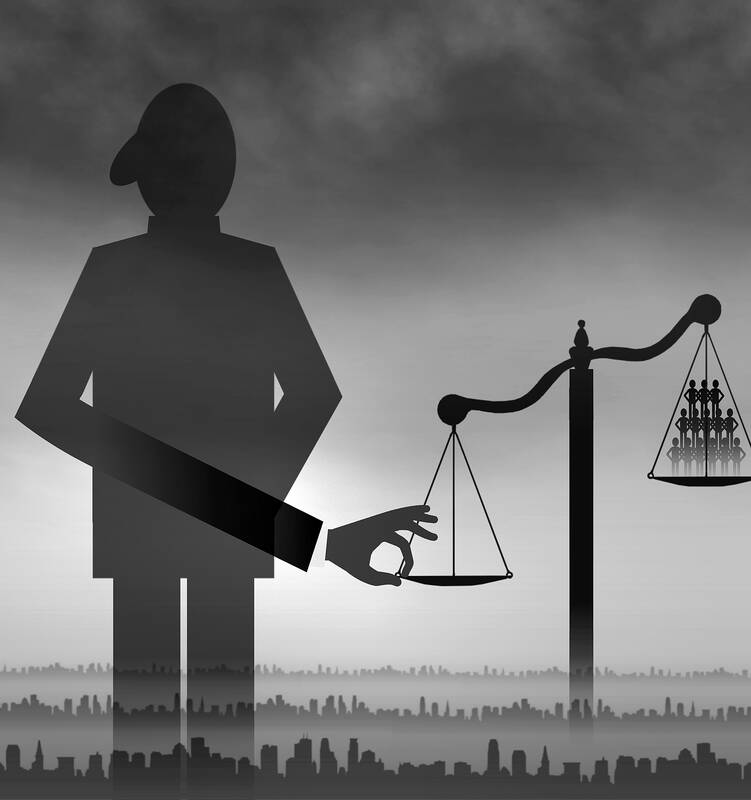
Illustration: Yusha
Both countries’ ambivalence toward international law has a long history, but the current crisis dates to the sadistic massacre that Hamas committed against Israel on Oct. 7 last year, and Israel’s subsequent war of self-defense and retaliation in the Gaza Strip, where Hamas is callously using the civilian population as human shields.
Last week, the US House of Representatives passed — the title says it all — the Illegitimate Court Counteraction Act. The bill takes aim at the International Criminal Court (ICC) in The Hague, threatening sanctions against any of its staff who investigate citizens of the US or Israel. It is meant as blowback for an application by the ICC’s prosecutor for arrest warrants against not only three commanders of Hamas, but also two leaders of Israel, including Israeli Prime Minister Benjamin Netanyahu.
The prosecutor alleged, among other things, that Israel’s government has used mass starvation as a weapon of warcraft, which would be a war crime. That said, his announcement was largely symbolic. The court’s judges would first have to grant his request. Even then, the US and Israel would ignore the warrants, because neither is a signatory to the Rome Statute that established the ICC.
The Illegitimate Court Counteraction Act, which stands no chance in the US Senate, might be political theater. It is also the latest scene in a tortuous drama about the US’ on-again, off-again relationship with the ICC, and with international law generally.
The US helped draft the Rome Statute in the 1990s, then backed out of it. During the Trump administration, Washington sanctioned a judge and lawyer of the court. More recently, the Biden administration, with bipartisan support, began selectively cooperating with the ICC to hold Russian President Vladimir Putin to account for war crimes in Ukraine. Now the US has again turned against the court.
Separate but similar theatrics are unfolding elsewhere in The Hague, at the International Court of Justice (ICJ), the tribunal before which all member nations of the UN can sue other states. In a case that has outraged most Israelis and many others, South Africa has charged Israel with genocide in the Gaza Strip.
The ICJ is just one of the appendages of the UN. Its charter, drafted in large part by US jurists in the 1940s, in theory represents a sort of world constitution, while its Security Council is a rough analog to a global legislature, with the prerogative of passing binding resolutions that can be enforced with military might.
However, Israelis increasingly regard the entire UN system as “the central vehicle for hijacking and perverting international ‘law’ and the principles of universal ‘human rights’ in the service of warfare and antisemitism,” as a report for the Jerusalem Center for Public Affairs said.
Israeli Ambassador to the UN Gilad Erdan, whose term is ending, demonstratively shredded its charter during a recent speech and thinks that the whole institution should be defunded.
The Security Council is indeed easy to mock or disdain. Five of its 15 members are permanent and wield a veto, and they include the three “great powers” of China, Russia and the US. Increasingly, and especially since Oct. 7, the autocratic duo among them vetoes anything the US proposes and vice versa, or, using abstentions, they allow only the most diluted resolutions to pass. Eight months since the massacre, the council has yet to pass either clear condemnation of Hamas or a ceasefire resolution, although the US is circulating another draft.
Are domestic legislatures and judiciaries paragons of rational and unbiased decisionmaking? Ultimately, the predicament is the same as that facing Trump, or anybody: You cannot respect the law only when you happen to agree with it.
The international arena is by necessity more chaotic than any national assembly or tribunal, because sovereign states have clashing interests and worldviews. So do not mock the UN unless you are also prepared to advocate for a world government and to explain how, short of war, one would be chosen.
Americans in particular should ask themselves what the alternative would be to the legal regime that postwar US leadership made possible. When respect for the law erodes, within or between nations, the result is always anarchy, which in world politics usually means more war.
Picture a world of Putins, invading and conquering as their military might permits, and of smaller nations and victims who would have no recourse to norms or law in the international community. Picture the Melians in the 5th century BC, whose men the Athenians killed and whose women and children they enslaved — for no other reason, according to Thucydides, than that the Athenians could.
What then should the US and Israel do instead of criticizing the courts in The Hague? David Scheffer, a former US ambassador-at-large for war crimes issues who led the US team negotiating the Rome Statute in the 1990s and wrote its early drafts, said they should both stop maligning the ICC.
Israel’s judiciary should instead begin its own investigation into the prosecutor’s allegations, he said.
Scheffer himself drafted the “complementarity” article — the one he is most proud of — which says that the ICC can only intervene if a state cannot or refuses to bring a genuine case in its own judicial system.
Autocracies such as China or Russia cannot credibly argue that they would, while democracies such as the US or Israel can. The credibility derives from the process, not from the outcome, whether conviction or exoneration.
Scheffer of course also wants the US to join the Rome Statute. That is why then-US president Bill Clinton told him to negotiate it, after all. That way, Washington would also have sway inside the court, and probably even a judge on the bench.
The same logic applies to the ICJ. The US and Israel should trust the tribunal’s processes, professionalism and fairness, and Israel should keep arguing its case, which it could probably win.
The US should pledge to respect the verdict, whatever it is. It cannot afford not to.
Wherever Scheffer and other US diplomats go, the first gripe they hear is that Washington has double standards, one for itself and its allies, another for everybody else. This perception of hypocrisy undermines US soft power and global clout, hobbling Washington as it competes with Beijing and Moscow.
The US’ commitment to the rule of law is being tested at home as abroad. The principle that should prevail is that everyone is presumed innocent until proven guilty, but no one, not even a former president, and no nation, not even a superpower, is above the law.
Andreas Kluth is a Bloomberg Opinion columnist covering US diplomacy, national security and geopolitics. Previously, he was editor-in-chief of Handelsblatt Global and a writer for The Economist. This column does not necessarily reflect the opinion of the editorial board or Bloomberg LP and its owners.
Taiwan’s higher education system is facing an existential crisis. As the demographic drop-off continues to empty classrooms, universities across the island are locked in a desperate battle for survival, international student recruitment and crucial Ministry of Education funding. To win this battle, institutions have turned to what seems like an objective measure of quality: global university rankings. Unfortunately, this chase is a costly illusion, and taxpayers are footing the bill. In the past few years, the goalposts have shifted from pure research output to “sustainability” and “societal impact,” largely driven by commercial metrics such as the UK-based Times Higher Education (THE) Impact
History might remember 2026, not 2022, as the year artificial intelligence (AI) truly changed everything. ChatGPT’s launch was a product moment. What is happening now is an anthropological moment: AI is no longer merely answering questions. It is now taking initiative and learning from others to get things done, behaving less like software and more like a colleague. The economic consequence is the rise of the one-person company — a structure anticipated in the 2024 book The Choices Amid Great Changes, which I coauthored. The real target of AI is not labor. It is hierarchy. When AI sharply reduces the cost

I wrote this before US President Donald Trump embarked on his uneventful state visit to China on Thursday. So, I shall confine my observations to the joint US-Philippine military exercise of April 20 through May 8, known collectively as “Balikatan 2026.” This year’s Balikatan was notable for its “firsts.” First, it was conducted primarily with Taiwan in mind, not the Philippines or even the South China Sea. It also showed that in the Pacific, America’s alliance network is still robust. Allies are enthusiastic about America’s renewed leadership in the region. Nine decades ago, in 1936, America had neither military strength
The Chinese Nationalist Party (KMT) is often accused of getting close to, and even conspiring with, the Chinese Communist Party (CCP). There are certainly good reasons behind these accusations, yet the confounding truth is that it makes neither historical nor logical sense for it to do so. Whether one believes that the Chinese civil war fought between the KMT and CCP in the previous century has ended or has yet to be resolved, the KMT’s retreat to Taiwan in 1949 resulted in the CCP governing China and the KMT taking root in Taiwan. For years, the KMT refused to even


 RSS
RSS