


Following the inauguration of President William Lai (賴清德) on May 20, Taiwan’s representative to Japan said that a delegation of 37 Japanese legislators from across all parties attended the swearing-in ceremony. Also present was the wife of former Japanese prime minister Shinzo Abe. These attendances mark a new high in bilateral relations.
During her eight years in office, the administration of former president Tsai Ing-wen (蔡英文) continued to elevate the status of Taiwan-Japan relations. Not only was Japan’s representative office renamed the “Taiwan-Japan Economic and Cultural Office,” Taiwanese-Japanese amity has expanded in all areas, ranging from tourism to the building of Taiwan Semiconductor Manufacturing Co’s (TSMC) newest foundries in Kumamoto.
Nonetheless, there is still room to grow in the domain of national security cooperation. Improvements can also be made in terms of education cooperation. The public is hopeful that the new president, a diligent promoter, could further deepen the nation’s relationship with Japan.
For starters, there is TSMC’s fab investment in Kumamoto — Japan Advanced Semiconductor Manufacturing — which is a joint venture with Sony Semiconductor Solutions Corp and Denso Corp. The first fab in Kumamoto is scheduled to begin mass production in the fourth quarter, while a second one is scheduled to start construction at the end of the year. The progress at these two plants has far outpaced that of TSMC’s plant in the US state of Arizona. They are a testament to the enthusiasm that Taiwan and Japan have toward this project, marking a new milestone in economic and technological cooperation. In the past, Taiwanese industries were heavily reliant on Japanese investment and technological cooperation; today, with Taiwan dominating the global chip market, it is assisting Japan in developing its semiconductor industry. This industrial tie-up has also spurred cooperation in tourism and education. These are the kinds of mutual benefits both countries look forward to and expect.
Apart from Kumamoto University, institutions that have invested in TSMC’s move to Japan include many other universities that have established specialized departments tied to semiconductor research. Seeing such enthusiasm from Japanese institutions, Taiwanese universities and research institutes should proactively set up overseas campuses in Japan.
The Japanese Cabinet in April last year set up a policy consultation committee, which said that the nation should bolster its presence abroad through the establishment of branches of Japanese universities overseas. Taiwan’s Ministry of Education could similarly take advantage of such opportunities and assist local universities in setting up overseas campuses to recruit many more international students.
At the same time, Taiwan hopes to attract reciprocal investment from Japan, which is a world leader in industries ranging from food and beverages to tourism and animated films. A near-term target could be increasing cooperation in the film and entertainment industries. Although there are past examples of cooperation, I am optimistic that the Japanese and Taiwanese film and entertainment industries would have many more exchanges and interactions.
Over the past several years, Asian cinema has labored under the shadow of China. Many industry personnel have moved westward — to China — but if Japan were to bolster cooperation with Taiwan, more film and entertainment industry talent would be encouraged to stay in Taiwan, alleviating the pressure on the government of yet another form of “red” infiltration.
Another issue that is worth pursuing is the Comprehensive and Progressive Agreement for Trans-Pacific Partnership (CPTPP). From the iteration of the formerly US-led Trans-Pacific Partnership to the Japan-led CPTPP, Taiwan has submitted multiple applications to join the trade accord, but it has yet to receive a firm response about its application. The CPTPP could be the most important milestone in economic and trade cooperation between Taiwan and Japan. If Taiwan is admitted, it would allow Taiwanese to feel seen and appreciated.
Over the past eight years, Taiwan has not seen any progress on this front. During this legislative session, I have again established a policy promotion committee to promote Taiwan’s admission to the CPTPP. With the backing of the Foreign Affairs and National Defense Committee, we are continuing to push for Taiwan’s entry. Moreover, we hope that Japan would be willing to put more effort toward helping Taiwan gain admission.
National security is also an issue of concern to both sides. The greatest accomplishment of Taiwanese-Japanese cooperation is Taiwan’s construction of an indigenous submarine, aided in part by Japanese expertise. It is to be hoped that there would be greater increases in military exchanges, especially in regard to national security awareness. The two nations must have contingencies for more high-level officer exchanges and discussions.
Among Asian countries, Japan is the one that understands China the most and is cognizant of the Chinese threat. Geographically, Japan is close to Taiwan proper. As Abe once said: “A Taiwan emergency is a Japanese emergency.” The two nations ought to bolster cooperation amid awareness of the danger and risks emanating from China. In doing so, they can respond to a multitude of scenarios in the Taiwan Strait.
It is my fervent wish that the Lai administration would be able to continue to build on the accomplishments in bilateral relations of the past eight years, further deepening trade, education and security ties and elevating bilateral relations to a new peak that blesses and enriches the peoples of both nations, and brings the fruit of peace to all corners of the world.
Chiu Chih-wei is a Democratic Progressive Party legislator.
Translated by Tim Smith
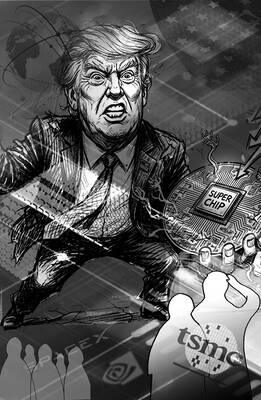
The White House’s decision to take a 9.9 percent stake in Intel Corp is looking like very shrewd business indeed. Since the government bought in at US$20.47 a share last August, the US chipmaker’s surging stock price has delivered the US a US$43 billion return. One of the reasons the investment has so far proved so sound is that the White House has made sure of it. According to The Wall Street Journal, Howard personally pushed deals on Intel’s behalf with some of the most lucrative clients imaginable. They include Nvidia Corp, the company at the heart of the AI
A single photograph can cut through a lot of noise, but it can also be used to misrepresent the truth. At the very least, it can concentrate the mind on something that requires further investigation. On Monday last week, Ma Ying-jeou Foundation CEO Tai Hsia-ling (戴遐齡) and former National Security Council secretary-general King Pu-tsung (金溥聰) held a news conference in which they showed a photograph of former foundation CEO Hsiao Hsu-tsen (蕭旭岑), now Chinese Nationalist Party (KMT) deputy chairman. In the image Hsiao is seated next to Xiamen Taiwan Businessmen Association chairman Han Ying-huan (韓螢煥). The two men were holding
I first met Professor Ray Jiing (井迎瑞) as a film and documentary student at Shih Hsin University’s (SHU) Department of Radio Television and Film in 1988. The following year, he went on to become the director of the Chinese Taipei Film Archive — forerunner of the Taiwan Film and Audiovisual Institute (TFAI). Over his eight-year tenure, Jiing rescued and restored over 200 classic Taiwanese films. In 1997, he established the Graduate Institute of Studies in Documentary and Film Archiving at Tainan National University of the Arts (TNNUA), and I joined the program in his third cohort of students. Beyond a
A recent report concerning a student who is suing his teacher posed the question in its headline: Does failing a student in two subjects constitute bullying? The college student in Chiayi County apparently sought NT$2 million (US$63,603) in state compensation, but a court dismissed the case. The first reaction of many might have been to ask: What has happened to students nowadays? Some say that teachers have lost their authority, while others say students are overindulged. Some even start reminiscing over the days when “whatever the teacher says goes.” However, the real issue might be overlooked if emotional reactions like that are the


 RSS
RSS