


Premier Chen Chien-jen (陳建仁) on Tuesday called for rationality in dealing with the security of Kinmen County amid heightened cross-strait tensions following the death of two Chinese last week.
The two men died when their speedboat capsized during a pursuit by a Coast Guard Administration vessel after it had entered the nation’s restricted waters.
China’s Taiwan Affairs Office (TAO) denied the legitimacy of the restricted zone and said the deaths had angered the Chinese public.
“The mainland reserves the right to take further measures and Taiwan will bear all consequences,” TAO spokeswoman Zhu Fenglian (朱鳳蓮) said on Saturday.
Over the past week, China’s coast guard vessels have increased patrols along the zone’s perimeter and have boarded a Taiwanese tourist vessel. The situation is concerning, because Beijing does not recognize the zone, which was defined unilaterally in 1992 to help protect Taiwanese fishers.
Chinese vessels regularly make incursions in waters near Taiwan’s outlying islands — for example, to engage in illegal fishing or dredging.
China could easily use an incident such as the deaths of the fishers as a pretext to invade Kinmen.
In an article titled “T-Day: The Battle for Taiwan” published by Reuters on Nov. 5, 2021, which analyzed ways in which a Taiwan-China military conflict could unfold, one scenario described China’s annexation of one or more of the nation’s outlying islands.
Another report published by Bloomberg on Nov. 5 last year suggested that China could take Kinmen “perhaps by using subterfuge such as a supposed humanitarian crisis to put its forces ashore.”
Taking Kinmen would allow China to gauge the nation’s resolve and defense capabilities, put it closer to an attempted invasion and potentially affect the morale of the nation’s military and public.
The US might not intervene to defend Kinmen and, if so, would find itself in a precarious situation. It would be pressured to confirm a commitment to the defense of Taiwan proper and failure to do so would be seen by many in Taiwan as abandonment, which China would most certainly use to its advantage.
Minister of National Defense Chiu Kuo-cheng (邱國正) on Wednesday told reporters that affairs related to Kinmen’s restricted waters fall under the jurisdiction of the Coast Guard Administration and that the military would not intervene to prevent matters from escalating.
That is not the message the military should be sending. What the public needs to hear is that the military would resolutely defend the nation’s sovereignty and its people. The nation must be prepared to move assets to Kinmen and Lienchiang County as needed.
Foreign Affairs magazine on Friday last week cited US policy experts as saying that a Chinese takeover of Taiwan would be a geopolitical catastrophe for the US and its allies.
Taiwan proper is strategically valuable, as it “anchors Japan’s defense and denies China a springboard from which it could threaten US allies in the western Pacific,” former US deputy national security adviser Matthew Pottinger and others said.
“Taiwan’s annexation in the face of US inaction or ineffective action would present US allies in Asia and Europe with a nightmare they have never faced before: Washington proving unable to protect a polity that is an ally in all but name,” they said.
Given the potential for events off the coast of Kinmen to spiral out of control, the government should seek assurance of the US’ commitment to defend the nation. This would be in the US’ interest and would imbue Taiwanese with confidence that could spur the reforms its military so desperately needs.
Taipei and Washington should view events in Kinmen with the utmost concern — particularly Chinese actions such as balloons it is floating over Taiwan proper and the redrawing of a commercial flight route.
The government should prepare for the worst and hope for the best.
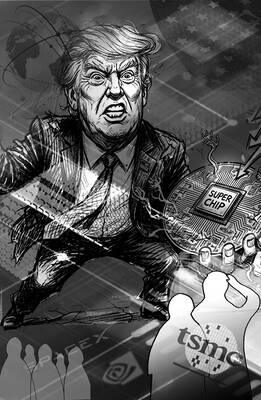
The White House’s decision to take a 9.9 percent stake in Intel Corp is looking like very shrewd business indeed. Since the government bought in at US$20.47 a share last August, the US chipmaker’s surging stock price has delivered the US a US$43 billion return. One of the reasons the investment has so far proved so sound is that the White House has made sure of it. According to The Wall Street Journal, Howard personally pushed deals on Intel’s behalf with some of the most lucrative clients imaginable. They include Nvidia Corp, the company at the heart of the AI
A single photograph can cut through a lot of noise, but it can also be used to misrepresent the truth. At the very least, it can concentrate the mind on something that requires further investigation. On Monday last week, Ma Ying-jeou Foundation CEO Tai Hsia-ling (戴遐齡) and former National Security Council secretary-general King Pu-tsung (金溥聰) held a news conference in which they showed a photograph of former foundation CEO Hsiao Hsu-tsen (蕭旭岑), now Chinese Nationalist Party (KMT) deputy chairman. In the image Hsiao is seated next to Xiamen Taiwan Businessmen Association chairman Han Ying-huan (韓螢煥). The two men were holding
I first met Professor Ray Jiing (井迎瑞) as a film and documentary student at Shih Hsin University’s (SHU) Department of Radio Television and Film in 1988. The following year, he went on to become the director of the Chinese Taipei Film Archive — forerunner of the Taiwan Film and Audiovisual Institute (TFAI). Over his eight-year tenure, Jiing rescued and restored over 200 classic Taiwanese films. In 1997, he established the Graduate Institute of Studies in Documentary and Film Archiving at Tainan National University of the Arts (TNNUA), and I joined the program in his third cohort of students. Beyond a
A recent report concerning a student who is suing his teacher posed the question in its headline: Does failing a student in two subjects constitute bullying? The college student in Chiayi County apparently sought NT$2 million (US$63,603) in state compensation, but a court dismissed the case. The first reaction of many might have been to ask: What has happened to students nowadays? Some say that teachers have lost their authority, while others say students are overindulged. Some even start reminiscing over the days when “whatever the teacher says goes.” However, the real issue might be overlooked if emotional reactions like that are the


 RSS
RSS