


Over the past three months, on banners and T-shirts and balloons and social media posts, one piece of imagery has emerged around the world in protests against the Israel-Hamas war: the watermelon.
The colors of sliced watermelon — with red pulp, green-white rind and black seeds — are the same as those on the Palestinian flag. From New York and Tel Aviv to Dubai and Belgrade, the fruit has become a symbol of solidarity, drawing together activists who do not speak the same language or belong to the same culture, but share a common cause.
To avoid repressive censorship, Chinese dissidents once pioneered “algospeak,” or creative shorthands that bypass content moderation, with examples such as Winnie the Pooh memes mocking Chinese President Xi Jinping (習近平). People around the world began using algospeak to subvert algorithmic biases on TikTok, Instagram and other platforms.
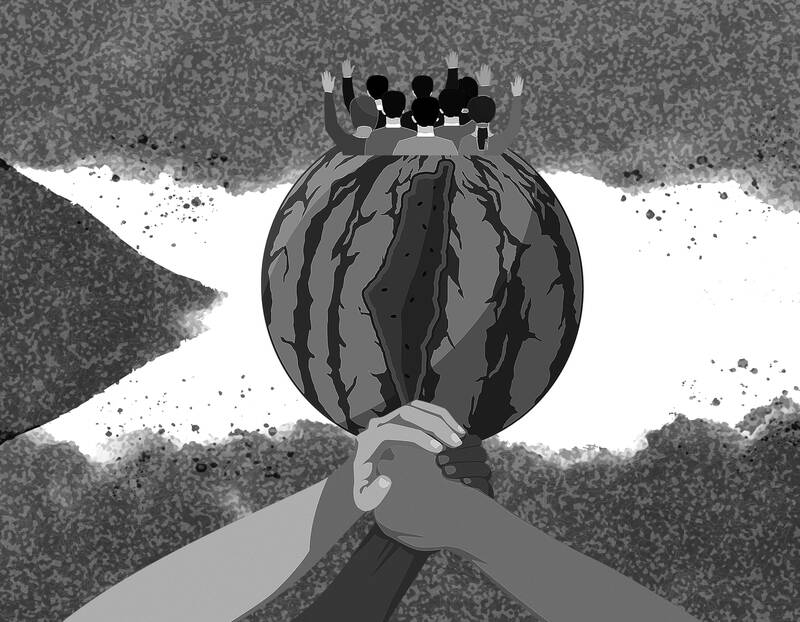
Illustration: Louise Ting
The Internet is now teeming with pictorial signs — pixelated images, emojis and other typographical codes — that signal political dissent. The watermelon emoji is the latest example.
Here is how the watermelon went from being a symbol of protest in the West Bank and Gaza to a global sign of solidarity with Palestinians online:
HISTORICAL CONTEXT
After the 1967 Six-Day War, the Israeli government cracked down on displays of the Palestinian flag in Gaza and the West Bank. In Ramallah in 1980, the military shut down a gallery run by three artists because they showed political art and works in the colors of the Palestinian flag — red, green, black and white.
The trio was later summoned by an Israeli army officer. According to artist and exhibit organizer Sliman Mansour, the officer told him: “It is forbidden to organize an exhibition without permission from the military, and secondly, it is forbidden to paint in the colors of the Palestinian flag.” The officer mentioned a watermelon as one example of art that would violate the army’s rules, Mansour told reporters last week.
People began to wave the fruit in public in protest.
“There are stories of young men who defiantly walked the streets with slices of the fruit, risking arrest by Israeli soldiers,” wrote Jerusalem-born author Mahdi Sabbagh. “When I see a watermelon, I think of the unbreakable spirit of our people.”
From the mid-1990s, when Israelis and Palestinians reached interim peace deals, until the nationalist Israeli government took office a year ago, raising the Palestinian flag receded as a major issue. Three decades later, “it became a national symbol” again, Mansour said.
A year ago, far-right Israeli National Security Minister Itamar Ben-Gvir banned Palestinian flags in public places. This effort was met with fervent opposition. In response, Zazim, an activist group of Arab and Jewish Israelis, plastered taxis in Tel Aviv with large watermelon stickers that read: “This is not a Palestinian flag.”
“Our message to the government is clear,” the organization said in a written statement. “We’ll always find a way to bypass any absurd ban and we won’t stop struggling for freedom of expression and democracy — whether this involves the Pride flag or the Palestinian flag.”
For some, embracing the colors of the flag is about striving for freedom and equality rather than necessarily statehood.
“I’ve never cared for flags or nationalism,” says Mayssoun Sukarieh, an expert in Middle Eastern studies at King’s College London. “But when it comes to Palestine, it’s a flag of a colonized people who never saw independence. And because it has been banned, it becomes more of a symbol of resistance than it is of nationalism.”
WATERMELON EMOJI
Watermelons have long been a food staple in the region, with some dishes such as a popular salad in southern Gaza, originating among Bedouin Arab tribes.
Young activists have increasingly adopted the watermelon emoji in calling for a ceasefire in Gaza. Emojis might confuse algorithms that activists say tech companies deploy to suppress posts with keywords such as “Gaza” and even just “Palestinian.”
“With the watermelon [emoji], I think this is actually really the first time where I’ve seen it widely used as a stand-in. And that to me marks a notable uptick in censorship of Palestinian content,” Electronic Frontier Foundation director for international freedom and expression Jillian York said.
York, based in Berlin, has analyzed Meta’s policies. While “shadow banning,” or the limited visibility of certain posts, can be difficult to discern, advocacy and nonprofit organizations studying digital rights in the Middle East say they have tracked stark biases, especially on the Meta platforms Facebook and Instagram. Meta has not said much directly about this, but cites a statement it released in October last year.
“Censorship is somewhat obvious” on Instagram, York said. In mid-October last year, people began to notice that if one’s Instagram bio said “Palestinian” in English alongside the Palestinian flag emoji and “Praise be to god” in Arabic, the app translated the text to “Terrorist.” Meta released a public apology.
Watermelons are not the only symbol to catch on with activists. Other signs of global Palestinian solidarity include keys, spoons, olives, doves, poppies and the keffiyeh scarf. In November last year, to connect with the peaceful message of Armistice Day, when many Britons traditionally wear red poppy pins, protesters passed out white poppy pins to commemorate victims of all wars. On the memorial day, scores of protesters wearing poppy pins marched across London calling for an end to the war in Gaza.
In the US, Jewish Voice for Peace amplified watermelon imagery in calling for a ceasefire in Gaza last month. The group held signs in New York in the colors of the Palestinian flag and with triangular watermelons, leveraging the triangle symbol of ACT UP, the historic AIDS activist group.
Jason Rosenberg, a member of both organizations, said: “Our reinvented image shows that our fight for liberation and fight to end the epidemic is intrinsically connected to the Palestinian struggle.”
SEED IMAGERY
Another reason the watermelon might resonate: It has seeds. There is a saying, often attributed to the Greek poet Dinos Christianopoulos, that is popular among activists: “They wanted to bury us; they didn’t know we were seeds.”
“You might be able to smash a watermelon. You might be able to destroy a fruit, but the seed is a little harder to crush,” says Shawn Escarciga, an artist who created the coalition’s design. “It’s really powerful that life can come out of something so small and something so resilient — and that it can be spread so, so easily.”
The image of a watermelon punctuated by bold, triangular seeds was held up at the groups’ protest at Manhattan’s Lincoln Center, and has since proliferated online. That often happens — art emerges from protest movements and then enters the mainstream.
“Artists have always been at the forefront of revolution, resistance, politics, in varying degrees,” Escarciga says. “We’re doing this, using this iconic imagery, because AIDS isn’t over — and war is obviously not over.”
Israel’s air, ground and sea assault in Gaza has killed more than 24,000 people, about 70 percent of them women and children, the Hamas-ruled territory’s health ministry said. The count does not differentiate between civilians and combatants.
Throughout, activists around the world have continued to call for peace and a permanent ceasefire. Israel says ending the war before Hamas is crushed would give a victory to the militants who attacked southern Israel on Oct. 7 last year, and killed about 1,200 people and took about 250 people hostage.
“We’re seeing Palestinian flags being banned, even the emoji online being flagged — and, you know, the word ‘Palestine’ being censored online,” Escarciga said. “But having this image that transcends language, that transcends culture, that transcends algorithms — can really reach people.”
A gap appears to be emerging between Washington’s foreign policy elites and the broader American public on how the United States should respond to China’s rise. From my vantage working at a think tank in Washington, DC, and through regular travel around the United States, I increasingly experience two distinct discussions. This divergence — between America’s elite hawkishness and public caution — may become one of the least appreciated and most consequential external factors influencing Taiwan’s security environment in the years ahead. Within the American policy community, the dominant view of China has grown unmistakably tough. Many members of Congress, as
The Hong Kong government on Monday gazetted sweeping amendments to the implementation rules of Article 43 of its National Security Law. There was no legislative debate, no public consultation and no transition period. By the time the ink dried on the gazette, the new powers were already in force. This move effectively bypassed Hong Kong’s Legislative Council. The rules were enacted by the Hong Kong chief executive, in conjunction with the Committee for Safeguarding National Security — a body shielded from judicial review and accountable only to Beijing. What is presented as “procedural refinement” is, in substance, a shift away from
After declaring Iran’s military “gone,” US President Donald Trump appealed to the UK, France, Japan and South Korea — as well as China, Iran’s strategic partner — to send minesweepers and naval forces to reopen the Strait of Hormuz. When allies balked, the request turned into a warning: NATO would face “a very bad” future if it refused. The prevailing wisdom is that Trump faces a credibility problem: having spent years insulting allies, he finds they would not rally when he needs them. That is true, but superficial, as though a structural collapse could be caused by wounded feelings. Something
The shifting geopolitical tectonic plates of this year have placed Beijing in a profound strategic dilemma. As Chinese President Xi Jinping (習近平) prepares for a high-stakes summit with US President Donald Trump, the traditional power dynamics of the China-Japan-US triangle have been destabilized by the diplomatic success of Japanese Prime Minister Sanae Takaichi in Washington. For the Chinese leadership, the anxiety is two-fold: There is a visceral fear of being encircled by a hardened security alliance, and a secondary risk of being left in a vulnerable position by a transactional deal between Washington and Tokyo that might inadvertently empower Japan


 RSS
RSS